Built-In Grinder or Separate Grinder for Espresso: Which Setup Should You Buy?
Choose by how you expect to upgrade, not by the idea that one box must be cheaper. A built-in grinder gives you one purchase and one footprint. A separate grinder costs a second spot on the counter and can be replaced without touching the machine.
Disclosure: This page contains affiliate links (marked with *). If you buy through them, we earn a small commission at no extra cost to you. As an Amazon Associate I earn from qualifying purchases. Learn more
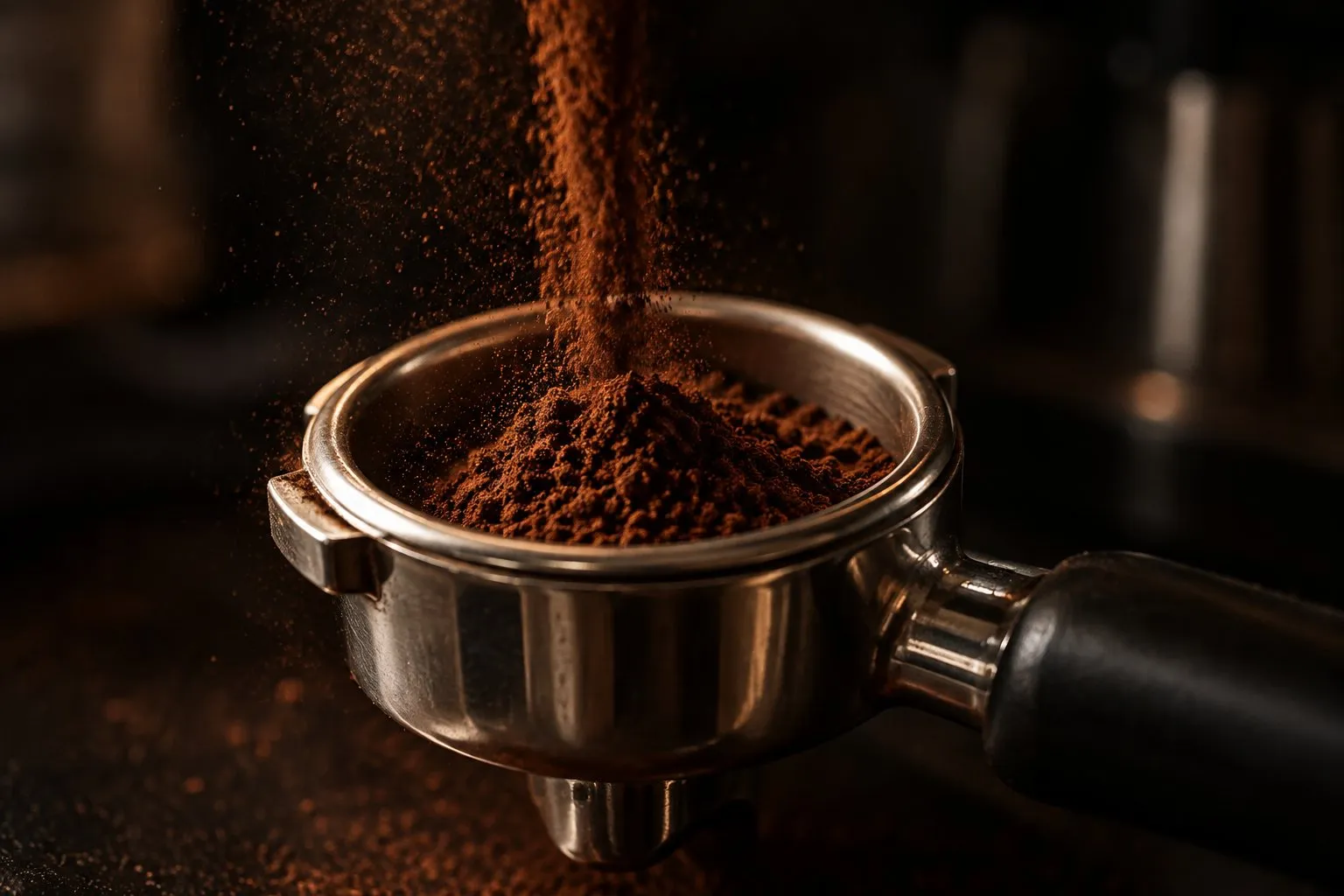
Neither route wins on price by default. At full price the separate pair is cheaper; on sale they cost the same. Check both on the day. Buy the built-in Breville Barista Express if you want one box and one decision. Buy a Bambino and a separate grinder if you expect to upgrade the grinder later.
On this page
Both routes end in the same place: a grinder that goes fine enough for espresso, feeding a semi-automatic espresso machine where you start and stop the shot. What differs is the money on the day, the room on your counter, and what happens when you get picky.
Is the built-in machine really cheaper?
Two AI assistants we asked on November 2, 2026 both said a machine with a built-in grinder is usually cheaper than a machine plus a grinder. So we did the sum for the most obvious pair: the Breville Barista Express* against a Breville Bambino* plus a Breville Smart Grinder Pro*.
At full price the separate pair is cheaper; on sale they cost the same. Check both on the day.
That rests on Amazon data from November 1 and 2, 2026. The Barista Express listing moved sharply between those two days, and that swing decides the comparison. We print no amounts, because they would be out of date quickly. It is also one pair of products, not a law. In the budget class the built-in route may well come out differently, and we have not run that sum.
What actually differs
| Built-in grinder | Separate grinder | |
|---|---|---|
| Price | Sale days can make it match the pair | Cheaper than the box at full price, in the pair we checked |
| Counter | One footprint | Two, and the Smart Grinder Pro alone stands 15.3 inches tall (Breville) |
| Settings | Barista Express: 16 (Breville) | Smart Grinder Pro: 60 (Breville). Encore ESP: 40, of which 1 to 20 are fine espresso steps (Baratza) |
| Upgrade | Buy a separate grinder later, and the built-in one goes unused | Replace the grinder, keep the machine |
| Faults | Grinder and machine sit in one body | Each can be swapped or repaired alone |
| First day | Nothing else to choose | One more decision before the first shot |
We found no failure-rate data for either route, so the row on faults is plain logic and not a reliability claim.
Do more settings mean a better grinder?
Not by themselves. A settings count says nothing about how big each step is. The Smart Grinder Pro's 60 settings run from espresso to French press, and Breville's manual gives settings 1 to 30 to espresso. Baratza is more open about it: settings 1 to 20 on the Encore ESP* are small steps for espresso, and 21 to 40 are large steps for filter.
Outside sources pull in two directions. America's Test Kitchen counted 16 espresso settings on the Barista Express, close to the 20 on the standalone grinder it rates highest, and found as few as five on some other built-in models. Serious Eats, in a copy dated May 2, 2023, says the built-in grinder on the Barista Express Impress lacks the precision and power of standalone favorites. So read the count for the machine in front of you, and treat “built-in” as a range, not a verdict.
Where the upgrade path matters
If you dial in by weight and change one thing at a time, grind is the first thing you adjust and the first limit you will meet. A separate grinder lets you buy past that limit and leave the machine alone. If you drink the same coffee every morning and stop tuning once it tastes good, you may never reach it.
Which route fits you?
If you want one box and no grinder to choose → Breville Barista Express
View(paid link to Amazon, opens in a new tab)Ad · paid link · check price & delivery on AmazonIf you want to choose the grinder and replace it later → Breville Bambino
View(paid link to Amazon, opens in a new tab)Ad · paid link · check price & delivery on AmazonIf you already own a machine and only need the grinder → Breville Smart Grinder Pro
View(paid link to Amazon, opens in a new tab)Ad · paid link · check price & delivery on AmazonIf you want to compare every machine with a grinder inside
Our default for a first purchase is still the Barista Express, and our page on it says who it does not fit. If you lean separate, our espresso grinder guide sorts the options by how you work, and the beginner page puts the purchases in order. While you compare spec sheets, don't let the pump number sway you: 15 bar and 20 bar describe the pump, not the shot. We rank by spec sheet and published sources and run no tests of our own; how we compare explains that in full.
Asked at the bar
Is a machine with a built-in grinder cheaper than buying both separately?
Not as a rule. In Amazon data from November 1 and 2, 2026, a Breville Bambino plus a Smart Grinder Pro cost less than a Barista Express at full price, and the same on a sale day. At full price the separate pair is cheaper; on sale they cost the same. Check both on the day.
Can I add a separate grinder to a machine with a built-in grinder later?
Yes. Grounds from a separate grinder go into the portafilter like any others, so the machine doesn't care where they came from. The built-in grinder then simply sits unused, and you have paid for it. That is the real cost of starting with one box and outgrowing it.
Is a built-in grinder good enough for espresso?
It depends on the machine, and sources differ. America's Test Kitchen counts 16 espresso settings on the Barista Express, close to the 20 on the standalone grinder it rates highest, but found as few as five on other built-in models. Serious Eats, in a copy dated May 2, 2023, says the built-in grinder on the Barista Express Impress lacks the precision and power of standalone favorites.
Where this comes from
- Breville: BES870 Barista Express product page
- Breville: BCG820 Smart Grinder Pro product page
- Breville: BES450 Bambino product page
- America's Test Kitchen: espresso machines, July 2, 2025
- Serious Eats roundup, read through a Yahoo copy dated May 2, 2023
- Baratza: Encore ESP product sheet (copy on a third-party server)
Next round
- With grinderEspresso machines with a built-in grinder compared by spec sheet: Barista Express, Impress, Pro and Touch, plus Ninja, De'Longhi, KitchenAid, Gevi and CASABREWS.
- Espresso grindersWhat makes a grinder suitable for espresso: burrs, small steps and clean dosing. One clear pick, the alternatives sorted by routine, and honest notes on the data.
 Dial in espressoHow to dial in espresso: fix the dose, set a yield, then change only the grind until time and taste line up. Steps, a symptom table and the exception to the rule.
- For beginnersThe beginner espresso machine to buy first, and in which order: machine, espresso-capable grinder, scale. Our pick is the Breville Bambino, with budget options.
 15 Bar vs 20 Bar: Is the Bigger Number Better?Is a 20 bar espresso machine better than 15 bar? No: the box shows what the pump can reach, and espresso is brewed at about 9 bar. What to compare instead.
semiautomaticespressomachine.com Editorial Team
Espresso gear & shot craft
We are the editorial team at semiautomaticespressomachine.com. We read maker spec sheets, manuals, standards and published research on espresso and turn them into plain-English buying advice, with sources on every page. We do not run lab tests, and we say so openly.
- Spec sheets & standards read
- Sources on every page
- No lab tests – stated openly
- Publisher details in the imprint