Espresso Scales: 0.1 g, a Timer, and What Fits Under the Portafilter
An espresso scale needs three things: 0.1 g steps, a timer on the same display, and a footprint that fits your drip tray with your cup still under the spouts. Measure before you order. Almost any scale that meets those three will do the job, so buy the simplest one that fits.
Disclosure: This page contains affiliate links (marked with *). If you buy through them, we earn a small commission at no extra cost to you. As an Amazon Associate I earn from qualifying purchases. Learn more
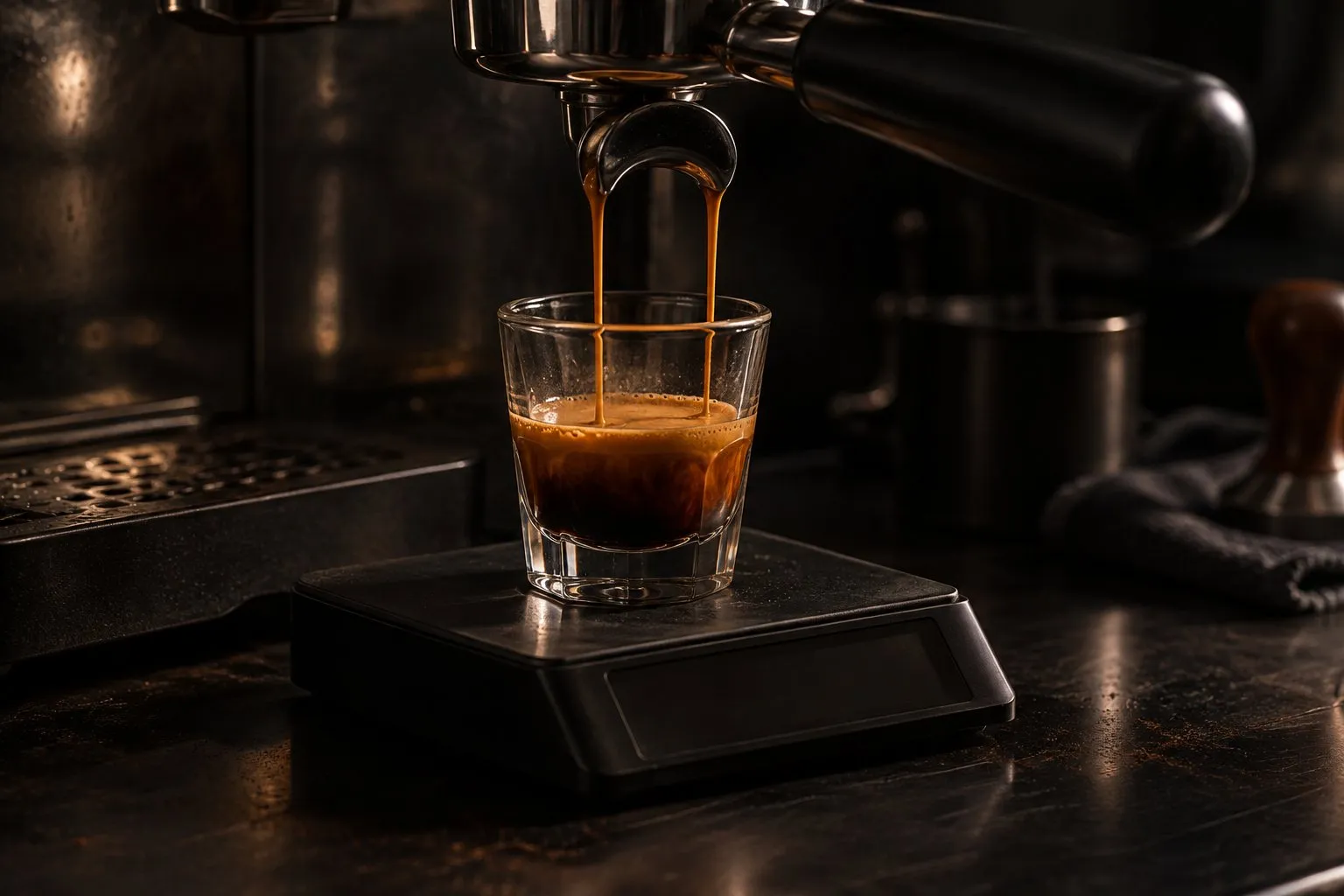
Look for 0.1 g steps, a built-in timer and a body small enough for your drip tray. Measure the tray and the gap under your portafilter first, because a scale takes space away from your cup. Auto-tare and flow detection are conveniences. The Maestri House S2 is one listed option that has the basics.
On this page
A scale is the first accessory we would buy, as our accessories page explains. This page answers the narrower question of which one, and what to measure on your own machine before you order.
For the scales we link, we only have Amazon listings, so they are options and not picks. Our recommendation is about what to look for, and any scale that meets those points does the same job. We have not used any of them, and how we compare explains what the “Seller data only” label means.
Maestri House S2 scale
A shot scale with timer and 0.1 g steps per the listing: the tool that makes dialing in repeatable.
Seller data only: We only have the Amazon listing for this product. We list it as an option, not as a recommendation.
Why here: Listed with a timer and 0.1 g steps, which covers both the dose and the yield. Check the size against your drip tray.
Best for: Anyone who wants to weigh dose and yield
- Timer and 0.1 g precision, per listing title
- We only have the listing
- Type
- Shot scale with timer
- Price class
- Budget
Which one for whom
If you want the basics and nothing else → Maestri House S2 scale · Seller data only
View(paid link to Amazon, opens in a new tab)Ad · paid link · check price & delivery on AmazonIf you want auto-tare and a silicone mat in the box → IKAPE scale · Seller data only
View(paid link to Amazon, opens in a new tab)Ad · paid link · check price & delivery on AmazonIf you single dose and want to weigh in the cup you grind into → Subminimal SubScale · Seller data only
View(paid link to Amazon, opens in a new tab)Ad · paid link · check price & delivery on AmazonIf you have no routine yet
The options side by side
| Seller data onlyMaestri House S2 scale | Seller data onlyIKAPE scale | Seller data onlySubminimal SubScale | |
|---|---|---|---|
| Type | Shot scale with timer | Shot scale with timer | Dosing cup with scale |
| Price class | Budget | Budget | Mid-range |
| Best for | Anyone who wants to weigh dose and yield | Anyone who wants auto-tare and a silicone mat in the box | Single dosers who want to weigh in the cup |
| On Amazon(paid link to Amazon, opens in a new tab)Ad · paid link · check price & delivery on Amazon | On Amazon(paid link to Amazon, opens in a new tab)Ad · paid link · check price & delivery on Amazon | On Amazon(paid link to Amazon, opens in a new tab)Ad · paid link · check price & delivery on Amazon |
The table is short because the listings say little. Sizes and battery figures for these three are not stated here, so read them on the listing before you buy.
What the numbers actually do
Why 0.1 g is the useful step
On an 18 g dose, 0.1 g is about half a percent. A scale with 1 g steps can hide more than 5 percent of your dose. Since dialing in works by changing one thing at a time, you need to know that the dose really stayed the same.
The timer belongs on the same display because you watch weight and time together. You stop the shot at the yield, and read the time as your result. Breville's guide times from the start of the brew and aims for 25 to 30 seconds, while saying a good shot can fall anywhere from 20 to 40. It's a good first recipe, not a standard. Set your own dose and read the yield:
Target in the cup
36 g1.3 oz
Plain arithmetic. The ratios are starting points from Breville's guide, not a standard.
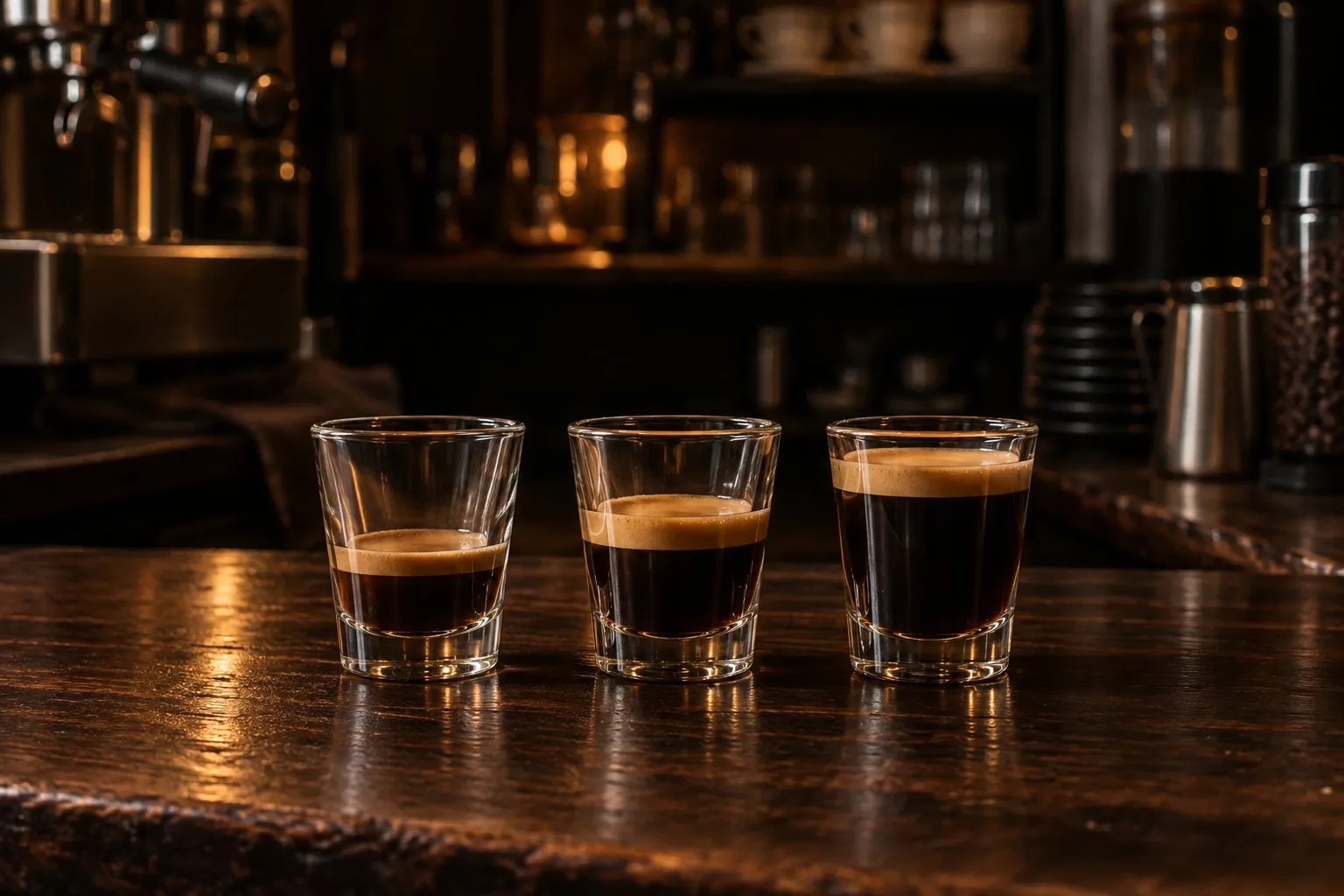
Same coffee, three yields. Only a scale tells them apart.
The espresso ratio page goes further into what those yields do to the cup.
Measure these two things first
No maker publishes a drip tray size in the documents we read, including Breville's page and booklet for the Bambino Plus. So take a ruler to your own machine.
- Drip tray width and depth. The scale has to sit flat on the grid, with its display where you can read it during the shot.
- Height under the spouts. Measure from the drip tray grid to the bottom of the portafilter spouts, then subtract your cup and the scale. On a small machine with little room to spare, a thin scale can decide whether your cup fits at all.
Here is what two well-known scales take up. We don't link them because they are not in our Amazon list, but their published sizes make a useful yardstick.
| Scale | Size | Capacity | Steps | Timer | Source |
|---|---|---|---|---|---|
| Acaia Lunar | 105 x 105 x 15 mm (about 4.1 x 4.1 x 0.6 in) | 2000 g | 0.1 g, 0.01 g in high resolution mode | Yes, can start with flow | Acaia manual |
| Timemore Black Mirror Basic 2 | 130 x 152 x 26 mm (about 5.1 x 6.0 x 1.0 in) | 2 kg | 0.1 g | Yes | Prima Coffee listing |
The difference is about half an inch of height and an inch or more of footprint. Prima's listing credits an auto-starting timer to the Basic Plus model, not to the Basic 2, so check the exact model if you want that.
The options one by one
Maestri House S2
The Maestri House S2* is listed as an espresso scale with a timer and 0.1 g precision. Those are the two features that matter, and it sits in the budget class. The listing is all we have, so size and battery life are for you to check there. If your drip tray isn't unusually small, a scale like this is all most people need.
IKAPE scale with timer
The IKAPE scale* adds more to its title: 2 kg capacity, 0.1 g steps, a silicone mat, 4 modes, an LED display and auto-tare. If you like a scale that zeroes itself, this is the listing to compare. As with any listing, the modes are only as good as how they behave in use, and we can't speak to that.
Subminimal SubScale
The Subminimal SubScale* is a different kind of tool. It is a dosing cup with a built-in scale and LED display, per the listing, so you weigh beans or grounds in the cup itself. That suits single dosing at the grinder. It isn't built to sit under your cup and weigh the yield, so treat it as a second tool and not as a first.
Buying criteria
| Feature | Need it? | Why |
|---|---|---|
| 0.1 g steps | Yes | Shows small changes in dose and yield |
| Timer on the display | Yes | Lets you read weight and time together |
| Fits the drip tray | Yes | Otherwise the scale can't sit under the cup |
| Low height | On small machines | Leaves room for the cup |
| Auto-tare | Optional | Saves one button press |
| Timer that starts with flow | Optional | Saves another one, if it behaves well |
| 0.01 g mode | Rarely | More digits than a home routine calls for |
| Silicone mat | Optional | Some sellers include one |
The same scale works for filter coffee, since many of the features here are the same. If that's your main use, a larger scale may suit a dripper better.
Common mistakes
- Buying before measuring. A scale that overhangs the drip tray is a daily annoyance.
- Paying for modes you won't use. The weight you read is the point.
- Trusting a shot line on a glass. Crema shows CO2, so freshness and roast. It says little about flavor, so a line on the glass tells you little. Weigh instead.
- Forgetting the tare. Zero the scale with the empty cup on it, then start the shot.
- Weighing only the dose. Breville's guide asks for both numbers. The yield is the one that decides when you stop.
- Leaving it wet. Acaia's manual says to clean its scale with a soft cloth and warm water only. Check your own scale's instructions before you rinse it.
Which to buy
Measure the tray, then buy the simplest scale with 0.1 g steps and a timer that fits. For most people that's a listing like the Maestri House S2*. Once it's on the counter, make your first weighed shot, then see the accessories page for what comes next. Still choosing the machine? Our guide for beginners and the start page begin from what you drink, and these four questions end in one machine:
Asked at the bar
Do I really need a scale for espresso?
Yes, if you want to repeat a good shot. Breville's guide says you need a scale to weigh both the dry grounds and the brewed espresso. Without it you are guessing at dose and yield, which are two of the three numbers you compare between shots. A spoon and a pair of shot lines can get you coffee, but not a recipe you can repeat.
Can I use a kitchen scale for espresso?
For a start, if it reads to 0.1 g and fits on your drip tray. Many kitchen scales read in steps of 1 g, and that hides small changes: on an 18 g dose, 1 g is more than 5 percent. You will also want a timer, so a phone or a clock has to sit beside it. A dedicated scale puts all of that in one display.
What does auto-tare do on a coffee scale?
It zeroes the scale by itself when you set a cup or portafilter on it, so you press one button less. Acaia's manual for the Lunar has several modes built on this, including one that also starts the timer when it detects flow. It is a convenience. It does not change the weight you read, so don't pay extra for it unless you will use it.
Is an Acaia scale worth it for home espresso?
We can't answer that from specs, and we have not used one. What Acaia's manual gives us is a 105 x 105 x 15 mm body, about 4.1 x 4.1 x 0.6 in, with 0.1 g readability and modes that start the timer with the flow. That small size is the clearest practical difference. The basics of weighing are also available in the budget class.
Does the scale go under the cup or under the portafilter?
Both, at different moments. To weigh the dose, you tare the portafilter or a dosing cup and grind into it. To weigh the yield, the scale sits on the drip tray with the cup on top. That second job is why the size matters, and why a thin scale leaves more height for your cup.
Where this comes from
Next round
 AccessoriesWhich espresso accessories are worth buying first: scale, tamper, pitcher, WDT tool and more, sorted by portafilter size, with what your machine already includes.
- Dial in espressoHow to dial in espresso: fix the dose, set a yield, then change only the grind until time and taste line up. Steps, a symptom table and the exception to the rule.
- Espresso ratioEspresso ratio explained: 1:2 in 25 to 30 seconds is a good first recipe, not a standard. See the numbers, Italy's 7 g to 25 ml, and a calculator for your own dose.
 Make espressoHow to make espresso at home on a semi-automatic machine: warm up, grind, weigh 18 g, tamp level, pull 36 g in about 25 to 30 seconds, then taste and clean up.
 Compact machinesCompact espresso machines compared by width, depth and height, with sources. Why “compact” on a listing means little, what to measure, and which machine to pick.
semiautomaticespressomachine.com Editorial Team
Espresso gear & shot craft
We are the editorial team at semiautomaticespressomachine.com. We read maker spec sheets, manuals, standards and published research on espresso and turn them into plain-English buying advice, with sources on every page. We do not run lab tests, and we say so openly.
- Spec sheets & standards read
- Sources on every page
- No lab tests – stated openly
- Publisher details in the imprint