Espresso Brew Ratio: 1:2 Is a Starting Point, and Italy's Standard Is Different
The espresso ratio is the weight of dry coffee compared with the weight of liquid in the cup. Start at 1:2, so 18 g in and 36 g out, in 25 to 30 seconds. That's a good first recipe, not a standard. Italy's certified espresso is 7 g to 25 ml.
Disclosure: This page contains affiliate links (marked with *). If you buy through them, we earn a small commission at no extra cost to you. As an Amazon Associate I earn from qualifying purchases. Learn more
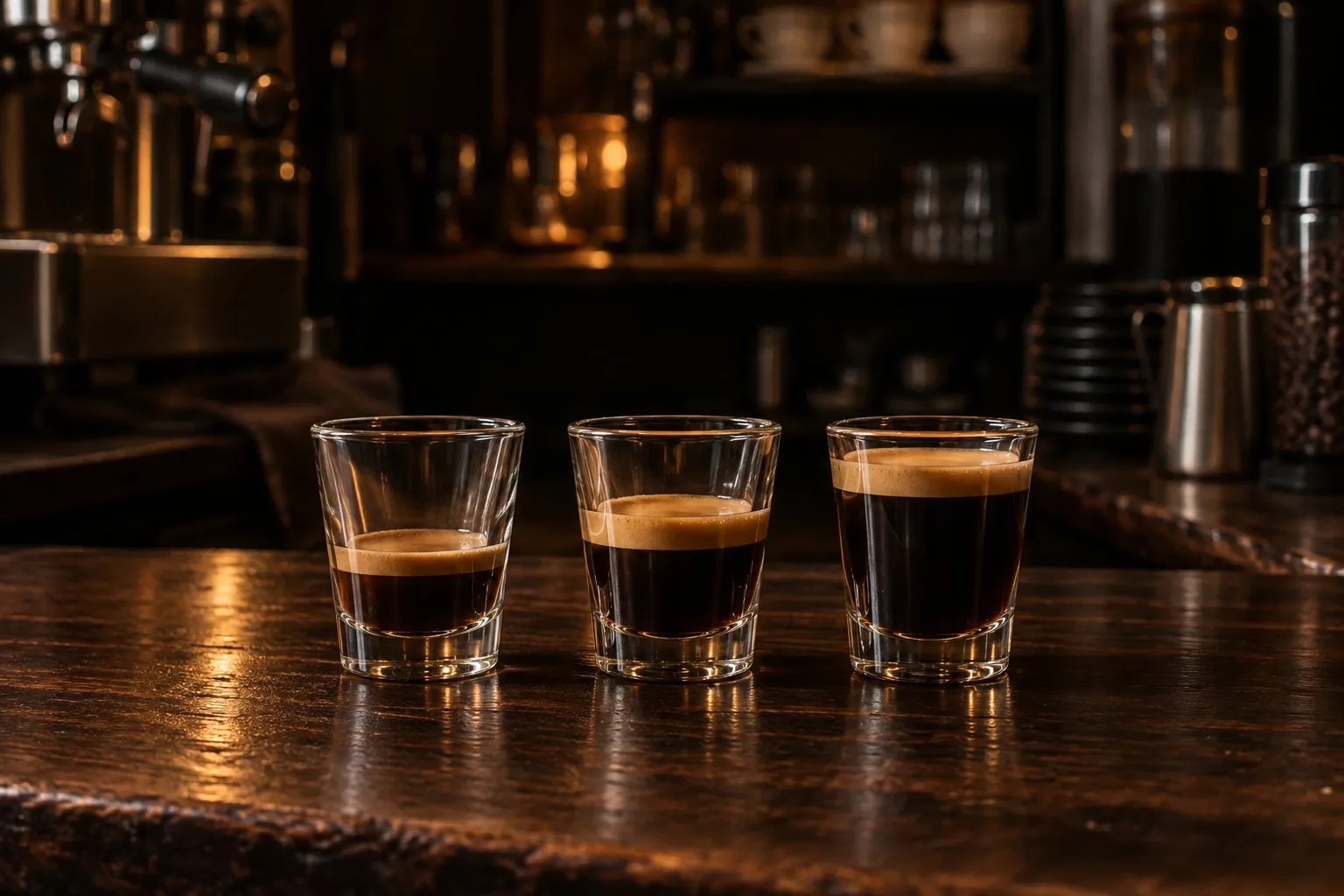
Start with 1 part coffee to 2 parts espresso by weight, in about 25 to 30 seconds. Breville's guide gives that recipe, adds 1:1 for ristretto and 1:3 for lungo, and says 20 to 40 seconds can taste good. It's a good first recipe, not a standard. Italy's certified espresso is 7 g to 25 ml, in 25 seconds give or take 5.
On this page
If you already weigh your shots, you have probably seen 1:2 described as the rule. It is a sensible convention, and Breville itself calls it the “golden standard” in its guide. Yet the only certified recipe we could find, from Italy, doesn't use it at all. Knowing that makes the number more useful, because you stop defending it and start using it.
What the ratio means
Take your dose in grams of dry coffee and compare it with your yield in grams of liquid. 18 g in and 36 g out is 1:2. Both numbers are weights, so you need a scale that reads to 0.1 g and goes under the cup. Set your own dose here and read off the yield:
Target in the cup
36 g1.3 oz
Plain arithmetic. The ratios are starting points from Breville's guide, not a standard.
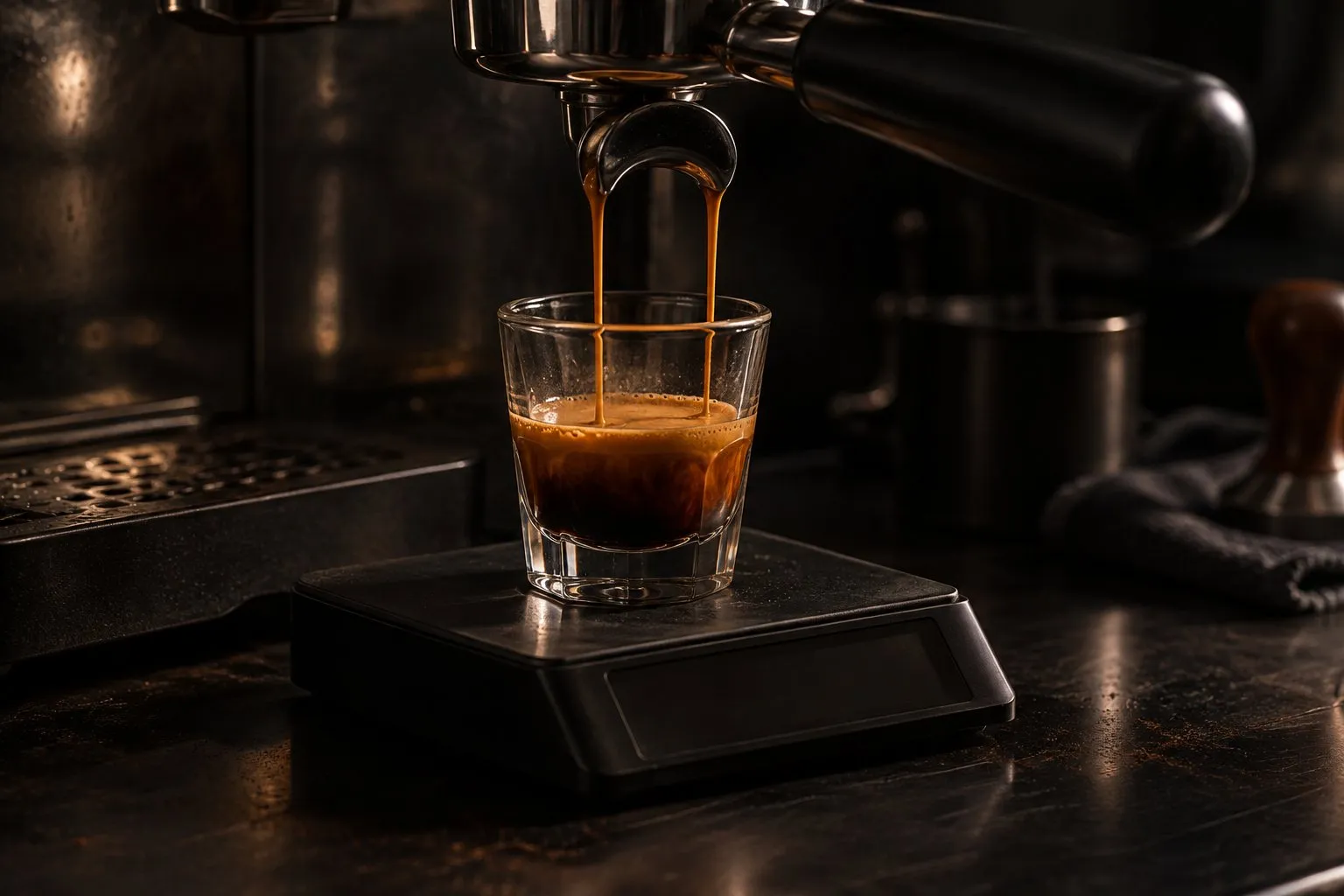
Stop by weight, not by eye
Breville notes that a single is about 1 oz and a double about 2 oz, then says weighing gives a more accurate ratio. There is a simple reason. Crema is light: Illy and Navarini report foam densities of 0.40 to 0.60 g per mL. A marked shot glass counts that foam as coffee, so two shots at the same line can hold different amounts of liquid.
The numbers side by side
| Recipe | Dose | Out | Time | Who says so |
|---|---|---|---|---|
| Ristretto | Your dose | 1:1 by weight | Not given | Breville |
| Espresso | 18 to 22 g | 1:2 by weight | 25 to 30 s, and 20 to 40 s can taste good | Breville |
| Lungo | Your dose | 1:3 by weight | Not given | Breville |
| Certified Italian Espresso | 7 g, give or take 0.5 | 25 ml, give or take 2.5, froth included | 25 s, give or take 5 | INEI |
Here are the yields across Breville's dose range:
| Dose | 1:1 | 1:2 | 1:3 |
|---|---|---|---|
| 18 g | 18 g | 36 g | 54 g |
| 20 g | 20 g | 40 g | 60 g |
| 22 g | 22 g | 44 g | 66 g |
Those are simple multiplications, not recommendations for your coffee. Breville's guide also says the right dose depends on your portafilter size and the coffee's roast date.
Why Italy's numbers are not a 1:3.5
It is tempting to divide 25 by 7 and call Italy's recipe a very long shot. Don't. INEI measures the cup in milliliters and counts the froth in that volume, while the ratio above uses grams of liquid. Since foam weighs so much less than coffee, the 25 ml in the cup weighs less than 25 g, by an amount that depends on how much foam it has. We found no INEI figure in grams, so we won't print a converted ratio.
The differences are real anyway. INEI's recipe is a single small dose, and its leaflet specifies water leaving the unit at about 190 °F (88 °C) and 9 bar, give or take 1, at the entry. Breville's home recipe is a double-size dose from a larger basket. Same word, different cup.
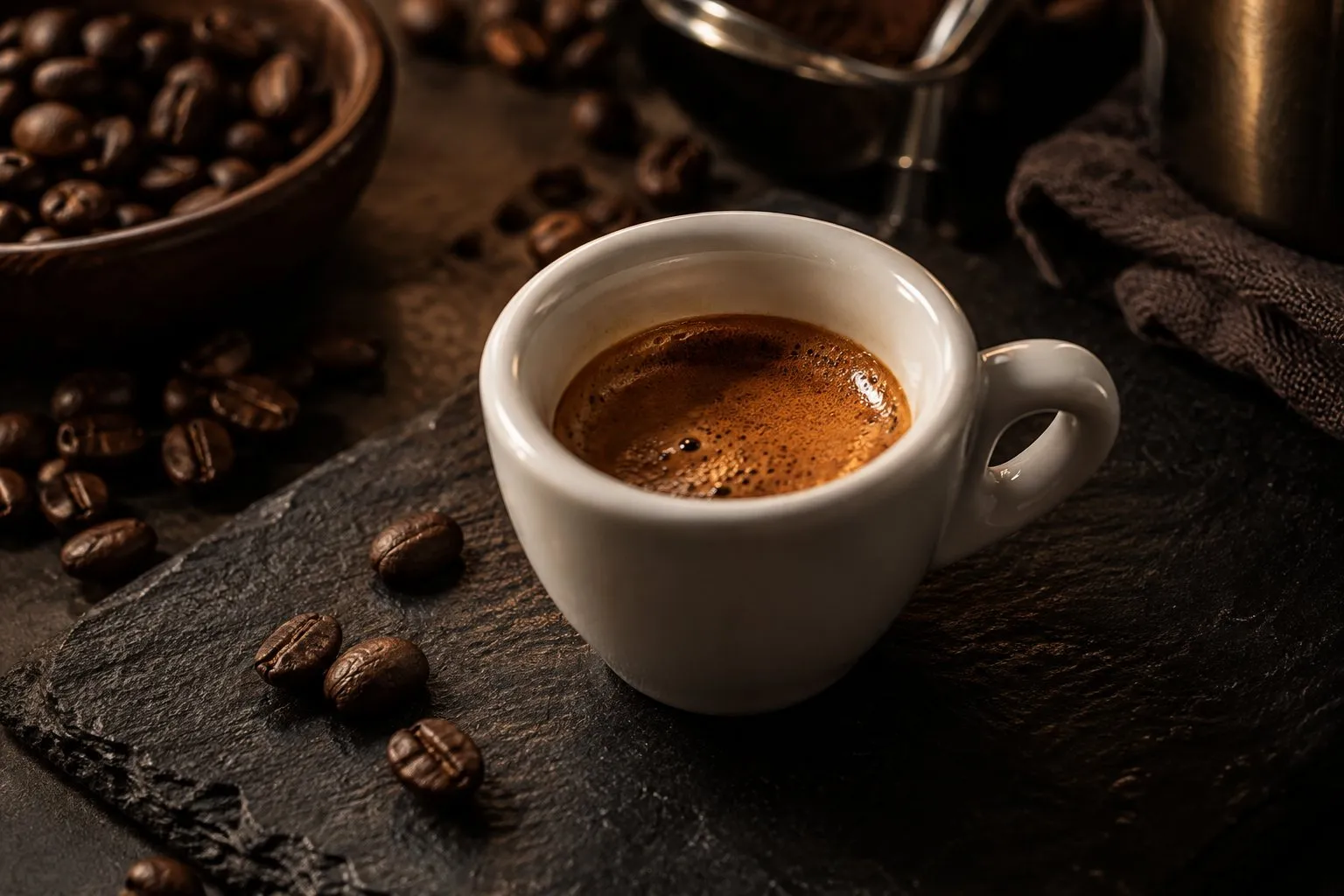
One word, several recipes. Pick the one you like.
Shot time is a readout
Keep the yield fixed and time becomes what it should be: information. Breville's guide puts an ideal shot at 25 to 30 seconds and says a good one can fall anywhere from 20 to 40 seconds. Its Bambino instruction book adds a useful detail for that machine: the first flow should start 8 to 12 seconds in, like warm honey. That gives you something to watch before the shot is over.
- Much faster than your target, and sour or thin: grind finer. See why espresso tastes sour.
- Much slower than your target, and bitter: grind coarser. See why espresso tastes bitter.
- On time, but not good: trust your tongue, then adjust the ratio.
The full method for a new bag is in our dial-in guide, and how to make espresso covers the whole shot if you are just starting out.
How to use the ratio
Set the dose by the basket
Fill it to what fits, weigh it, and keep that number. Breville names 18 g for the 54 mm Barista Express and 22 g for the 58 mm Dual Boiler.Start at 1:2
Stop the shot when the scale reaches twice your dose, whatever the clock says.Fix the time with the grind
Grind is the first thing Breville says to change. Leave the ratio alone until the time is in range.Then move the ratio
Taste first, and change the yield a little at a time. Breville describes 1:1 as rich and intense, and 1:3 as more delicate. Write down what you liked.
Milk drinks and ratios
Milk changes the math, because you choose the shot and the milk separately. Starbucks' comparison page describes its flat white as “two ristretto espresso shots finished with steamed milk”, its home recipe says 2 shots of espresso, and Breville's recipes use the same espresso for a flat white and a latte. Neither is the rule, and our flat white and latte comparison shows how far the recipes differ. If you drink mostly milk, try your usual ratio first and change only the amount of milk.
The one tool this takes
You can't work with ratios without a scale. Any kitchen scale that reads to 0.1 g and fits under the cup will do. A shot scale with a timer saves you a second device on the counter. Our espresso scale comparison goes through the differences, or start from the home page if you are still setting up your bar. For the short end of the scale, read ristretto vs espresso.
Maestri House S2 scale
A shot scale with timer and 0.1 g steps per the listing: the tool that makes dialing in repeatable.
Seller data only: We only have the Amazon listing for this product. We list it as an option, not as a recommendation.
Why here: A timer and 0.1 g precision in one device, per its listing, which covers both numbers this page depends on.
Best for: Anyone who wants to weigh dose and yield
- Timer and 0.1 g precision, per listing title
- We only have the listing
- Type
- Shot scale with timer
- Price class
- Budget
Asked at the bar
What is the best ratio for espresso?
There is no best one. Start at 1:2 by weight, because it gives you a fixed target, then move toward 1:1 or 1:3 if the coffee asks for it. Breville gives those three ratios for ristretto, espresso and lungo. Italy's certified espresso uses another system entirely: 7 g of coffee and 25 ml in the cup.
How long should an espresso shot take?
Breville's guide says 25 to 30 seconds is typical, and that a good shot can land anywhere from 20 to 40 seconds. INEI specifies 25 seconds, give or take 5, for 7 g of coffee. So the clock is a guide. If a shot at 34 seconds tastes good, it is a good shot.
Should I measure espresso by weight or by volume?
By weight. Crema is mostly gas and takes up a lot of room, so the same liquid can read very differently in a marked glass. Illy and Navarini report foam densities of 0.40 to 0.60 g per mL. Breville's guide also says that weighing the output gives you a more accurate ratio than counting ounces.
What ratio is a ristretto or a lungo?
Breville's guide gives 1:1 for a ristretto and 1:3 for a lungo, with 1:2 between them. We found no standards body behind those numbers, so read them as one maker's useful labels. At an 18 g dose that means about 18 g, 36 g and 54 g in the cup.
Does the ratio change with the dose?
The ratio stays the same and the yield moves with it. At 1:2, an 18 g dose gives 36 g, and a 22 g dose gives 44 g. Your basket decides which dose fits. Breville names 18 g for the 54 mm Barista Express and 22 g for the 58 mm Dual Boiler.
Where this comes from
Next round
- Dial in espressoHow to dial in espresso: fix the dose, set a yield, then change only the grind until time and taste line up. Steps, a symptom table and the exception to the rule.
- Espresso scaleWhat an espresso scale needs: 0.1 g steps, a timer and a size that fits your drip tray. Listed options, plus Acaia and Timemore dimensions from their own data.
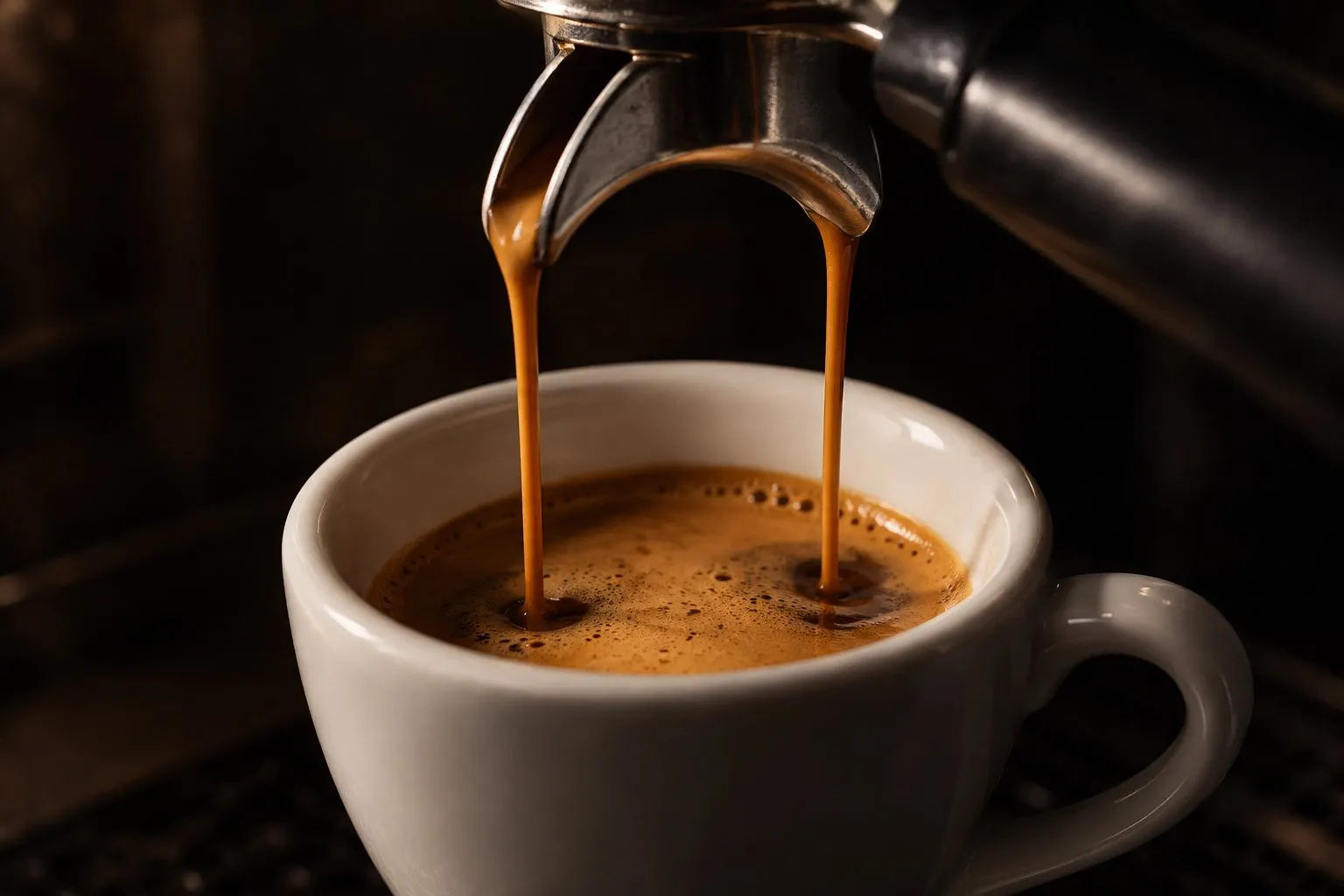 Make espressoHow to make espresso at home on a semi-automatic machine: warm up, grind, weigh 18 g, tamp level, pull 36 g in about 25 to 30 seconds, then taste and clean up.
- Bitter espressoWhy espresso tastes bitter: read the flow first. Slow and dark means grind coarser, fast and watery means something else. Then check roast, cleaning and temperature.
- Sour espressoSour espresso usually means under-extraction. What to change first, when grinding finer stops helping, and where roast, water and temperature fit in.
semiautomaticespressomachine.com Editorial Team
Espresso gear & shot craft
We are the editorial team at semiautomaticespressomachine.com. We read maker spec sheets, manuals, standards and published research on espresso and turn them into plain-English buying advice, with sources on every page. We do not run lab tests, and we say so openly.
- Spec sheets & standards read
- Sources on every page
- No lab tests – stated openly
- Publisher details in the imprint