Water for Espresso Machines: Scale, Corrosion and the SCA Target
Use water with some minerals in it, but not many. Too hard and it leaves scale. Too pure and it can corrode parts or confuse the machine's sensors. So test your water first: Breville asks for 50 to 150 ppm dissolved solids, and La Marzocco for 90 to 150 ppm. Then pick the cheapest route that gets you there.
Disclosure: This page contains affiliate links (marked with *). If you buy through them, we earn a small commission at no extra cost to you. As an Amazon Associate I earn from qualifying purchases. Learn more
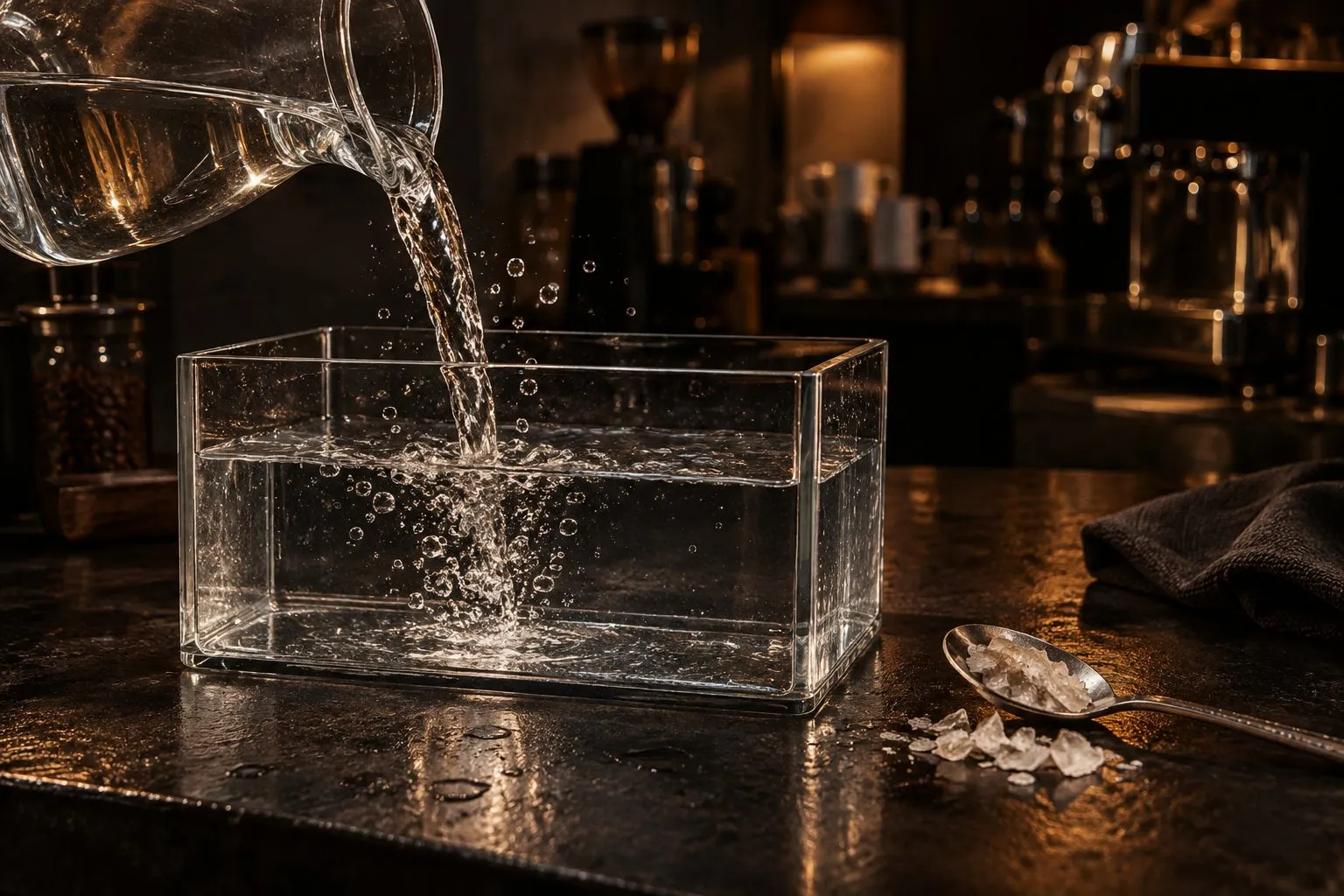
Test your water before buying anything. Breville recommends 50 to 150 ppm dissolved solids, and La Marzocco 90 to 150 ppm, with hardness of 70 to 100 ppm and chloride under 30 ppm. Hard water builds scale, and distilled water or plain reverse osmosis water is not the safe choice: both makers advise against water with almost no minerals.
On this page
The white mineral flakes on that spoon are the whole topic. Water carries dissolved minerals you can't see, and they decide both how a shot tastes and how long a boiler stays clean. Most advice treats this as a shopping question. Treat it as a measuring question first, because your tap may already be fine.
Third Wave Water, espresso profile
Mineral packets for espresso machines. The maker says the minerals are chosen to avoid scale.
Seller data only: We only have the Amazon listing for this product. We list it as an option, not as a recommendation.
Why here: The one recipe here whose numbers we could read from its maker. Only buy it if your test shows your own water falls short.
Best for: People who want a known recipe instead of working out their tap water
- Espresso profile, per listing title
- About 150 mg/L TDS and no chlorides (Third Wave Water support article)
- The maker's alkalinity of about 85 to 94 mg/L sits above the targets of the SCAA and La Marzocco
- We found no independent measurement of its scale claim
- Type
- Mineral packets, espresso profile
- Price class
- Budget
Too hard or too pure: both cause trouble
This is the part most buyers get backwards. Distilled water feels like the careful choice. It isn't.
| Too much mineral | Too little mineral | |
|---|---|---|
| Typical water | Hard tap water | Distilled, demineralized, plain reverse osmosis |
| What goes wrong | Limescale, then blockages (La Marzocco). Reduced flow, temperature and power (Breville manual) | Corrosion of internal parts at heat and pressure; sensors may fail to detect water, so the machine won't fill or heat (La Marzocco) |
| In the cup | Mineral buildup can affect taste (Breville manual); we found no measurement to cite | Breville says it can affect taste |
| What to do | Filter, switch source, or descale per your manual | Add minerals back, or use a mineralized source |
Low pH and high chloride also count toward corrosion, according to La Marzocco. Breville allows reverse osmosis water on applicable models, but only when some minerals have been added back.
The numbers, side by side
These targets come from different kinds of documents, and they don't fully agree. The SCAA paper is about extraction, and the two makers are looking after their machines.
| Value | SCAA 2009, brewing target | Breville | La Marzocco, home machines | Third Wave Water, espresso profile |
|---|---|---|---|---|
| Dissolved solids (TDS) | 150 mg/L (75 to 250) | 50 to 150 ppm | 90 to 150 ppm | About 150 mg/L |
| Hardness | Calcium hardness 68 mg/L (17 to 85) | Follow your model's strip | Total hardness 70 to 100 ppm | Not given |
| Alkalinity | 40 mg/L | Not given | 40 to 80 ppm | About 85 to 94 mg/L |
| pH | 7.0 (6.5 to 7.5) | Not given | 6.5 to 8 | Not given |
| Chloride | Not given | Not given | At most 30 ppm | None |
| Chlorine | 0 mg/L total | Not given | Total at most 0.1 ppm | Not given |
Parts per million and milligrams per liter are the same scale for water at these levels. Calcium hardness and total hardness are not the same measurement, so don't compare those two columns too closely.
So what is the “SCA target” good for? It's a fair aim for flavor, and it comes with a caveat: we read a third-party copy of the 2009 version, and we could not reach the SCA's own page. It says nothing about scale. For protecting the machine, go by your manual.
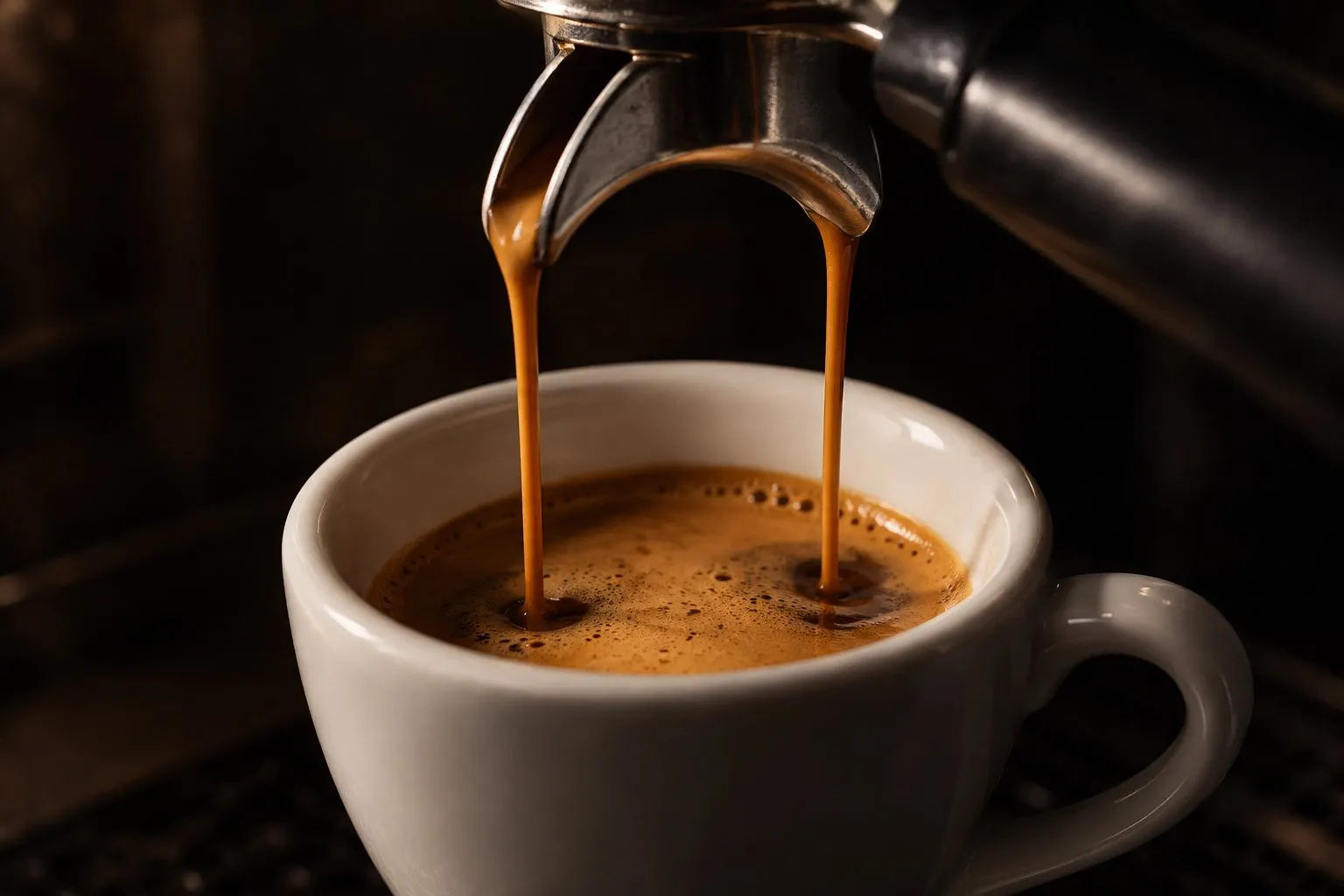
Nearly all of this is water. It's worth a test strip.
How hard is your water?
The USGS sorts water by hardness in mg/L as calcium carbonate: 0 to 60 is soft, 61 to 120 moderately hard, 121 to 180 hard, and above 180 very hard. La Marzocco's 70 to 100 ppm sits inside the moderately hard band. Water in the hard or very hard bands is above what La Marzocco recommends, so expect to act there.
To find your number, use the strip if your machine came with one. Breville includes one with the Dual Boiler, for example, and asks you to set the machine's hardness level to match. Test cold water that hasn't been through the machine, as La Marzocco advises. A home kit or your water utility's report can fill in the rest.
Which route to take
If your test already falls inside your manual's range
If you have a Barista Touch and need a new tank filter → Replacement filter for Barista Touch · Seller data only
View(paid link to Amazon, opens in a new tab)Ad · paid link · check price & delivery on AmazonIf you have a Barista Pro or Touch and want spares → Replacement filters for Breville · Seller data only
View(paid link to Amazon, opens in a new tab)Ad · paid link · check price & delivery on AmazonIf your water is far off and you want a known recipe → Third Wave Water, espresso profile · Seller data only
View(paid link to Amazon, opens in a new tab)Ad · paid link · check price & delivery on AmazonIf you prefer to mix a gallon at a time → Third Wave Water, espresso sticks · Seller data only
View(paid link to Amazon, opens in a new tab)Ad · paid link · check price & delivery on Amazon
The options, one by one
| Seller data onlyThird Wave Water, espresso profile | Seller data onlyThird Wave Water, espresso sticks | Seller data onlyCOFFEE WATER mineral packs | Seller data onlyReplacement filter for Barista Touch | Seller data onlyReplacement filters for Breville | |
|---|---|---|---|---|---|
| Type | Mineral packets, espresso profile | Mineral sticks, espresso profile | Mineral packs | Replacement water filter | Replacement water filters |
| Fits | – | – | – | Barista Touch BES880, per listing | BES880, BES878, BES990, BES980, per listing |
| Price class | Budget | Budget | Budget | Budget | Budget |
| Best for | People who want a known recipe instead of working out their tap water | People who mix a gallon at a time | Comparing a second mineral recipe, once you have read its numbers | Barista Touch owners who have checked that it fits their filter holder | Owners of a listed model who want spare filters, after checking the fit |
| On Amazon(paid link to Amazon, opens in a new tab)Ad · paid link · check price & delivery on Amazon | On Amazon(paid link to Amazon, opens in a new tab)Ad · paid link · check price & delivery on Amazon | On Amazon(paid link to Amazon, opens in a new tab)Ad · paid link · check price & delivery on Amazon | On Amazon(paid link to Amazon, opens in a new tab)Ad · paid link · check price & delivery on Amazon | On Amazon(paid link to Amazon, opens in a new tab)Ad · paid link · check price & delivery on Amazon |
We only have the listings for these five products, so none of them is a pick, and the card says so. Listing values are marked as such.
Your machine's own filter
Start here if your machine has one. Breville says to use the filter supplied with the machine and replace it on your model's schedule. The Barista Express manual says every two months, and more often in hard water areas, and that the filter should come out if you use filtered or bottled water. On a replacement, check the model number: the filter for the Barista Touch* and the filters listed for four Breville models* are third-party listings, and we have not checked the fit.
A jug or under-sink filter
These may help with taste, but don't assume they fix hardness. La Marzocco says common drinking-water filters are often unsuitable because they barely change mineral content or chemistry. Test the water after the filter, not before it.
Bottled water
It can work, and Breville lists spring and mineral water among the alternatives for hard water areas. Read the label, because a bottle is only as good as what's dissolved in it. La Marzocco recommends checking that the needed minerals are present, and that goes for any brand on the shelf.
Mineral packets
The Third Wave Water espresso profile*, also sold as gallon sticks*, is the best-documented option here. Its support article lists magnesium sulfate, calcium citrate and potassium bicarbonate, about 150 mg/L TDS, and no chlorides, and says the minerals are chosen to prevent scale. That's the maker's claim, and we found no independent measurement. The article gives no mixing directions, so follow the package, because the numbers only hold when it's mixed as the maker says.
COFFEE WATER mineral packs* are listed as making 25 gallons. The title names no espresso profile and no mineral values, so look those up first.
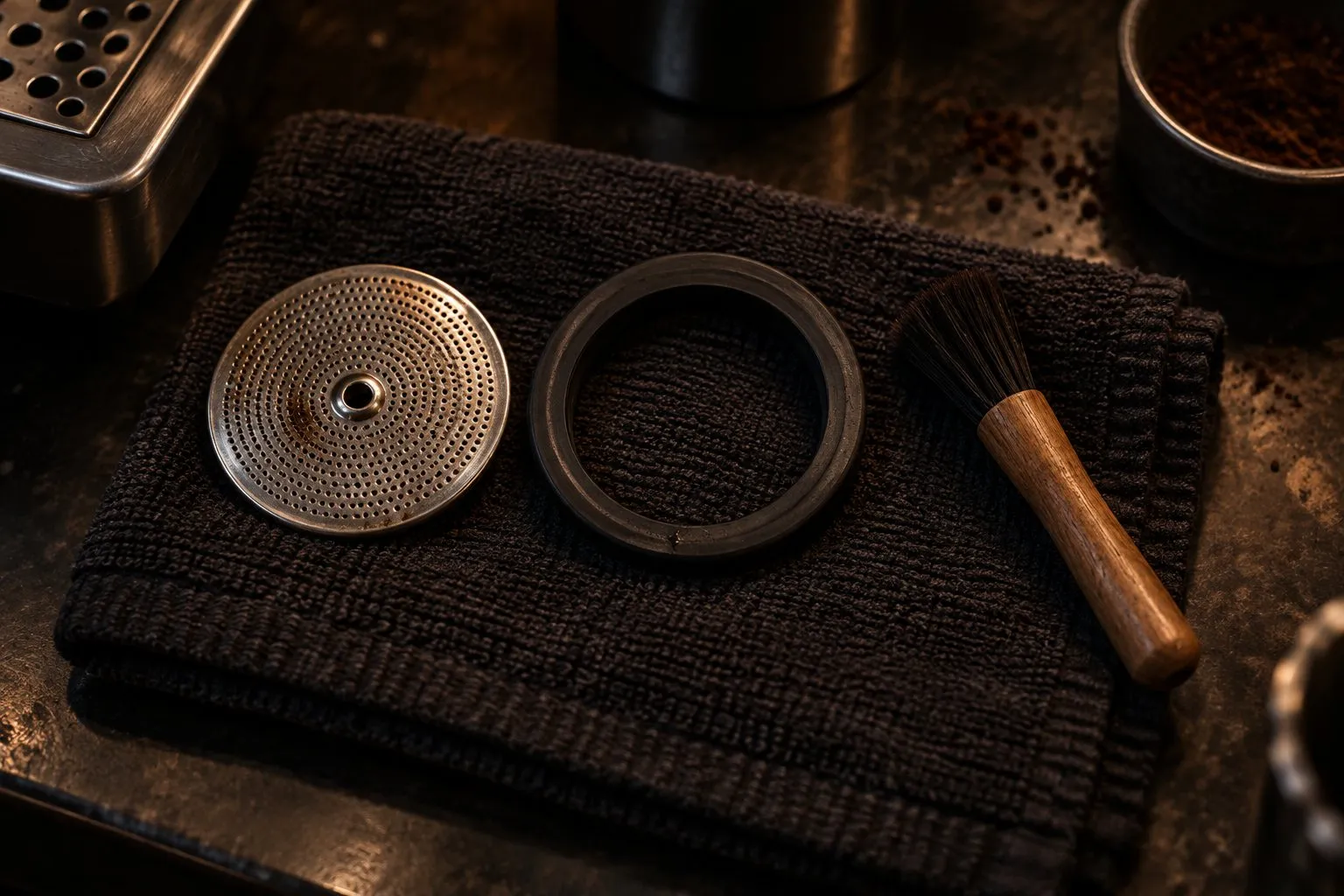
Good water doesn't replace descaling
Follow the cleaning and descaling schedule in your manual either way. On the Barista Express, a light tells you when descaling is due, and the manual warns that mineral buildup reduces flow, temperature, power and taste. The right water spaces that work out. It doesn't cancel it. For Breville's model-by-model notes, start from our Breville overview.
Common mistakes
- Buying minerals before testing. Your tap may already be inside the range.
- Filling with distilled water to “save the machine”. Breville and La Marzocco both advise against it.
- Treating a pitcher filter as a softener. It may barely change the hardness.
- Blaming the water first for a sour shot. Fix the grind first: our page on sour espresso has the order. Change one thing at a time.
- Reading the SCA numbers as a machine warranty. They describe brewing water, and your manual decides the rest.
We looked for maker guidance on salt-based softeners and could not read anything we'd cite, so ask your machine's service partner before you plumb one in.
Find your machine
Still shopping for the machine itself? These four questions end in one model.
Our recommendation
Test first. If your water falls in your manual's range, use it, with the filter the machine came with. If it's too hard, change the source or filter it and test again. If you'd rather not think about it, a mineral recipe like Third Wave Water is a reasonable shortcut, with the caveats above. Don't run a machine on plain distilled water. A scale tells you whether a water change did anything to your shot, more gear in buying order sits on our accessories page, and the guide to choosing a machine starts from what you drink.
Drinking it long? Machines for Americanos covers the water in the cup.
Asked at the bar
Can I use distilled water in an espresso machine?
Both makers we read say no. Breville's support article says to avoid water with little or no mineral content, and warns you not to assume purified water is better for a machine. La Marzocco says very pure water can corrode internal parts at high temperature and may not work with the sensors, so the machine may fail to fill or heat.
What is the best water for an espresso machine?
There is no single best one. Look for mild mineral content: 50 to 150 ppm dissolved solids at Breville, or 90 to 150 ppm at La Marzocco, with low chloride. Your tap water may already fit. Test it first, then filter it, switch sources or add minerals only if the test says you need to. Your manual has the last word.
Is Third Wave Water good for espresso machines?
Its maker says the espresso profile uses permanent hardness minerals to prevent scale, contains no chlorides, and targets about 150 mg/L TDS. That fits what La Marzocco and Breville ask for on those points, although its alkalinity of about 85 to 94 mg/L is above La Marzocco's and the SCAA's figures. We found no independent measurement of the scale claim.
Do I need a water filter for my espresso machine?
Use the one your machine comes with, if it has one. Breville's Barista Express manual says replacing its filter every two months reduces the need to descale, and sooner in hard water areas. La Marzocco warns that common drinking-water filters often barely change mineral content, so a pitcher filter won't necessarily solve hard water.
Is the SCA water standard the target for my machine?
It's a brewing target, not a machine spec. The SCAA document of November 21, 2009 sets out water for a superior extraction: 150 mg/L TDS, 68 mg/L calcium hardness and 40 mg/L alkalinity. It doesn't discuss scale or corrosion. We read a third-party copy, and later SCA guidance may differ, so use your machine's manual for machine protection.
Where this comes from
- SCAA water standard of November 21, 2009 (third-party copy)
- Breville support: which water to use in an espresso machine
- La Marzocco: water solutions for your home espresso machine
- USGS: hardness of water
- Third Wave Water support: about the Espresso Machine Profile
- Breville: Barista Express instruction book (copy hosted by Williams-Sonoma)
Next round
 AccessoriesWhich espresso accessories are worth buying first: scale, tamper, pitcher, WDT tool and more, sorted by portafilter size, with what your machine already includes.
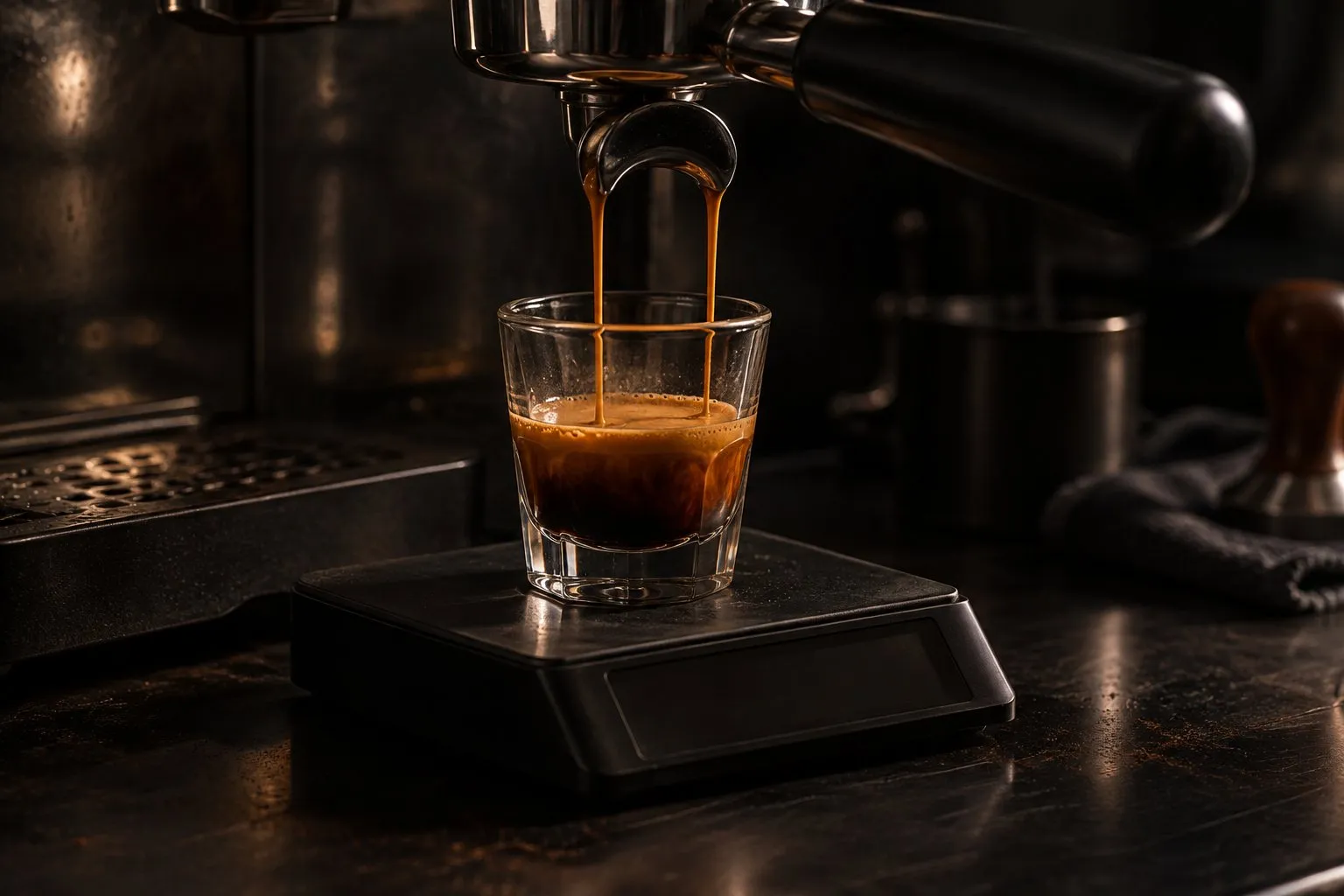 Dial in espressoHow to dial in espresso: fix the dose, set a yield, then change only the grind until time and taste line up. Steps, a symptom table and the exception to the rule.
- BrevilleEvery Breville semi-automatic espresso machine we cover, from Bambino to Dual Boiler: how they differ, what Breville states and omits, and which one to pick.
 Barista ExpressBreville Barista Express BES870XL: grinder, PID, 54 mm portafilter and care from Breville's own documents, and who should buy something else.
- Sour espressoSour espresso usually means under-extraction. What to change first, when grinding finer stops helping, and where roast, water and temperature fit in.
semiautomaticespressomachine.com Editorial Team
Espresso gear & shot craft
We are the editorial team at semiautomaticespressomachine.com. We read maker spec sheets, manuals, standards and published research on espresso and turn them into plain-English buying advice, with sources on every page. We do not run lab tests, and we say so openly.
- Spec sheets & standards read
- Sources on every page
- No lab tests – stated openly
- Publisher details in the imprint