Espresso Machine Descalers: Citric, Lactic and What Manufacturers Specify
Use the descaler your machine's manual names. That is our whole recommendation, because the makers disagree on the point that matters: Gaggia's Classic Evo manual rules out every other product, while others simply name their own. Acid type comes second, since we found no independent comparison of citric and lactic formulas.
Disclosure: This page contains affiliate links (marked with *). If you buy through them, we earn a small commission at no extra cost to you. As an Amazon Associate I earn from qualifying purchases. Learn more
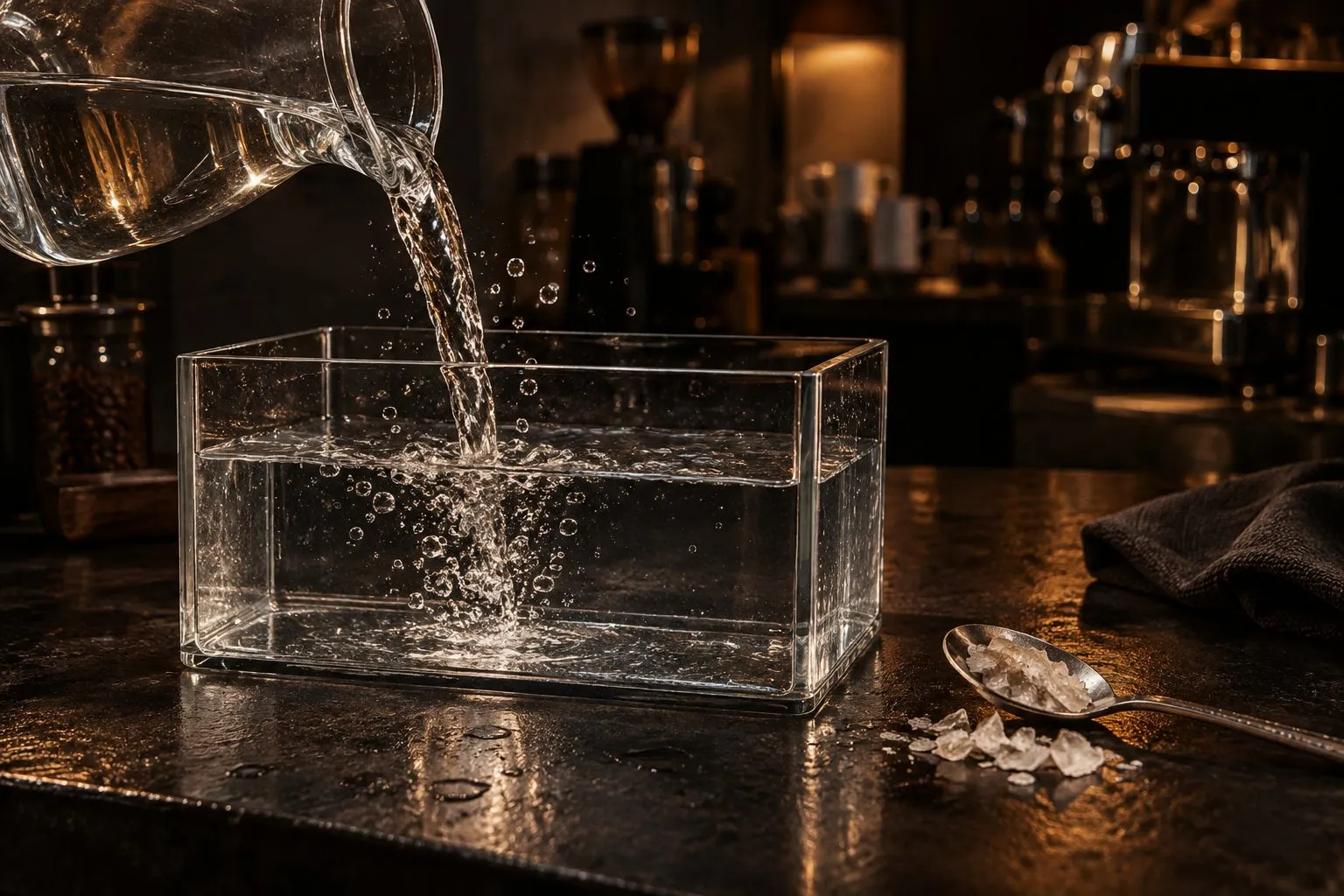
Use what your manual names. Breville's Barista Express manual calls for Breville descaling powder, Gaggia's Classic Evo manual says Gaggia's product only and never vinegar, and De'Longhi points to EcoDecalk. Maker formulas include citric and lactic acid, and we found no independent test of which works better. Treat a universal descaler as your own call, after reading the manual and the label.
On this page
Scale builds up from the minerals in your water. Breville's manual says it reduces brewing flow, brewing temperature, the power of the machine and the taste of the espresso. Buying a product to fix that sounds like a simple search. The trouble is that your machine's maker may have views on what goes into its tank, and those views are the first thing to check. The white mineral flakes on the spoon in the photo above stand in for what you are trying to remove.
Find your machine
If you own a Breville
If you own a Gaggia Classic
If you own a Rancilio Silvia
If you own a De'Longhi
If your manual leaves the product open
What the manuals specify
| Machine | Product named | How often | What the cycle involves |
|---|---|---|---|
| Barista Express | One Breville descaling powder sachet in 34 fl. oz (1 L) of water | When the light stays on | Coffee, steam and hot water parts, then a full tank to rinse |
| Bambino | “Descaling agent,” powder in the box | When the 2 Cup button flashes | Fill to the DESCALE line, use a 68 fl. oz (2 L) container, then rinse |
| Gaggia Classic Evo | Gaggia's product only | Every 2 months | About 20 minutes of waiting, then four tanks of rinse |
| De'Longhi pump machines | EcoDecalk | About every three months, or after 200 uses | See your model's manual |
| Rancilio Silvia | No descaling section in the copy we read | Ask Rancilio's service | Ask Rancilio's service |
Gaggia is the clearest of the group. Its Classic Evo manual says to use the Gaggia descaling product only, and to “never use vinegar or other descaling agents.” It also warns never to drink the solution or anything dispensed until the cycle is finished. We read the Evo's file (RI9481), so owners of a Classic Pro or E24 should look for their own.
Breville's Barista Express manual doesn't ban other products in so many words. It just writes its procedure around its own powder. De'Longhi's page calls EcoDecalk universal in a narrower sense than you might assume, meaning it works on almost all De'Longhi machines. It also says the frequency depends on your water hardness.
Citric, lactic and what's actually in the bottle
Search for descalers and you will read that one acid is gentler or works better. We looked for evidence and found only marketing and forum posts, which we don't use as sources. What we could read were two safety data sheets from the makers' side:
| Product | Acid listed | Share listed | Document |
|---|---|---|---|
| De'Longhi EcoDecalk | Lactic acid, with water and lactates | 30 to under 50 percent | De'Longhi sheet, March 10, 2023 |
| Breville Eco Liquid Descaler | Citric acid and tartaric acid | 10 to 30 percent, and 1 to 10 percent | Cafetto sheet, March 1, 2019 |
Three limits apply here. We read both as copies on retailers' servers outside the US, and a current bottle may differ. Breville's sheet covers a liquid, while the Barista Express manual we read asks for a powder. And percentages don't tell you how well a product works in your machine.
These are also real chemicals. The De'Longhi sheet classifies EcoDecalk as causing severe skin burns and eye damage, so read the label before you pour, and follow its first aid and storage notes.
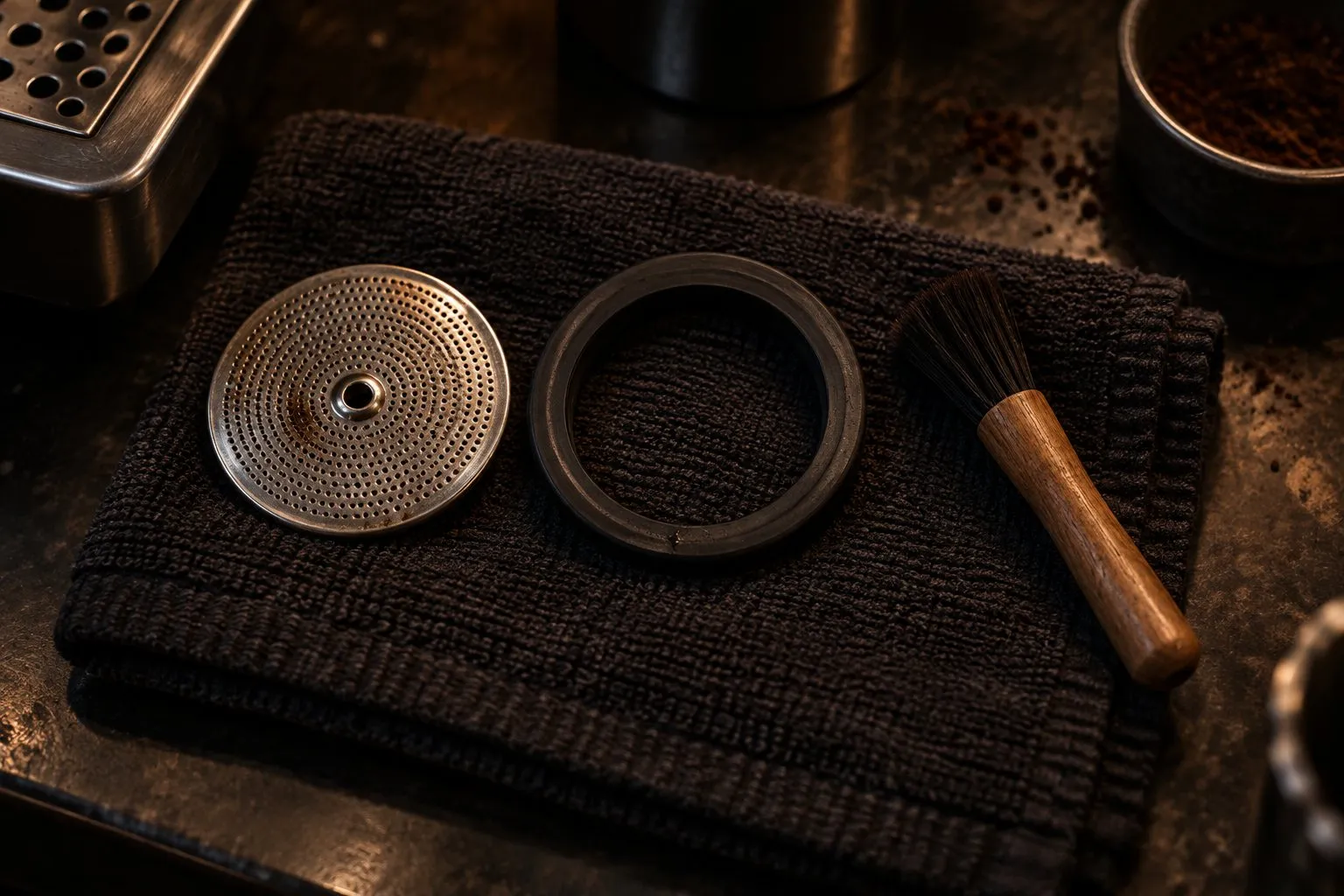
Descaling deals with minerals. Coffee oils need a separate clean.
Those two jobs get confused all the time. Descaling removes minerals, and cleaning removes coffee oils. On the Barista Express, a solid light means the first and a flashing light means the second. How to clean an espresso machine covers the other half.
Universal descalers
The product we can link from this category is a universal one from a third-party brand. We list it here as an option for one case: your manual doesn't name or require a specific product, and you've checked the label for your machine type.
IMPRESA descaler
A universal descaler from a third-party brand, per the listing title.
Seller data only: We only have the Amazon listing for this product. We list it as an option, not as a recommendation.
Why here: Sold as universal, per its listing title. We found no maker page or safety data sheet, so we can't tell you what's in it. Not for a machine whose manual requires its own product.
Best for: Machines whose manual leaves the descaler open, after you check the label
- Sold as universal, per listing title
- We only have the listing, and found no maker page or safety data sheet
- Not for machines whose manual names its own descaler only, such as the Gaggia Classic Evo
- Type
- Descaler
- Fits
- Universal, per listing
- Price class
- Budget
If your manual does name a product, buy that one instead, from the maker or a retailer. We currently have no maker's descaler in our product list, and we would rather say so than steer you to the one we do have.
How to lower your descaling load
Water is the part you control. Breville says replacing the water filter every two months reduces the need to descale, and sooner in hard water areas. Gaggia says purified or bottled water is good for taste, and still asks for periodic descaling every 2 to 3 months. Our page on espresso water goes through hardness and filters.
Common mistakes
- Reading a general how-to first. The steps differ by machine. The Barista Express manual has you hold buttons to enter a descale mode. The Classic Evo has you run water by hand and wait.
- Assuming “universal” means your warranty agrees. Ask the maker if the manual doesn't settle it.
- Removing the tank mid-cycle. Breville's manuals warn that the tank should never be removed or completely emptied during descaling.
- Skimping on the rinse. The Barista Express rinses with a full tank, and the Classic Evo with four. Never drink anything from the cycle before it's complete.
Still choosing a machine?
If you are reading this ahead of a purchase, the care routine is a fair thing to weigh. These questions sort out which type of machine fits you.
Our recommendation
Open your manual, and buy what it names. If it names nothing, ask the maker's support, then pick a product whose label covers your machine type. On a Breville, our descaling guide has the steps from the manuals. Your home bar setup will also run better with the right water in the tank.
Asked at the bar
What descaler should I use for an espresso machine?
The one your manual names. The Barista Express manual uses Breville descaling powder, Gaggia's Classic Evo manual allows Gaggia's product only, and De'Longhi recommends its EcoDecalk for its own machines. If your manual leaves it open, check the label for your machine type, and ask the maker's support about the warranty before you use a third-party product.
Can I use vinegar to descale an espresso machine?
Not on a Gaggia Classic Evo, since its manual says never to use vinegar or other descaling agents. The Breville manuals we read don't discuss vinegar, they just name a descaling product. So the safe answer is to use what your own manual names, and ask the maker if it says nothing.
Citric or lactic acid: which is better for descaling?
We found no independent comparison, so we won't pick. De'Longhi's safety data sheet for EcoDecalk lists lactic acid, and the sheet for Breville's Eco Liquid Descaler lists citric and tartaric acid. Both are acid products with their own hazard statements. Choose by what your manual specifies, not by the acid on the label.
How often should I descale a Gaggia Classic?
The Classic Evo manual says every 2 months with Gaggia's own descaler, and it asks for periodic descaling every 2 to 3 months even with purified or bottled water. The cycle has about 20 minutes of waiting with the machine off, and the rinse takes four tanks. Use the manual for your own model, since older Classic machines have their own book.
How do I descale a Rancilio Silvia?
The copy of the Silvia manual we read has no descaling section. So ask Rancilio's service or your retailer for the procedure and the product, instead of following a guide written for another machine. The manual does reserve work inside the machine, such as pump pressure adjustment, for a qualified technician.
Where this comes from
- Breville: Barista Express instruction book (copy hosted by Williams-Sonoma)
- Breville: Bambino BES450 instruction book (US and Canada)
- Gaggia: Classic Evo (RI9481) operating instructions, copy on a third-party server
- De'Longhi: espresso machine maintenance
- De'Longhi: EcoDecalk safety data sheet, revision 6 of March 10, 2023 (copy on a retailer's server)
- Cafetto: Breville Eco Liquid Descaler safety data sheet, March 1, 2019 (copy on a retailer's server)
Next round
- Descale a BrevilleHow to descale a Breville espresso machine, step by step from the manuals: Barista Express, Impress, Bambino and Bambino Plus, what the lights mean, and what to use.
- Espresso waterWhich water to use in an espresso machine: why too hard and too pure both cause trouble, what Breville and La Marzocco ask for, and where the SCA target fits in.
- Clean your machineHow to clean a semi-automatic espresso machine: daily wipe-downs, the clean cycle or blind filter step, and where the Breville, Gaggia and Rancilio manuals differ.
 Gaggia Classic ProGaggia Classic Pro and E24: Gaggia's own values, the manuals on steam and descaling, what mods risk for the warranty, and who should pick something else.
 Rancilio SilviaRancilio Silvia: Rancilio's 0.3 L boiler and own data, a 58 mm portafilter per retailers, the slow heat-up, PID listings, and what to upgrade first.
semiautomaticespressomachine.com Editorial Team
Espresso gear & shot craft
We are the editorial team at semiautomaticespressomachine.com. We read maker spec sheets, manuals, standards and published research on espresso and turn them into plain-English buying advice, with sources on every page. We do not run lab tests, and we say so openly.
- Spec sheets & standards read
- Sources on every page
- No lab tests – stated openly
- Publisher details in the imprint