Espresso Machine Glossary: Portafilter, PID, OPV and WDT in Plain English
Espresso talk is full of short words that product pages rarely explain. This glossary translates the most important ones into plain English, sorted alphabetically, and says where a term means different things to different brands.
The terms sit in three groups, and it helps to know which one you are looking at.
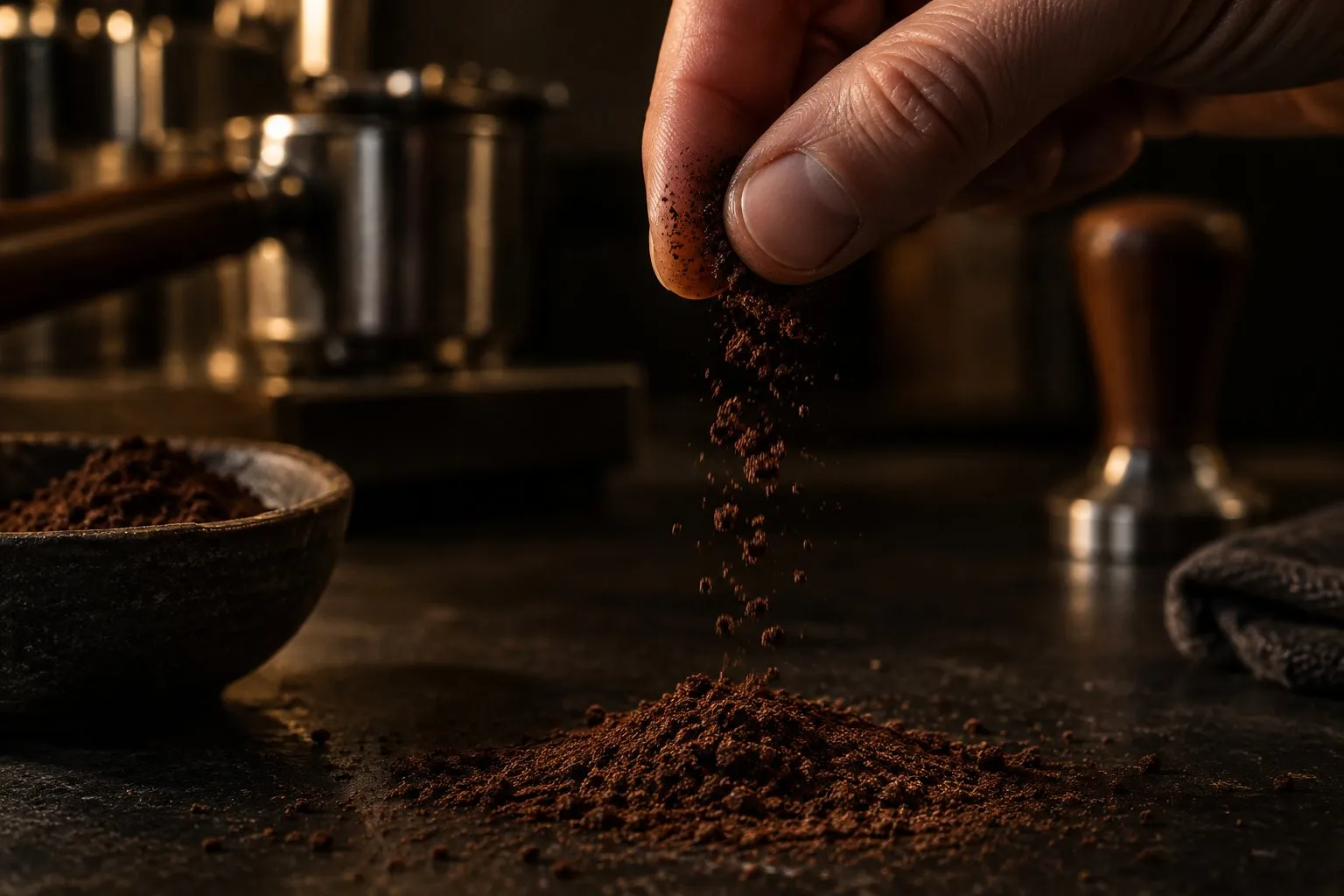
The coffee itself. Dose, yield and brew ratio are numbers you can weigh. Grind them into a routine and you are dialing in, which our dial-in guide walks through one change at a time. The puck and the tamp are what happens to the dose before water reaches it. Both get more attention online than the evidence supports, and the accessories guide sorts out which tools are worth buying first.

The machine. Heating words decide how you make milk drinks: a single boiler takes turns, a heat exchanger and a dual boiler do not, and thermoblock or thermocoil machines heat water as they go. Our page on dual boiler machines goes further. OPV and PID are the two control words on spec sheets. The pressure word that matters most is not in this list at all, because it is printed on the box and says less than it seems.
The labels. Words like "manual" and "automatic" mean different things from brand to brand. A pump machine can be sold as "Compact Manual", and "automatic" can describe a machine, a brand's marketing or a milk frother. "Semi-automatic" and "super-automatic" are the two labels we use throughout this site, and the comparison of both shows where assisted machines sit between them. Breville and Sage are the same maker's machines in different markets.
Espresso labels on a coffee bag belong in this group too. Espresso on a bag is a suggestion from the roaster. Any roasted bean can be brewed as espresso.
How to read a spec sheet with these words. Start with the portafilter size, because it decides which baskets, tampers and funnels fit, and a tool made for one size will not fit another. Then look at the heating word, which tells you how milk drinks will go. Treat the pump rating as a pump rating. If a page does not mention PID, that does not prove the machine lacks it, so check the manual when it matters to you. On this site a value marked "per retailers" or "per listing" tells you we could not confirm it at the maker.
Answers to typical questions are under questions and answers. If a term you were looking for is missing, please tell us and we will add it to this page: all contact details are in the imprint.
- Back-flush
- A cleaning cycle run against a closed basket or disc. Breville's Barista Express does it with a cleaning disc and a tablet, while other manuals use a blind filter. Do it only if your manual describes it.
- Blind filter
- A filter without holes, used in a cleaning cycle. Breville's version is a cleaning disc that sits in a basket.
- Bottomless portafilter
- A portafilter with no spouts, so you can watch the underside of the puck while the shot pulls. It shows channeling, but it doesn't improve the shot.
- Brew ratio
- The weight of coffee in the basket against the weight of espresso in the cup. At 1:2, 18 g of coffee gives 36 g of espresso. Breville's guide uses 1:2 as a first recipe; it is a convention, not a standard.
- Burr grinder
- A grinder that cuts the beans between two burrs, conical or flat. Espresso needs a grinder that goes fine and moves in small steps.
- Channeling
- Water finds an easy path through the coffee and bypasses part of it. Breville names moisture in the basket as one cause.
- Crema
- The foam on top of an espresso. Crema shows CO2, so freshness and roast. It says little about flavor.
- Descaling
- Dissolving mineral build-up from the machine's water path. Breville says build-up can reduce flow, temperature, power and taste. Intervals and products differ by maker, so follow your manual.
- Dialing in
- Adjusting grind, dose and yield until a coffee tastes right, changing one thing at a time.
- Dose
- The weight of ground coffee in the basket. Breville's dial-in guide starts from 18 to 22 g; the Italian certified espresso uses 7 g for one cup.
- Dual boiler
- A machine with two separate boilers, one for brewing and one for steam, so it can do both at once. In budget listing titles the phrase may mean two heating units instead, which we have not checked per model.
- E61
- The Faema E61 of 1961, which the historian Jonathan Morris calls the first commercially successful semi-automatic espresso machine. Spec sheets also use the name for a type of group.
- Extraction yield
- The percentage of the coffee that ends up dissolved in the cup, read with a refractometer. It isn't the same as yield, which is the weight of the shot.
- Flat white
- Less milk than a latte and a thin layer of microfoam. Shot type and size differ by café, and we found no standards body that defines it.
- Gasket
- The rubber or silicone ring in the group head that the basket presses against. A worn one can leak around the portafilter.
- Group head
- The part of the machine that the portafilter locks into, and where the hot water comes out.
- Heat exchanger (HX)
- A design that runs brew water through a pipe inside a steam boiler, so one boiler can serve brewing and steaming at the same time.
- Hopper
- The bean container on top of a grinder. Breville says not to store beans in the Smart Grinder Pro's hopper.
- Knock box
- A small box with a bar across it, for knocking spent pucks out of the basket.
- Lungo
- A longer shot. Breville's guide gives 1:3, and we found no standards body behind that number.
- Microfoam
- Steamed milk with bubbles too small to see. It looks glossy, and it is what makes latte art possible.
- OPV (over-pressure valve)
- The valve that limits brew pressure. This is one reason the pump rating on the box differs from the pressure at the coffee.
- Over-extraction, under-extraction
- Breville's words for a slow shot that tastes bitter and burnt, and a fast shot that tastes bitter or sharp, weak and watery.
- PID
- A digital temperature controller. PID keeps the boiler closer to the set point. Measured stability at the puck depends on the machine.
- Portafilter
- The handled basket that holds the coffee and locks into the machine. Size matters for accessories: home machines commonly use 51, 53.3, 54 or 58 mm tools.
- Pre-infusion
- Water at low pressure before the full shot. Breville's Bambino pages list low-pressure pre-infusion followed by 9 bar extraction.
- Prosumer
- Trade word for home machines built with commercial parts.
- Puck
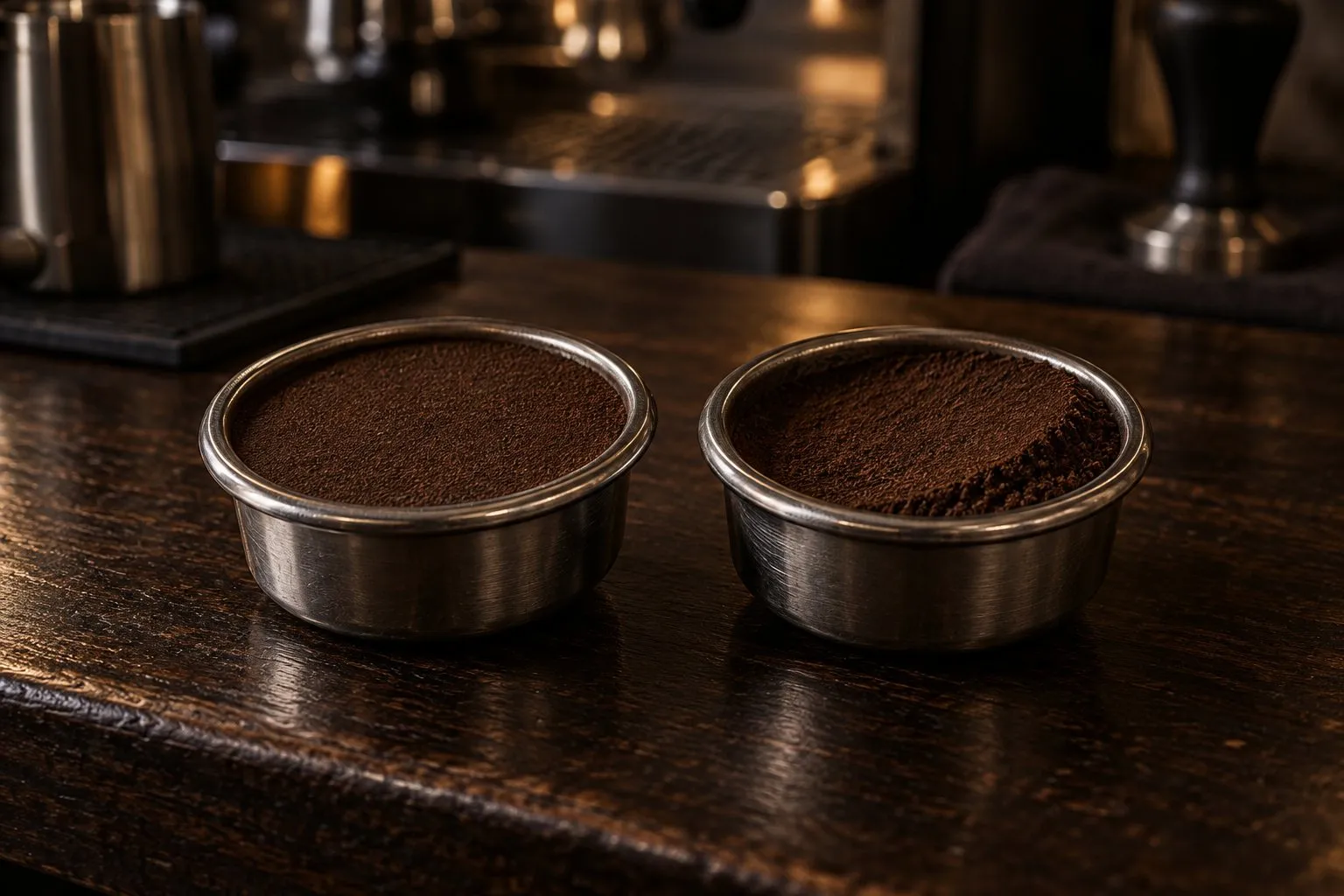
- The compacted bed of finely ground coffee in the basket, which hot water is forced through.
- Puck screen
- A thin metal disc that sits on top of the tamped coffee. Two small unreviewed measurements exist, Ribes 2021 and Nucleus 2022.
- Purge
- A short burst from the steam wand or the group to clear it. Manuals ask for it after steaming.
- Ristretto
- A shorter shot. Breville's guide gives 1:1, and we found no standards body behind that number.
- Semi-automatic espresso machine
- A pump-driven espresso machine in which you grind, dose and tamp the coffee yourself and start and stop the shot, while the machine supplies the water pressure and temperature.
- Shower screen
- The metal disc in the group head that spreads water over the coffee.
- Single boiler
- One boiler for brewing and steaming, so the machine has to take turns between the two.
- Single dosing
- Weighing the beans for each shot and grinding only those, instead of keeping beans in a hopper.
- Single wall and dual wall baskets
- Breville recommends single wall baskets with fresh grinding. Its manual says dual wall baskets “regulate the pressure”, and it recommends them for pre-ground coffee.
- Steam wand
- The metal tube that sends steam into the milk. On a manual wand the air and the spin are up to you, and an automatic wand does them for you.
- Super-automatic
- A machine that grinds, doses, tamps and brews by itself. The word "automatic" on its own has several meanings, depending on the brand.
- Tamp
- To press the coffee flat in the basket. Press until the coffee stops compressing, and keep it level.
- Thermoblock, thermocoil
- Heaters that warm water on demand in a metal block instead of holding it in a boiler. Thermocoil, thermoblock and ThermoJet are brand or design names for such flow heaters.
- Three-way solenoid
- A valve that vents pressure after the shot. Gaggia lists one on the Classic E24.
- Vibration and rotary pumps
- Two pump types named on spec sheets. Neither name tells you the pressure at the coffee, and Rancilio lists vibration pumps on the Silvia and the Silvia Pro X.
- WDT (Weiss Distribution Technique)
- Stirring the grounds with thin needles to break up clumps before tamping.
- Yield
- The weight of espresso in the cup. It is measured in grams on a scale, not read from the height in the glass.
Where this comes from
- Breville: BES870 Barista Express instruction book (US, Canada, Mexico)
- Jonathan Morris: The Faema E61 Espresso Machine, Perspectives on History, December 23, 2020
- Seattle Coffee Gear: why use a bottomless portafilter?
- Sage/Breville: semi-automatic vs automatic espresso machines
- Breville: how to dial in espresso
- INEI: Certified Italian Espresso leaflet
- Illy and Navarini: review on espresso foam (Food Biophysics, 2011)
- Serious Eats roundup, read through a Yahoo copy dated 2 May 2023
- Wikipedia: Espresso machine
Next round
- Questions & answersCommon questions about semi-automatic espresso machines, answered briefly: pressure, grinders, boilers, recipes and tamping, with sources and links to the guides.
 How we compareHow our espresso machine picks come about: spec sheets, standards and published research, what we cannot verify, which outside tests exist, and how we are funded.
- Dial in espressoHow to dial in espresso: fix the dose, set a yield, then change only the grind until time and taste line up. Steps, a symptom table and the exception to the rule.
semiautomaticespressomachine.com Editorial Team
Espresso gear & shot craft
We are the editorial team at semiautomaticespressomachine.com. We read maker spec sheets, manuals, standards and published research on espresso and turn them into plain-English buying advice, with sources on every page. We do not run lab tests, and we say so openly.
- Spec sheets & standards read
- Sources on every page
- No lab tests – stated openly
- Publisher details in the imprint