Milk Pitchers for Steaming: 12 oz or 20 oz, Spout Shape and What Actually Matters
Choose a milk pitcher by how much cold milk you steam at once: fill it to about half and see what that leaves you. A 12 oz pitcher suits one small drink, and a 20 oz pitcher suits a large latte or two small drinks. Check your box first, because many machines include a jug, and the Bambino Plus manual says to use only that one.
Disclosure: This page contains affiliate links (marked with *). If you buy through them, we earn a small commission at no extra cost to you. As an Amazon Associate I earn from qualifying purchases. Learn more
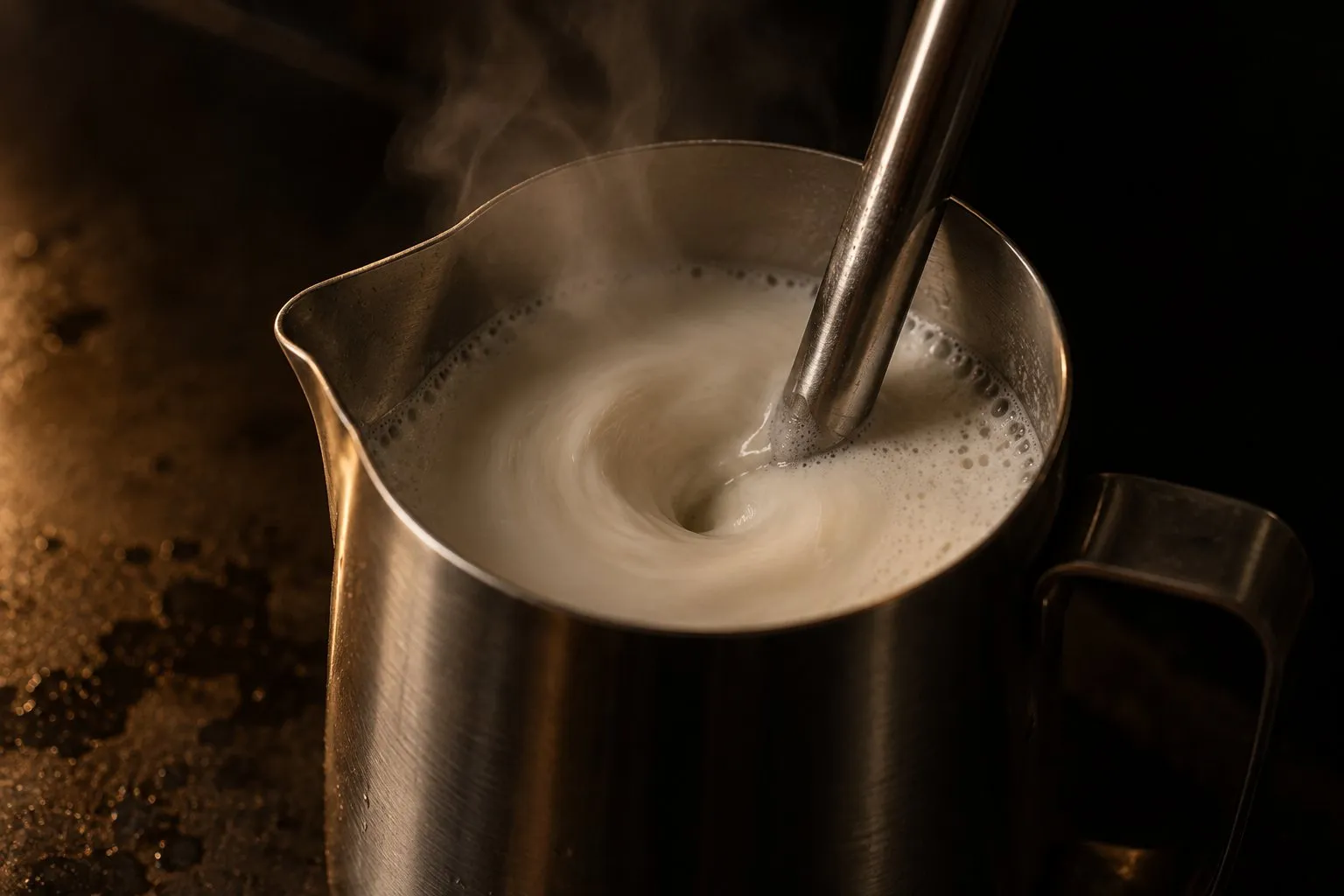
For one flat white or cappuccino, a 12 oz pitcher half filled gives you about 6 oz of milk, which is plenty. For a big latte or two drinks at once, take 20 oz. Choose stainless steel with a spout. Before you buy, read your manual: some machines need the supplied jug, and an automatic wand may not work with any other.
On this page
A pitcher is one of the cheapest things on your counter, so the sensible question is whether you need one at all. Many machines come with a jug. You only need another if yours is the wrong size for your drinks or if you make two at once. The accessories page sets out where this sits in the buying order.
For the pitchers we link, we only have Amazon listings, so they are options and not picks. We have not used them. Our recommendation is about the size, and any plain stainless pitcher of that size does the same job. How we compare explains the “Seller data only” label.
Amrules 12 oz pitcher
A plain 12 oz frothing pitcher, per the listing title.
Seller data only: We only have the Amazon listing for this product. We list it as an option, not as a recommendation.
Why here: 12 oz is the size that suits one small milk drink, half filled. It only has to be stainless, with a spout you can pour from.
Best for: One small milk drink at a time
- 12 oz, per listing title
- We only have the listing
- Type
- Milk pitcher
- Fits
- 12 oz, per listing
- Price class
- Budget
Check your box first
| Machine | Jug in the box | Source |
|---|---|---|
| Breville Bambino Plus | 16 fl oz (480 ml), with MIN and MAX marks | Breville page and booklet |
| Breville Dual Boiler | 16 oz | Serious Eats |
| Breville Barista Express Impress | 480 ml | Serious Eats |
| La Marzocco Linea Micra, Linea Mini | 12 oz | Serious Eats |
So 16 oz is common in the box, and half of it is 8 oz of milk, which is enough for most single drinks. If your machine has a jug that size, a second pitcher mostly helps if you want a smaller one for small drinks or a larger one for two at a time.
Which size for whom
If you make one small drink at a time, such as a flat white or cappuccino → Amrules 12 oz pitcher · Seller data only
View(paid link to Amazon, opens in a new tab)Ad · paid link · check price & delivery on AmazonIf you make a big latte or two drinks at once → Stainless milk pitcher · Seller data only
View(paid link to Amazon, opens in a new tab)Ad · paid link · check price & delivery on AmazonIf your machine has a jug and it does the job
The options side by side
| Seller data onlyAmrules 12 oz pitcher | Seller data onlyStainless milk pitcher | |
|---|---|---|
| Type | Milk pitcher | Milk pitcher |
| Fits | 12 oz, per listing | – |
| Price class | Budget | Budget |
| Best for | One small milk drink at a time | Any machine with a steam wand |
| On Amazon(paid link to Amazon, opens in a new tab)Ad · paid link · check price & delivery on Amazon | On Amazon(paid link to Amazon, opens in a new tab)Ad · paid link · check price & delivery on Amazon |
Listings say little about pitchers, and the size is the one number that counts here.
Size: work back from your milk
Gaggia's manual tells you to place the jug half filled with cold milk under the wand, and that's a handy rule for choosing a size. CASABREWS' CM5418 Basic manual adds that milk doubles in volume, so a half-full jug leaves room for that. Italy's certified cappuccino grows less, from 100 ml to about 125 ml, so how much the milk grows depends on how much air you let in.
| Pitcher | Half full, cold milk | Suits |
|---|---|---|
| 8.5 oz | About 4 oz | One small cappuccino or flat white |
| 12 oz | About 6 oz | One small to medium drink |
| 16 oz | About 8 oz | One large drink |
| 20 oz | About 10 oz | One very large latte, or two small drinks |
The right-hand column is our reading of the math and not a standard. The first figures to check are your own: pour your usual drink's milk into a measuring cup, then double it. CASABREWS uses about 4 oz (120 ml) in its example, and Italy's cappuccino uses 100 ml. For a sense of how much milk each drink takes, see flat white or latte. A flat white uses less milk than a latte, and shot type and size differ by café.
Too little milk can be a problem too. If the wand tip can't sit below the surface, you can't get a clean spin going, and Breville's booklet says the milk should cover the tip. A pitcher that is far too large for your milk makes that harder.
What you're after in the jug
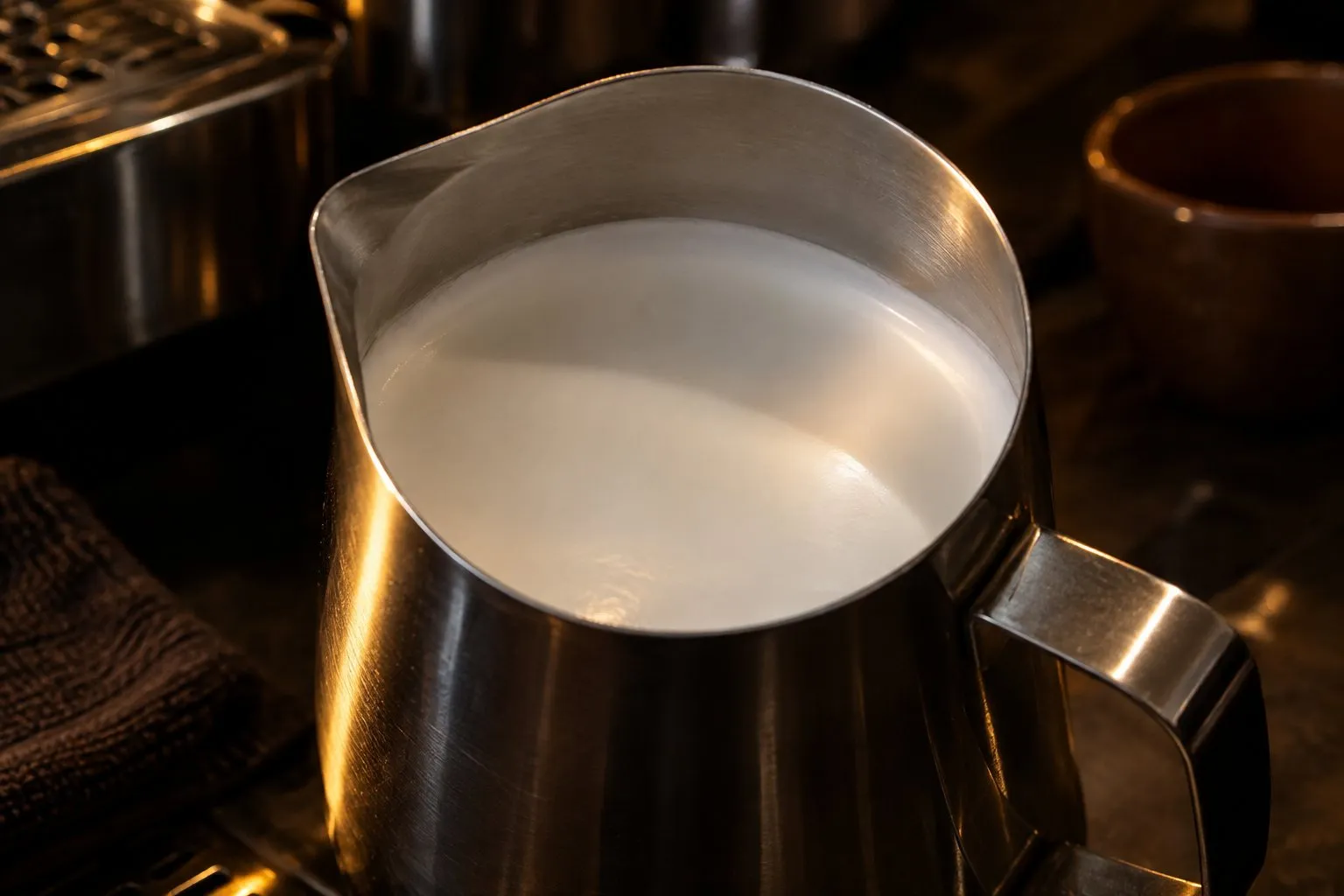
Glossy, paint-like milk with no visible bubbles. That comes from the steaming, not from the pitcher, and how to steam milk covers the technique. The pitcher only has to give the milk room to spin. If you want the vocabulary, our page on microfoam explains it.
Big bubbles are a wand problem
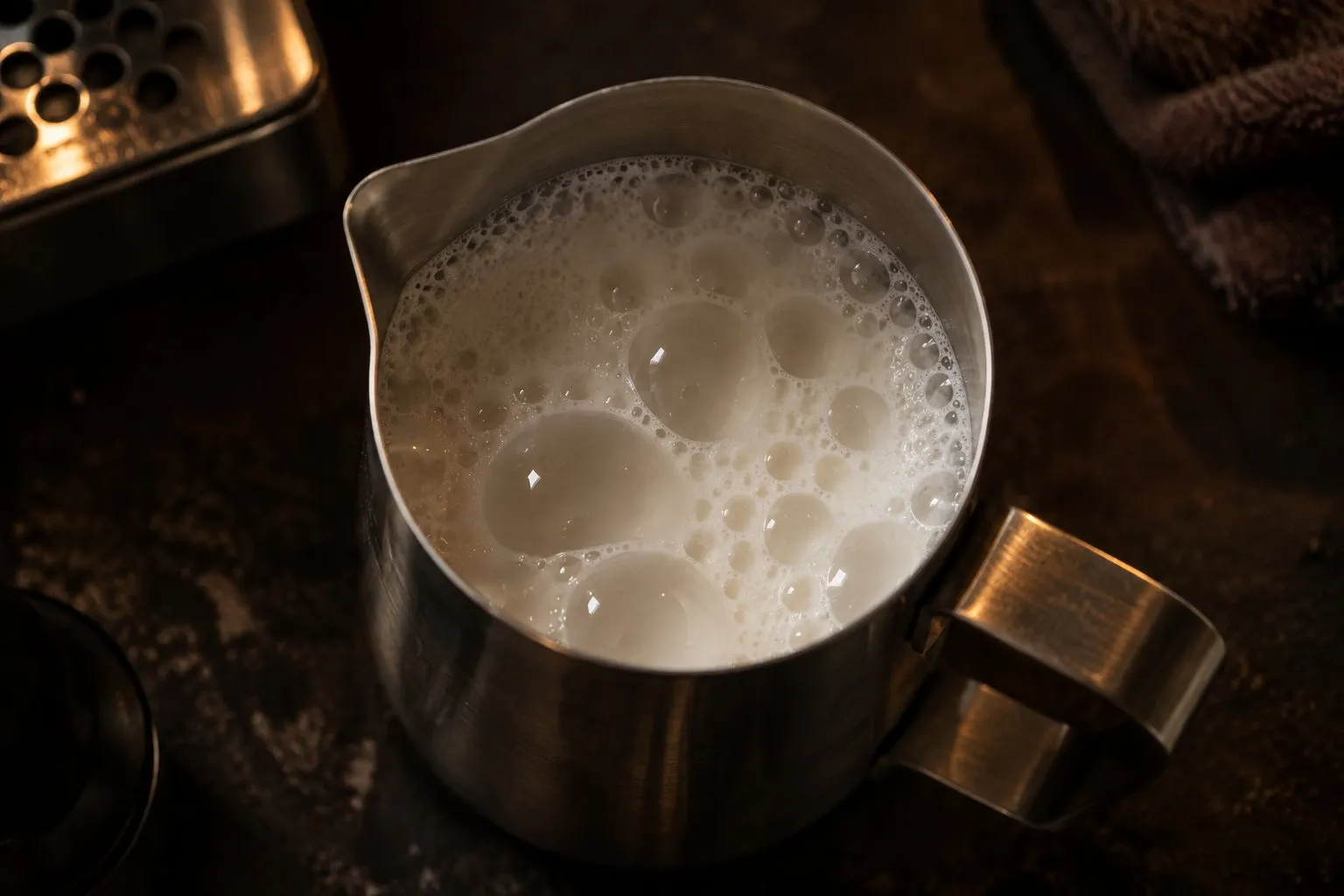
Gaggia's manual says that if the nozzle isn't deep enough, big bubbles form and then disappear at once. If it's in too deep, the milk won't froth. So before you blame the pitcher, adjust the depth of the tip. A new jug won't change that.
Shape and spout: what is actually known
Gaggia's manual is the most specific maker statement we found. It recommends stainless steel, circular, rounded jugs that are narrower at the top, with a spout, and says the spout is needed for cappuccino decorations. It doesn't go further than that.

Shops sell pointed and rounded spouts for different patterns. We found no test that compares them, so we won't tell you one is better. If you are learning latte art, choose a size you can control with one hand. A plain pitcher is a fine place to start.
CASABREWS gives one more useful number for small wands: it recommends a jug 70 to 75 mm across, about 2.8 to 3 in, for the CM5418. Check that against your wand's reach. It's a figure for that machine, and we saw no maker publish one for other machines.
Stainless steel, and your hand as the thermometer
Gaggia's manual says to keep a hand on the rounded part of the jug to feel the temperature rise. Breville's booklet says the milk is ready at 60 to 65 °C, about 140 to 149 °F, when the jug is hot to the touch. Italy's cappuccino is steamed to about 55 °C. So a metal jug tells you what's happening, and a thermometer is optional.
The options one by one
Amrules 12 oz
The Amrules 12 oz pitcher* is listed as a plain frothing pitcher in silver. That size suits single small drinks, which is what most people make at home. We only have the listing, so check the spout and handle in the photos.
Stainless pitcher range
The stainless pitcher range* runs from 8.5 oz to 66 oz, per the listing. Pick your size from the table above. The 66 oz end of the range goes far beyond what the half-full rule calls for at home, so stop well short of that.
Common mistakes
- Buying before opening the box. You may already own a good jug.
- Replacing a jug the manual tells you to keep. Check first, especially with an automatic wand.
- Going too large “to be safe.” Too little milk in a big jug is harder to steam.
- Filling to the spout. Leave room for the milk to grow.
- Expecting a spout to fix your texture. Big bubbles come from the wand depth.
- Starting warm. Gaggia and Breville both start with cold milk. Gaggia also warns that the steam shouldn't run for more than 60 seconds at a stretch on that machine.
Steam and hot metal can burn you. Follow the warnings in your own manual, and move your hand to the handle once the jug gets hot.
Which to buy
If your box has a jug and it fits your drinks, buy nothing. If it doesn't, get a 12 oz pitcher for one small drink, or a 20 oz one for bigger or double batches. Then spend your effort on steaming milk, which is where the texture comes from. Still choosing a machine? The start page sorts them by what you drink, and these four questions end in one machine:
Asked at the bar
What size milk pitcher do I need for a latte?
Work back from your milk. Gaggia's manual has you half fill the jug, so a 20 oz pitcher gives you about 10 oz of cold milk and a 12 oz one about 6 oz. There is no standard size for a latte, so measure the milk you use for your usual cup. If it's more than half of a 12 oz pitcher, go larger.
Is a 12 oz pitcher enough for a cappuccino?
Yes. Italy's certified cappuccino starts with 100 ml of cold milk, which steams up to about 125 ml. That leaves plenty of room in a 12 oz pitcher. An 8.5 oz pitcher can also do it, as long as there is room for your foam. Go larger only if you make two at a time.
How full should I fill a milk pitcher?
Follow your manual. Gaggia's says half filled with cold milk, and Breville's booklet for the Bambino Plus says between the MIN and MAX marks on its jug. CASABREWS warns in its CM5418 Basic manual that the milk doubles in volume, so the jug has to be tall enough. About half full leaves room for that.
Does a sharp spout make better latte art?
We found no test that compares spout shapes, so we can't say it does. Gaggia's manual calls a spout necessary for cappuccino decorations and stops there. Your milk texture and your pour matter first. Choose a spout you can pour from cleanly, and treat stronger claims about shape as shop advice until someone measures them.
Can I use any pitcher with the Breville Bambino Plus?
Breville's 2020 US booklet says to use only the supplied stainless steel jug, because other containers may lead to dangerous conditions. Its automatic mode also needs the jug to rest on a temperature sensor on the drip tray. So check the manual for your unit before you buy another pitcher, even if another pitcher looks like a good fit.
Where this comes from
- Breville: BES500 Bambino Plus instruction booklet, US edition 2020
- Gaggia: Classic Evo (RI9481) operating instructions, copy on a third-party server
- CASABREWS: CM5418 Basic instruction manual
- INEI: Certified Italian Espresso and Cappuccino leaflet (copy on a third-party server)
- Serious Eats roundup, read through a Yahoo copy dated May 2, 2023
- Breville: BES500 Bambino Plus product page
Next round
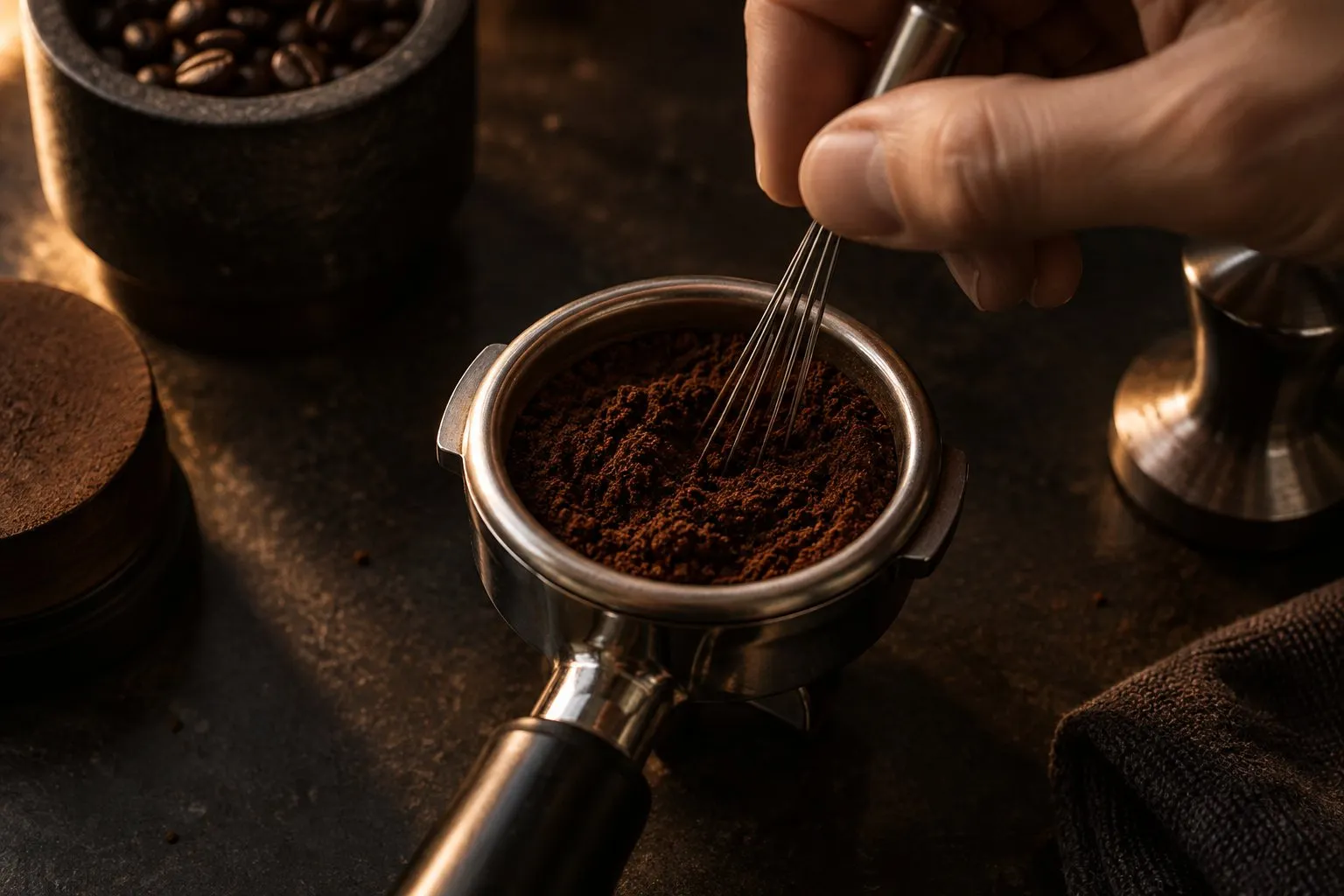 AccessoriesWhich espresso accessories are worth buying first: scale, tamper, pitcher, WDT tool and more, sorted by portafilter size, with what your machine already includes.
- Steam milkHow to steam milk at home: purge, stretch 5 to 10 seconds, spin, stop near 140 to 145 °F. Steps, the temperatures sources disagree on, and fixes for big bubbles.
 Flat white vs latteFlat white vs latte: less milk and a thin layer of microfoam against a larger, milkier drink. What sources agree on, where they differ, and how to steam for each.
- MicrofoamMicrofoam is steamed milk with bubbles too small to see. How it differs from froth, how hot to steam it, why you get big bubbles, and which wands can make it.
 Bambino PlusBreville Bambino Plus BES500: how the hands-free steam wand works, what the manual says about the jug, the specs from Breville, and who should skip it.
semiautomaticespressomachine.com Editorial Team
Espresso gear & shot craft
We are the editorial team at semiautomaticespressomachine.com. We read maker spec sheets, manuals, standards and published research on espresso and turn them into plain-English buying advice, with sources on every page. We do not run lab tests, and we say so openly.
- Spec sheets & standards read
- Sources on every page
- No lab tests – stated openly
- Publisher details in the imprint