Breville vs De'Longhi: Comparable Semi-Automatics in Each Price Class
For most people who weigh their shots we'd start with Breville, because it states the portafilter size and two roundups we read rate its machines. De'Longhi wins in specific spots: a budget machine Breville doesn't match in our list, a pressure gauge on the Classic Signature and a body just 8.15 inches wide with automatic milk. Match the models step by step, since neither brand is better across the board.
Disclosure: This page contains affiliate links (marked with *). If you buy through them, we earn a small commission at no extra cost to you. As an Amazon Associate I earn from qualifying purchases. Learn more
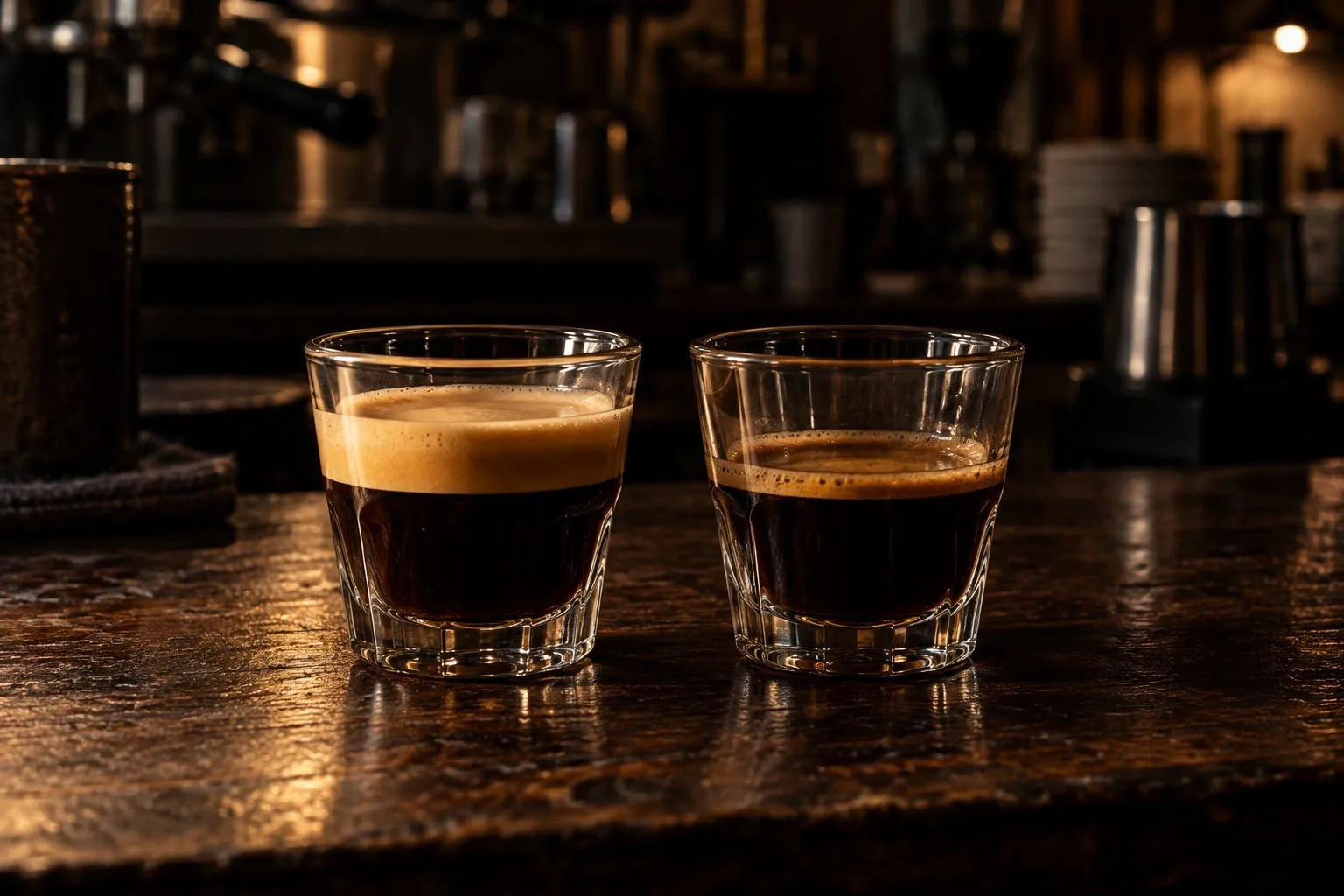
Breville is the easier pick if you want documented sizes and independent coverage: it states 54 mm on the Barista Express and Bambino, and America's Test Kitchen rates the Express and Bambino Plus highly. De'Longhi suits you if you want a budget Stilosa, a gauge and auto-stop presets on the Classic Signature, or a body about 8 inches wide with automatic milk.
On this page
Brand comparisons tend to end in a shrug, so here's a more useful version. Line the machines up by what they do, then see who tells you more. Breville usually states more. De'Longhi sometimes gives you a feature Breville leaves out at that step. Our Breville overview and our De'Longhi overview cover each range on its own, and this page deals only with the matchups.
The range, matched up
| Your step | Breville | De'Longhi | Who has the edge |
|---|---|---|---|
| Budget | Nothing in our list | Stilosa | De'Longhi, by default |
| Separate grinder, mid-range | Bambino | Classic Signature | Breville for documented size, De'Longhi for the gauge |
| Automatic milk | Bambino Plus | Dedica Maestro Plus | Breville for independent coverage, De'Longhi for a stated narrow body |
| Built-in grinder | Barista Express | La Specialista Arte Evo | Breville for documented size and coverage |
Values below come from each maker's own pages, unless we say otherwise. Price classes are our own wording.
Built-in grinder: Barista Express vs La Specialista Arte Evo
| Barista Express | La Specialista Arte Evo | |
|---|---|---|
| Grind settings | 16 | 15 |
| Heating | Thermocoil with PID, 200°F | Thermoblock, 3 temperature profiles; PID not mentioned on the page |
| Pressure, as stated | 15 bar pump, 9 bar extraction | 15 bar pump |
| Portafilter | 54 mm | Not stated |
| Tamping | Integrated tamper | Dosing and tamping guide, metal tamper |
| Milk | Manual wand | Manual wand |
| Extras | Dose trimming tool | Cold brew function |
| Warranty | Linked, length not on the page | 2 years, plus 1 with registration |
| Price class | Mid-range | Mid-range |
We read the Arte Evo's values on De'Longhi's Canadian page, so check them against the listing you buy.
Same limit on both sides
Sixteen settings or fifteen, neither grinder can be replaced on its own later. At full price the separate pair is cheaper; on sale they cost the same. Check both on the day. That sentence is about Breville's Express, Bambino and Smart Grinder Pro, and it's a good reason to price the separate route before you settle on either brand.
If you weigh your shots, the missing portafilter size matters more than it looks. It decides which tamper, funnel and bottomless portafilter you shop for. The La Specialista Arte Evo* makes you measure first. The Express tells you. America's Test Kitchen also names the Express best overall, and its roundup of July 2, 2025 doesn't cover De'Longhi at all.
The Arte Evo's real draw is the cold brew function, which De'Longhi says takes under 5 minutes with room temperature water. If you drink iced coffee all summer, that's a fair reason to go this way.
Breville Barista Express
Machine and conical burr grinder in one body, with PID and a 54 mm portafilter.
Why here: Our pick at this step: Breville states the portafilter size, PID and 9 bar extraction, and America's Test Kitchen rates it best overall.
Best for: First-time buyers who want one box and no separate grinder to choose
- Integrated conical burr grinder with 16 settings (Breville)
- Thermocoil heating with PID temperature control (Breville)
- Named best overall in America's Test Kitchen's roundup of 2 July 2025
- A better grinder later means buying a separate one
- One thermocoil, not two boilers
- The price swings widely between sale days, so check it on the day
- Heating
- Thermocoil
- Pump, as stated
- 15 bar
- Brew pressure, as stated
- 9 bar
- Portafilter
- 54 mm
- PID
- Yes
- Built-in grinder
- Yes, 16 settings
- Milk
- Manual wand
- Price class
- Mid-range
Separate grinder: Bambino vs Classic Signature
This is the closest contest, and it comes down to what you want to look at while the shot runs.
The Breville Bambino* is ready to start in 3 seconds, per Breville, with a 54 mm portafilter built for an 18 g dose. It's the better base for a grinder-and-scale routine, because you can buy tools for it without measuring anything. Breville's product page doesn't mention PID, though its US instruction book names “PID Temperature Control”.
The De'Longhi Classic Signature* puts a pressure gauge on the front and states “consistent 9-bar extraction”, along with single and double presets that stop by themselves. For someone learning to read a shot, the gauge is a real extra. The weak spot is the combined measuring scoop and tamper, and there's no stated portafilter size to shop by.
| Our pick: with a separate grinderBreville Bambino | De'Longhi Classic Signature | |
|---|---|---|
| Heating | ThermoJet | Thermoblock |
| Pump, as stated | 15 bar | 15 bar |
| Brew pressure, as stated | 9 bar | 9 bar |
| Portafilter | 54 mm | – |
| PID | Yes, per the instruction book | – |
| Built-in grinder | No | No |
| Milk | Manual wand | 2-setting steam wand |
| Price class | Mid-range | Mid-range |
| Best for | Beginners who want to pick their grinder and upgrade it later | Buyers who want a pressure gauge in front of them and stop-by-itself presets |
| On Amazon(paid link to Amazon, opens in a new tab)Ad · paid link · check price & delivery on Amazon | On Amazon(paid link to Amazon, opens in a new tab)Ad · paid link · check price & delivery on Amazon |
Automatic milk: Bambino Plus vs Dedica Maestro Plus
Both give you 3 milk temperatures and 3 textures, per their makers, and both state 9 bar extraction. The Bambino Plus* has the independent backing: America's Test Kitchen names it best compact model, and Serious Eats, in a copy dated May 2, 2023, calls it its best small machine. It also states a 54 mm portafilter.
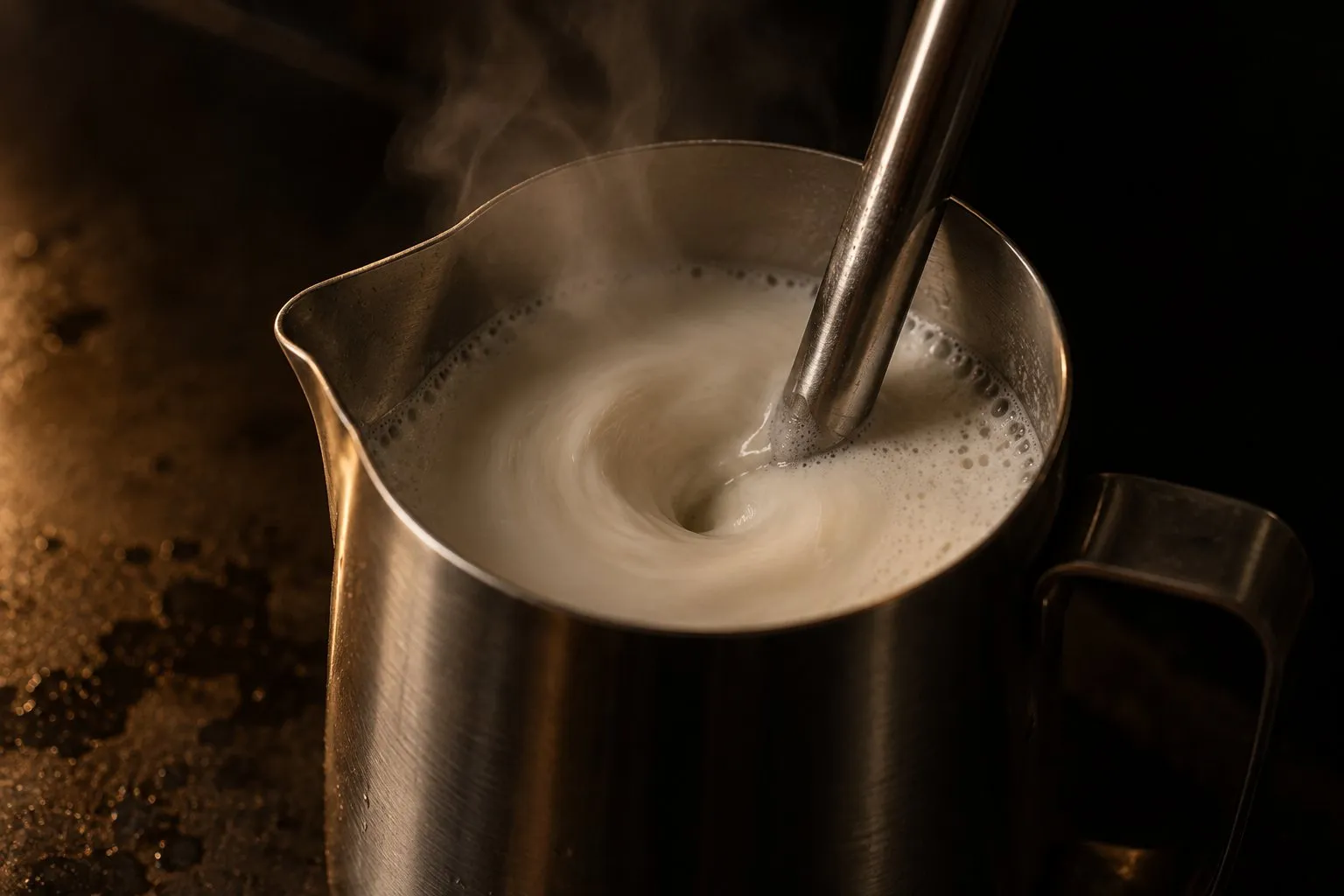
Who textures the milk: you, or the wand.
The Dedica Maestro Plus* answers a different problem. De'Longhi gives it a body just 8.15 inches wide. Be careful with the Bambino Plus on this point: Breville lists it at 11.9 x 7.4 x 14.3 in, labeled W x D x H, while Serious Eats gives 8 x 13 x 12 in. With figures that far apart, check the box or the store before you decide on width alone.
The budget step
Breville has nothing at this step in our list, so the De'Longhi Stilosa* stands alone here. De'Longhi lists a 15 bar pump, a stainless steel boiler and a manual frother. The 15 or 20 bar on the box is what the pump can reach. Espresso is brewed at about 9 bar. Our Stilosa page goes through what it leaves out, and budget espresso machines sets it against rivals from other brands.
What the two makers have in common
Both quote 15 bar pumps. De'Longhi files its range under “manual”, a word that confuses shoppers. Semi-automatic vs automatic sorts out the vocabulary. And the heating names differ more than the job does: thermoblocks and thermocoils both heat water on demand.
Take Breville if, take De'Longhi if
If you want one box with a grinder and a stated portafilter size → Breville Barista Express
View(paid link to Amazon, opens in a new tab)Ad · paid link · check price & delivery on AmazonIf you will pick your own grinder and buy tools to fit → Breville Bambino
View(paid link to Amazon, opens in a new tab)Ad · paid link · check price & delivery on AmazonIf you want a pressure gauge in front of you → De'Longhi Classic Signature
View(paid link to Amazon, opens in a new tab)Ad · paid link · check price & delivery on AmazonIf you want automatic milk and independent coverage → Breville Bambino Plus
View(paid link to Amazon, opens in a new tab)Ad · paid link · check price & delivery on AmazonIf your counter space is close to 8 inches wide → De'Longhi Dedica Maestro Plus
View(paid link to Amazon, opens in a new tab)Ad · paid link · check price & delivery on AmazonIf you want cold brew from the same machine → La Specialista Arte Evo
View(paid link to Amazon, opens in a new tab)Ad · paid link · check price & delivery on AmazonIf you want to see other brands too
Both makers also build in steps we skip here. Our built-in grinder comparison has the wider field, and the start page sorts every machine by what you drink. We compare spec sheets and published sources, and we run no tests. How we compare has the details.
Looking beyond these two makers? KitchenAid has its own page, and other brands covers the rest.
Asked at the bar
Is Breville better than De'Longhi?
Not across the board. Breville states more of what a home user needs, such as the portafilter size, and America's Test Kitchen rates the Barista Express and Bambino Plus highly. De'Longhi offers a budget machine and a pressure gauge at the mid-range step. Its machines don't appear in the two roundups we read, America's Test Kitchen and Serious Eats, so we have no neutral verdict for them.
Which has the better built-in grinder, the Barista Express or La Specialista Arte Evo?
We can't say from the spec sheets. Breville lists 16 grind settings and De'Longhi lists 15, and neither page we read gives burr size. A count of settings doesn't describe grind quality. We found no neutral comparison of the two grinders, and we run no tests, so treat them as equal on paper.
Do Breville and De'Longhi machines both brew at 9 bar?
Both quote a 15 bar pump, which is what the pump can reach. Espresso is brewed at about 9 bar. Breville names 9 bar extraction on the machines here, and De'Longhi does on the Classic Signature and Dedica Maestro Plus. The Stilosa page and the Arte Evo page we read list only the 15 bar pump.
Can I use Breville accessories on a De'Longhi?
Don't assume so. Breville states 54 mm on these machines, while De'Longhi's product pages we read give no portafilter size. Measure your basket before you buy a tamper or funnel, and check that a portafilter is sold for your exact model, because each one locks into its own group.
Where this comes from
- Breville: BES870 Barista Express product page
- De'Longhi: La Specialista Arte Evo EC9250M product page (Canada)
- De'Longhi: Classic Signature EM450M product page
- De'Longhi: Dedica Maestro Plus EC950M product page
- America's Test Kitchen: espresso machines, July 2, 2025
- Serious Eats roundup, read through a Yahoo copy dated May 2, 2023
Next round
 BrevilleEvery Breville semi-automatic espresso machine we cover, from Bambino to Dual Boiler: how they differ, what Breville states and omits, and which one to pick.
 De'LonghiDe'Longhi's pump machines by spec sheet: Stilosa, Classic Signature, Dedica Maestro Plus and La Specialista. What the maker states, and what it leaves out.
- With grinderEspresso machines with a built-in grinder compared by spec sheet: Barista Express, Impress, Pro and Touch, plus Ninja, De'Longhi, KitchenAid, Gevi and CASABREWS.
 Mid-range machinesMid-range espresso machines compared by spec sheet: Breville Bambino, Gaggia Classic, De'Longhi Classic Signature and CASABREWS Ultra, plus the one-box route.
- De'Longhi StilosaDe'Longhi Stilosa EC260BK: a budget pump machine sold as “manual”. What De'Longhi states, what its page leaves out, who it suits, and what to look at instead.
- Thermoblock machinesThermoblock espresso machines heat on demand, so they start fast and stay small. Where steam falls short, which models use which heater, and our pick.
semiautomaticespressomachine.com Editorial Team
Espresso gear & shot craft
We are the editorial team at semiautomaticespressomachine.com. We read maker spec sheets, manuals, standards and published research on espresso and turn them into plain-English buying advice, with sources on every page. We do not run lab tests, and we say so openly.
- Spec sheets & standards read
- Sources on every page
- No lab tests – stated openly
- Publisher details in the imprint