Budget Semi-Automatic Espresso Machines: Where the Money Starts to Matter
A budget espresso machine can pull real espresso if it has a pump and you feed it from a grinder that goes fine. The money starts to matter in three places: the grinder, then specs you can check, then milk. If you can stretch one price class, we recommend the Breville Bambino. If you can't, start with a CASABREWS CM5418 or De'Longhi Stilosa.
Disclosure: This page contains affiliate links (marked with *). If you buy through them, we earn a small commission at no extra cost to you. As an Amazon Associate I earn from qualifying purchases. Learn more
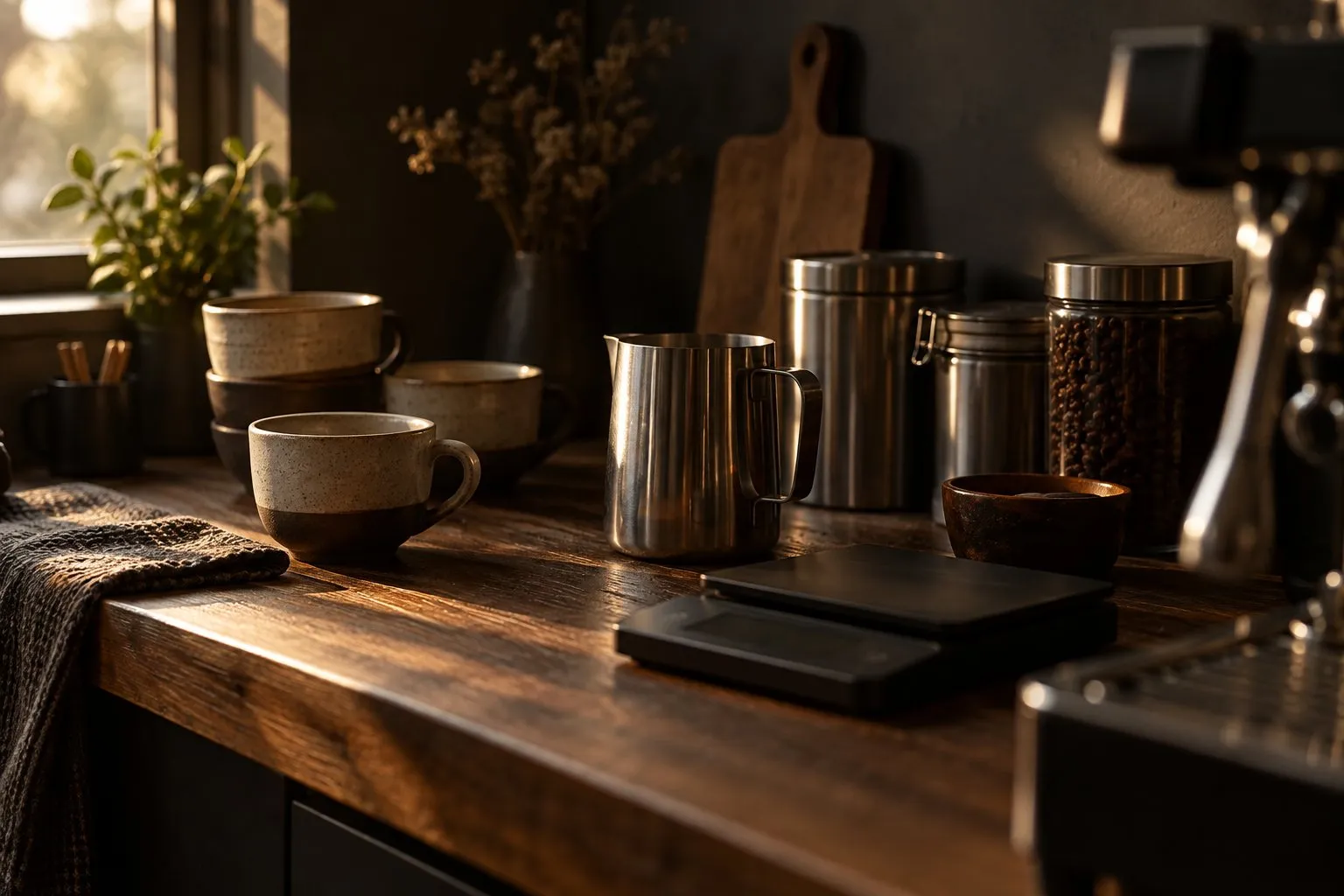
Set money aside for a fine-capable grinder first, then pick the machine. If you can reach the mid-range, take the Breville Bambino, whose maker documents its specs. If your budget is firm, the CASABREWS CM5418 or De'Longhi Stilosa gets you started, with listing data only. Skip steam-only machines, and ignore titles that sell you on 20 bar.
On this page
Cheap espresso machines aren't a scam, and they aren't a secret either. A low price gets you a pump, a heater and a portafilter. What it rarely gets you is a maker's spec sheet, and that makes this class harder to shop than it looks.
This page is about where to put a limited budget. For a model-by-model view of the low price class, see budget espresso machines compared. If you can go one class up, mid-range espresso machines is the next step.
Breville Bambino
A compact machine with a 54 mm portafilter, ready in 3 seconds. The grinder is yours to choose.
Why here: The point where the specs become checkable: Breville documents the 54 mm portafilter, 15 bar pump, 9 bar extraction and a start-up in 3 seconds. It sits a class above budget, and it's our pick if you can stretch.
Best for: Beginners who want to pick their grinder and upgrade it later
- Ready to start in 3 seconds (Breville)
- 54 mm portafilter, 18 g dose (Breville)
- Manual steam wand for hand-textured milk (Breville)
- Needs a separate espresso-capable grinder
- Breville's product page does not mention PID, though its BES450 instruction book does
- Heating
- ThermoJet
- Pump, as stated
- 15 bar
- Brew pressure, as stated
- 9 bar
- Portafilter
- 54 mm
- PID
- Yes, per the instruction book
- Built-in grinder
- No
- Milk
- Manual wand
- Price class
- Mid-range
Where the money starts to matter
| Spending step | What changes | What doesn't |
|---|---|---|
| A pump at all | You get espresso pressure and not a steam machine | Nothing else about the shot |
| A capable grinder | You can adjust the shot, the main thing you will ever do | Your machine stays the same |
| Maker's data | You can check portafilter size, heating and baskets | The cup, directly |
| One class up, such as a Bambino | A documented machine with a 3 second start, per Breville | You still need a grinder |
| A nicer wand or automatic milk | Easier milk drinks | Straight espresso |
The pump. Some of the cheapest listings on Amazon are steam machines at around 3.5 bar. Wikipedia notes that steam-driven machines produce less extraction pressure than pump-driven ones. If it doesn't say “pump,” look again. That's the one floor we would not go below.
The bar number. This is the spec that gets the most attention and deserves the least. The 15 or 20 bar on the box is what the pump can reach. Espresso is brewed at about 9 bar. A 20 bar title isn't an upgrade over a 15 bar one, as 15 bar vs 20 bar sets out.
Temperature. America's Test Kitchen left the cheapest machines out of its roundup of July 2, 2025 and says that low-cost models often don't heat water into the right range. It gives no figures for that, since it left them out, and we found none elsewhere. Treat it as a known risk of this class and not as a finding about any one machine.
Which one for which budget
If you can reach one class up and want checkable specs → Breville Bambino
View(paid link to Amazon, opens in a new tab)Ad · paid link · check price & delivery on AmazonIf your budget is firm and you want a compact machine with a steam wand → CASABREWS CM5418 · Seller data only
View(paid link to Amazon, opens in a new tab)Ad · paid link · check price & delivery on AmazonIf you want a brand you already know at the budget end → De'Longhi Stilosa
View(paid link to Amazon, opens in a new tab)Ad · paid link · check price & delivery on AmazonIf this has to be the smallest budget that still buys a pump machine → CASABREWS 3700 · Seller data only
View(paid link to Amazon, opens in a new tab)Ad · paid link · check price & delivery on AmazonIf you are not sure you will stick with espresso
The options compared
The three budget machines have Amazon listings only, so most of their rows stay empty. We leave them empty on purpose. Every one of these needs its manual read before you rely on it.
| Our pick: with a separate grinderBreville Bambino | Seller data onlyCASABREWS CM5418 | Budget first tryDe'Longhi Stilosa | Seller data onlyCASABREWS 3700 | |
|---|---|---|---|---|
| Type | – | – | Pump machine | – |
| Heating | ThermoJet | – | Stainless steel boiler | – |
| Pump, as stated | 15 bar | – | 15 bar | – |
| Brew pressure, as stated | 9 bar | – | – | – |
| Portafilter | 54 mm | – | – | – |
| PID | Yes, per the instruction book | – | – | – |
| Built-in grinder | No | No | No | No |
| Milk | Manual wand | Steam wand, per listing | Manual frother | Steam wand, per listing |
| Price class | Mid-range | Budget | Budget | Budget |
| Best for | Beginners who want to pick their grinder and upgrade it later | A first try at espresso on a tight budget | Budget first machines from a brand you already know | The smallest budget that still buys a pump machine |
| On Amazon(paid link to Amazon, opens in a new tab)Ad · paid link · check price & delivery on Amazon | On Amazon(paid link to Amazon, opens in a new tab)Ad · paid link · check price & delivery on Amazon | On Amazon(paid link to Amazon, opens in a new tab)Ad · paid link · check price & delivery on Amazon | On Amazon(paid link to Amazon, opens in a new tab)Ad · paid link · check price & delivery on Amazon |
Breville Bambino: the first checkable step
Breville lists a 54 mm portafilter, an 18 g dose, a ThermoJet heating system that is ready in 3 seconds, a 15 bar pump with 9 bar extraction, and low-pressure pre-infusion. The box includes single and dual wall baskets, a tamper and a milk jug, so a scale and a grinder are all that's missing. It's small, at 11.9 x 6.1 x 13.5 in, and the steam wand is manual.
The catch is that it's a mid-range machine by price class, and it has no grinder. Breville's page doesn't mention PID, and it's listed as “not stated” here for that reason. Our Breville Bambino page has the detail.
CASABREWS CM5418: the common first try
A compact machine with a steam wand*, per its title, and a sensible choice for a first try at espresso on a tight budget. We have only the listing, so check portafilter size and baskets before you order tools. Our CASABREWS page covers the line.
De'Longhi Stilosa: the known name
The Stilosa* is compact with a manual milk frother, per its title. The word “manual” is misleading: it's a pump machine. If a brand you recognize matters to you, this is the option to look at. Our De'Longhi page puts it next to the others in the brand.
CASABREWS 3700: the lowest step
The 3700* has stainless steel and a steam wand, per its title, and it's the lowest step in our list that still buys a pump machine. Bar numbers in this class are pump ratings, so don't choose on them.
A cheap machine can pull a good shot. A cheap grinder makes that harder.
Budget for the grinder first
Serious Eats says an espresso machine isn't much use without a great grinder, and it calls the Baratza Encore ESP* a solid pairing for a lower-cost machine. That's the reason this page keeps coming back to it. The grinder is what lets you fix a fast, sour shot, and you keep it when you replace the machine.
Where the savings actually come from
Hand grinders such as the TIMEMORE C3S* are the low-cost route, if you can live with grinding by hand for every shot. On the electric side, the SHARDOR conical* sits in the budget class per its listing, and the Smart Grinder Pro* is our pick one class up.
Thinking about a built-in grinder to save money? Check the math on the day. At full price the separate pair is cheaper; on sale they cost the same. Check both on the day. Built-in or separate goes through that comparison.
What “cheap dual boiler” means in a title
You will see listings such as the Chefman Crema Deluxe* and the Gevi “Dual Boiler”* using these words in a lower price class than the machines we can confirm. “Dual boiler” in titles of cheaper machines can mean two heating units. We haven't checked this per model, so we don't state it as fact in either direction.
A true dual boiler can brew and steam at the same time from two separate boilers. If that's what you are paying for, read the heating section of the manual first. And ask whether you need it at all: one morning latte doesn't need two boilers. Our dual boiler page has the confirmed ones.
Mistakes that cost more than they save
- Buying the machine with the whole budget. Then the grinder gets whatever is left, and it's the part you use to fix shots.
- Paying for a higher bar number. It describes the pump and not the shot.
- Buying tools before you know the basket size. Sizes don't swap, so read the manual or measure first.
- Judging the machine by a stale bag. Try fresher beans before you blame the hardware. It's the cheapest thing to check.
- Skipping the scale. It's a small purchase, and it's the tool that makes shots comparable.
Let four questions decide
If you are still torn between price classes, these questions end in one machine, with the reason next to it.
Our recommendation
Put the grinder first and the machine second. If you can reach it, buy the Bambino* and a Smart Grinder Pro. If you can't, a CASABREWS CM5418* or a Stilosa with a modest grinder will show you whether this hobby is for you. What to buy first lays out the whole order, and budget grinders covers the first purchase. We run no tests of our own. Everything else starts from our semi-automatic guide.
Asked at the bar
What is the cheapest espresso machine worth buying?
The lowest step we would look at is a pump machine with a steam wand, such as the CASABREWS 3700. Below that, some listings are steam machines at around 3.5 bar, which isn't espresso pressure. We only have Amazon listings for this class, so treat these as options. Check the manual for portafilter size and baskets before you buy.
Are budget espresso machines any good?
They can make real espresso, with limits. America's Test Kitchen left the cheapest machines out of its 2025 roundup and says low-cost models often miss the right water temperature range, though it gives no measurements for them. Maker data is scarce, too. A good grinder and a scale will do more for your shots than a nicer box.
Is a cheap dual boiler espresso machine a real dual boiler?
We don't know, and the listings don't settle it. “Dual boiler” in the titles of cheaper machines can mean two heating units, and we haven't checked this per model. A real dual boiler brews and steams at once from two separate boilers. Read the manual's description of the heating system before you pay for that claim.
Should I buy a cheaper machine or a better grinder?
If you must choose, the grinder. It decides how finely you can adjust the shot, and you keep it when you replace the machine. Serious Eats goes so far as to say a machine isn't much use without a great grinder. A machine in the budget class with a capable grinder gives you more to work with than the reverse.
Can I use pre-ground coffee to save on a grinder?
You can, if your machine includes dual wall baskets, which are meant for it, and it's a fair way to find out whether you like the routine. The Bambino includes them, per Breville, so check the manual on other machines. The limit is that you can't adjust the grind, so a shot that runs fast stays fast. Once you want to fix that, a grinder is the next purchase and not a better machine.
Where this comes from
Next round
 Budget machinesWhat budget espresso machines can do, what they can't, and how to read 15 and 20 bar listings. Options by price class in words, with what their manuals really say.
 Mid-range machinesMid-range espresso machines compared by spec sheet: Breville Bambino, Gaggia Classic, De'Longhi Classic Signature and CASABREWS Ultra, plus the one-box route.
- For beginnersThe beginner espresso machine to buy first, and in which order: machine, espresso-capable grinder, scale. Our pick is the Breville Bambino, with budget options.
 15 Bar vs 20 Bar: Is the Bigger Number Better?Is a 20 bar espresso machine better than 15 bar? No: the box shows what the pump can reach, and espresso is brewed at about 9 bar. What to compare instead.
- Espresso grindersWhat makes a grinder suitable for espresso: burrs, small steps and clean dosing. One clear pick, the alternatives sorted by routine, and honest notes on the data.
semiautomaticespressomachine.com Editorial Team
Espresso gear & shot craft
We are the editorial team at semiautomaticespressomachine.com. We read maker spec sheets, manuals, standards and published research on espresso and turn them into plain-English buying advice, with sources on every page. We do not run lab tests, and we say so openly.
- Spec sheets & standards read
- Sources on every page
- No lab tests – stated openly
- Publisher details in the imprint