How to Tamp Espresso: Level Beats Force, and Where the 30-Pound Rule Comes From
Press until the coffee stops compressing, and keep it level. Force above that adds nothing measurable in the one test we found. Tilt is the error to watch for, and consistency matters more than any number on a spring. Once your hand knows the motion, it takes a few seconds.
Disclosure: This page contains affiliate links (marked with *). If you buy through them, we earn a small commission at no extra cost to you. As an Amazon Associate I earn from qualifying purchases. Learn more
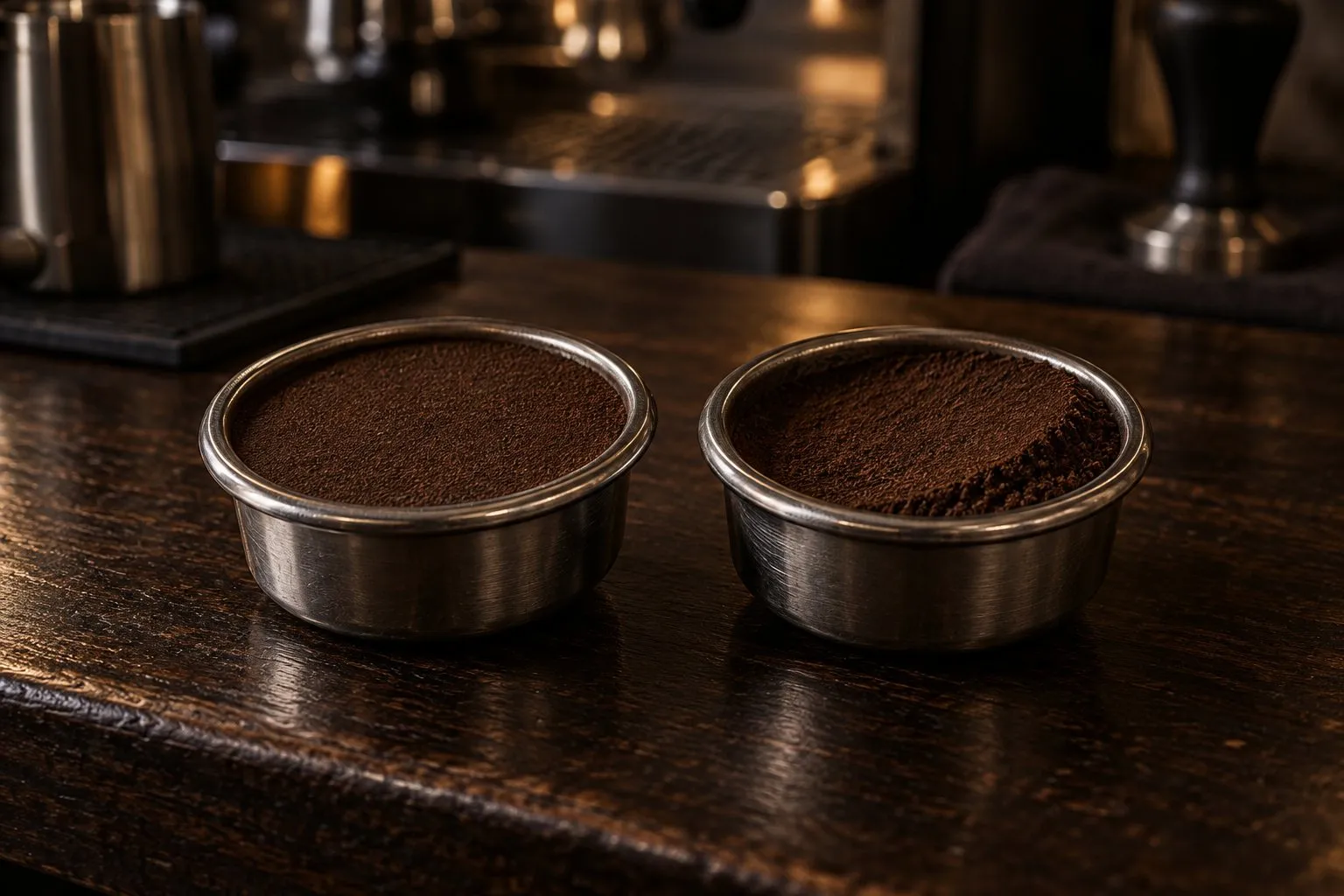
Settle the grounds, set the tamper flat on the bed, then press straight down with your wrist straight until the coffee stops giving. Press until the coffee stops compressing, and keep it level. Breville's manuals say 22 to 33 lb or 30 to 40 lb by model, which is a maker's guide and not a standard, and Breville adds that consistency matters more.
On this page
What you get: a flat, even bed that gives water no easy path, so a change in the cup comes from a change you meant to make. What it takes: a tamper that fits your basket, and a few seconds per shot. If you still need one, our tamper page sorts them by size. If your problem is the whole routine, puck prep puts this step in order with the others.
Tamping has more folklore than almost any other step at the bar. Most of it is about force. The evidence we could find points somewhere less exciting: get it level, and do it the same way each time.
The steps
Settle the grounds
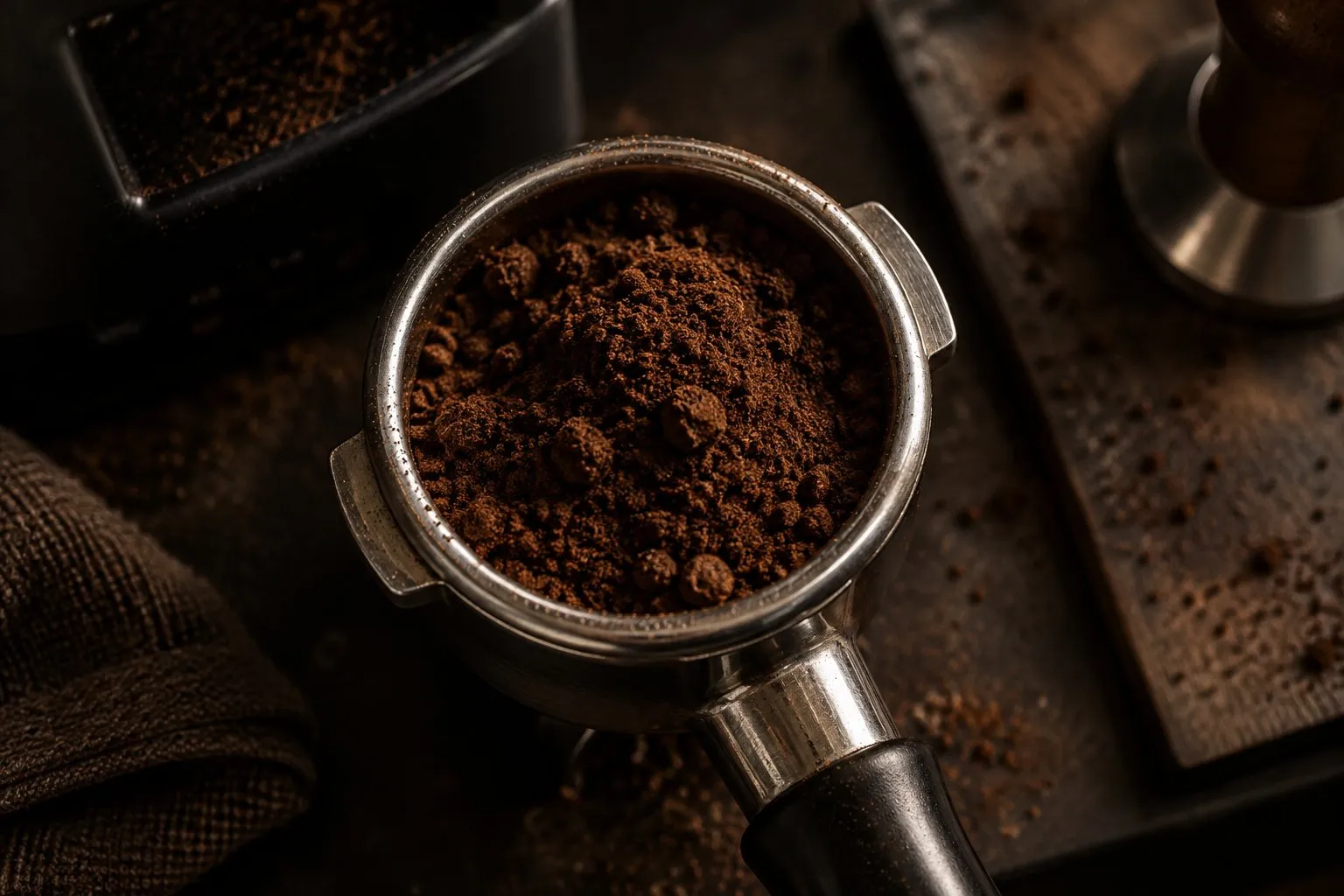
Tap the portafilter so the coffee collapses and spreads evenly, as Breville's manuals describe. Stir out any clumps first, because pressing doesn't fix them. See the WDT tool page.Rest the portafilter
Rest it against the corner of the bench, as Seven Miles suggests, rather than on the spouts, which can get damaged or pick up grit. A tamping stand does the same job.Take your grip
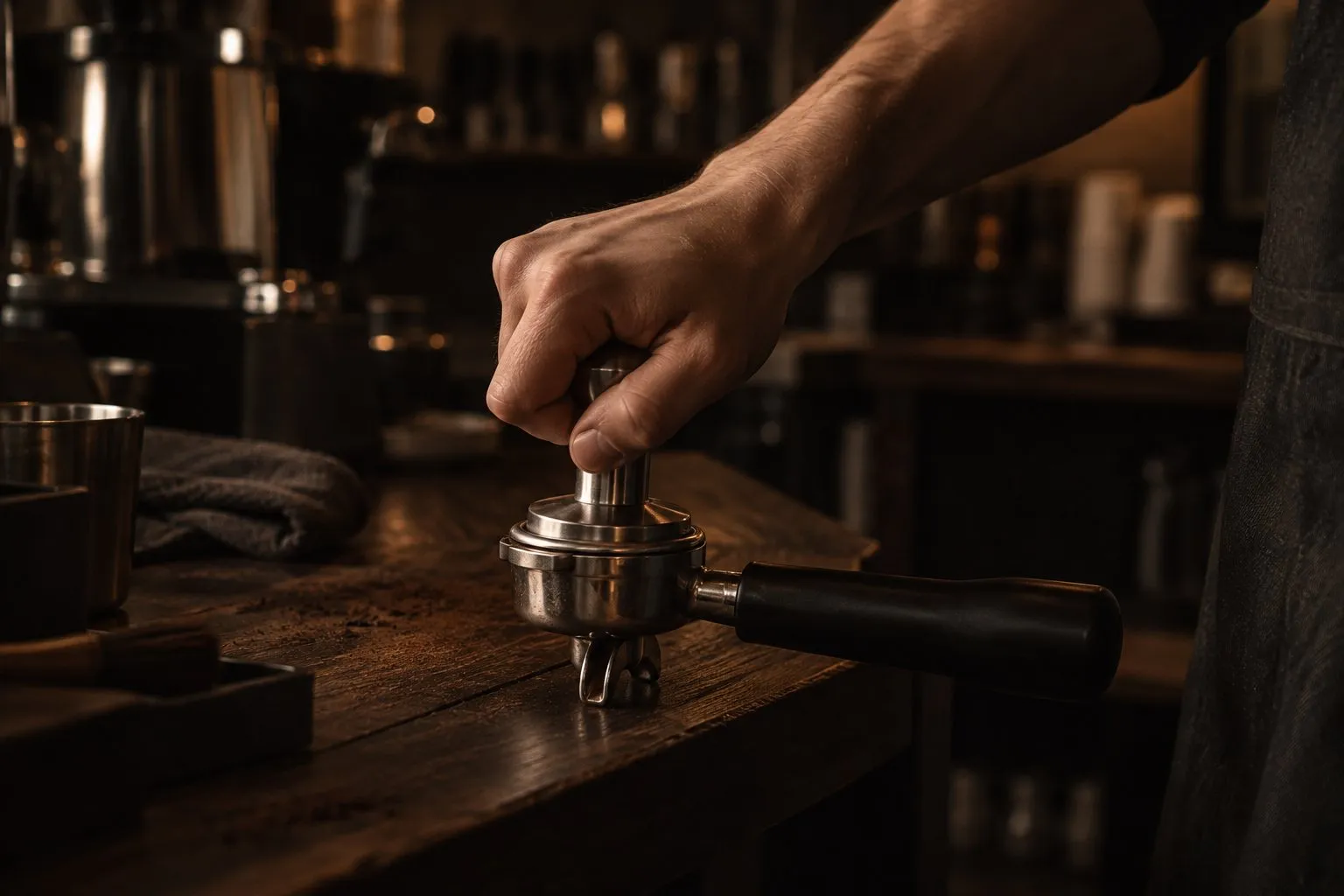
Wrap four fingers around the handle with your thumb on the base. Seven Miles compares it to holding a tennis racket. Stand side-on to the bench, with your wrist straight and your elbow up, so the press comes from your shoulder.Set it flat
Lower the tamper until the base sits flat on the coffee. Line it up with the basket before you press. If you find this hard to feel, rest your fingertips where the tamper meets the basket rim, and they will tell you if one side is sitting high.Press until it stops
Press straight down until the coffee stops compressing, and keep it level. Force above that adds nothing measurable in the one test we found. Then lift straight up.Check and lock in
On a Breville, the top edge of the tamper's metal cap should sit level with the top of the basket after tamping. That's a dose check, and the dose page explains what to change if it doesn't. Wipe the rim clean and lock in.
How hard, then?
Seven Miles, an Australian roaster, used an automatic Puqpress so that a person's hand couldn't skew the result. It reports “a total of 25 shots of espresso at 10, 20 & 30kg” across three blend styles, and concludes that “higher tamping pressure made no difference to the extraction”. Shot time didn't get longer at the top setting. It's one roaster's own test, so read it as a good signal and not as settled science. Its own advice is to use light pressure.
For the “30 pounds” we found no document from the Specialty Coffee Association. Here's what the makers we read actually print:
| Who | What they ask for | What they add |
|---|---|---|
| Breville, Bambino M26 and Bambino Plus 2020 manuals | Approx. 30 to 40 lbs (15 to 20 kg) | “The amount of pressure is not as important as the consistent pressure every time.” |
| Breville, Barista Express manual, edition F16 | Approx. 30 to 40 lbs (15 to 20 kg) | Same point on consistency |
| Breville, current US Barista Express X26, Dual Boiler X23 and Barista Pro Q26 manuals | Approx. 22 to 33 lbs (10 to 15 kg) | Same point on consistency |
| Breville, Force Gauge Tamper 54 mm | A spring range of 15.4 to 22 lb | A leveling plate to keep the press even |
So the figure comes from a manufacturer, not a norm, and Breville's own numbers differ between books. That's why we wouldn't lose any sleep over the exact number. Pick a firm press you can repeat. A shot that runs too fast calls for a finer grind, which is also Seven Miles's advice. Pressing harder isn't the fix.
Why level matters more
Level is where the same roaster did find a difference. People tamped at extreme tilts of 10° and 20°, against a level tamp, and the tilted shots had a “less consistent flow rate”, visible channeling in the spent puck and worse results in blind tastings. It was worse at 20° than at 10°. Water takes the easiest route, and a sloped bed offers one.
Common mistakes
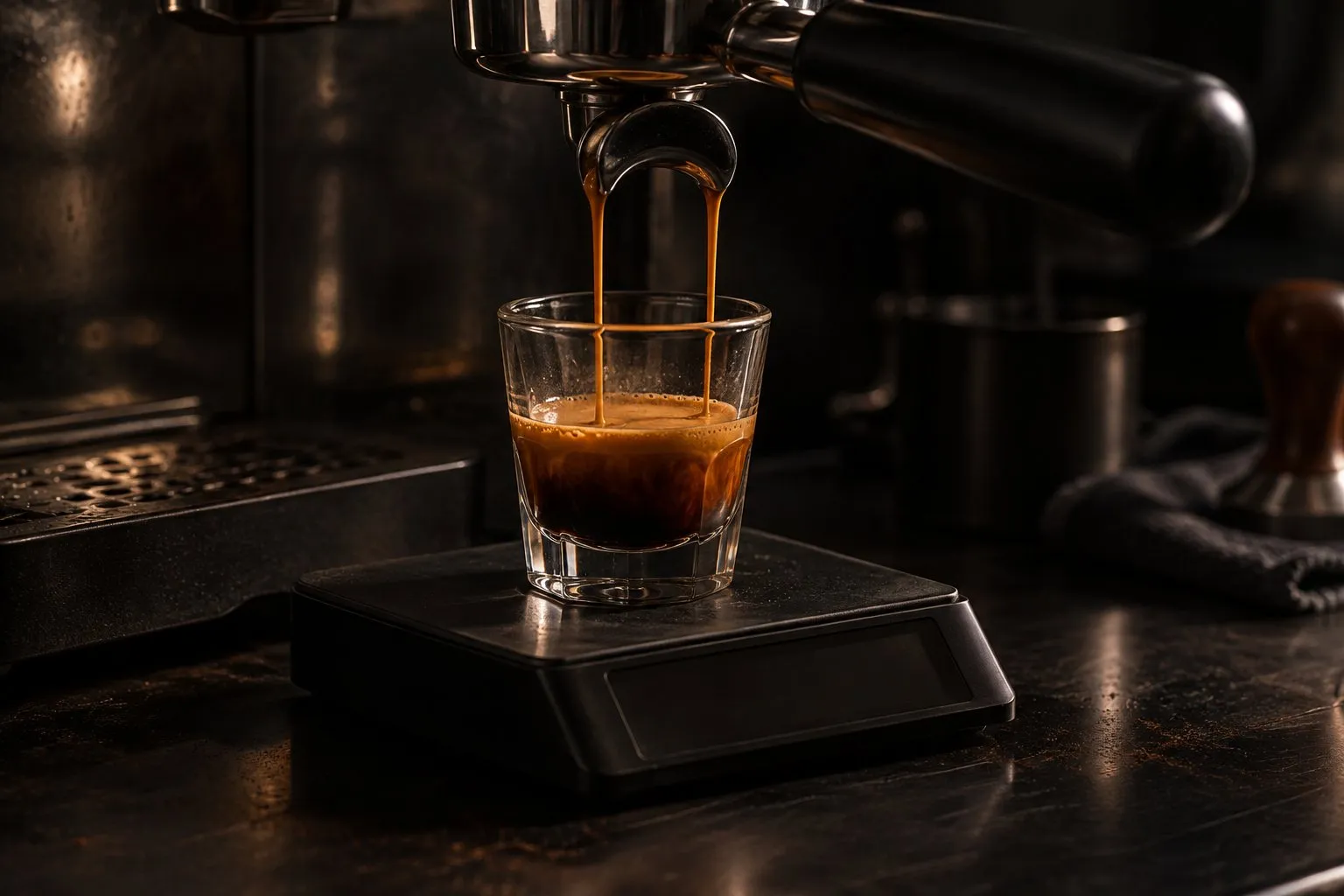
- Pressing harder to slow a fast shot. Change the grind, and keep the press the same.
- Knocking the handle after the tamp. Seven Miles warns it can damage equipment and open gaps that encourage channeling. Tap before the tamp, as Breville's books describe, and leave it alone after.
- A tamper that doesn't fit. A loose base leaves coffee at the wall, and Seven Miles notes that a closer fit helps. Measure your basket first, using our size chart.
- Twisting because someone told you to. It's optional polish. Seven Miles doesn't treat it as essential.
- Changing two things at once. Change the tamp and the grind together, and you won't know which one helped.
Do you need a calibrated tamper?
Only if your presses vary, or tilt keeps getting in the way. A spring gives you the same stopping point, and a plate that rests on the rim deals with tilt. The Normcore V4* and the IKAPE 53.3 mm* are both listed for 54 mm Breville baskets. Neither is a pick: these cards carry seller data, and we don't test tampers. The tamper guide covers both, along with 58 mm options, and the start page begins with the machine.
Asked at the bar
How hard should I tamp espresso?
Press until the coffee stops compressing, and keep it level. Force above that adds nothing measurable in the one test we found. Seven Miles, an Australian roaster, used an automatic tamper at 10, 20 and 30 kg and reported no difference in extraction. So use a firm press you can repeat, and change the grind if the shot runs too fast.
Do I really need 30 pounds of pressure?
Not as far as we can find. We found no Specialty Coffee Association document for the figure. Breville's Bambino manual says approximately 30 to 40 lb and its current Barista Express manual 22 to 33 lb, so the number comes from a maker and not a norm. Both add that the amount of pressure is not as important as consistent pressure every time.
Should I twist the tamper?
It's optional. Seven Miles describes the twist as a way some baristas polish the bed, and doesn't treat it as essential. If you do it, lift off gently after the press, because the point of the routine is a flat, undisturbed surface.
Should I tap the portafilter after tamping?
Tap before you tamp, not after. Breville's manuals have you tap the portafilter so the coffee settles before the press. Seven Miles warns against knocking the handle after the tamp to loosen coffee from the basket wall, because it can damage equipment and open gaps that encourage channeling.
Where this comes from
- Seven Miles Coffee Roasters: tamping test and technique
- Breville: Bambino instruction book BES450_USCM_IB_M26 (US, Canada, Mexico)
- Breville: Bambino Plus instruction book BES500_USCM_IB_2020 (US, Canada, Mexico)
- Breville: Barista Pro instruction book BES878_USCM_IB_Q26 (US, Canada, Mexico)
- Breville: Barista Express BES870XL instruction book, edition F16 (copy hosted by Williams-Sonoma)
- Breville: Barista Express BES870 instruction book, current US edition
- Breville: BES920 Dual Boiler instruction book (US, Canada, Mexico)
- Breville: Force Gauge Tamper 54 mm
Next round
- TampersWhich espresso tamper fits your machine: 51, 53.3, 54 and 58 mm by model, what calibrated and spring-loaded tampers really do, and where the 30 lb figure comes from.
- Puck prepEspresso puck prep in six steps: dry, weigh, stir, settle, tamp level, lock in. What channeling is, which tools have evidence, and what a wet puck means.
- Dial in espressoHow to dial in espresso: fix the dose, set a yield, then change only the grind until time and taste line up. Steps, a symptom table and the exception to the rule.
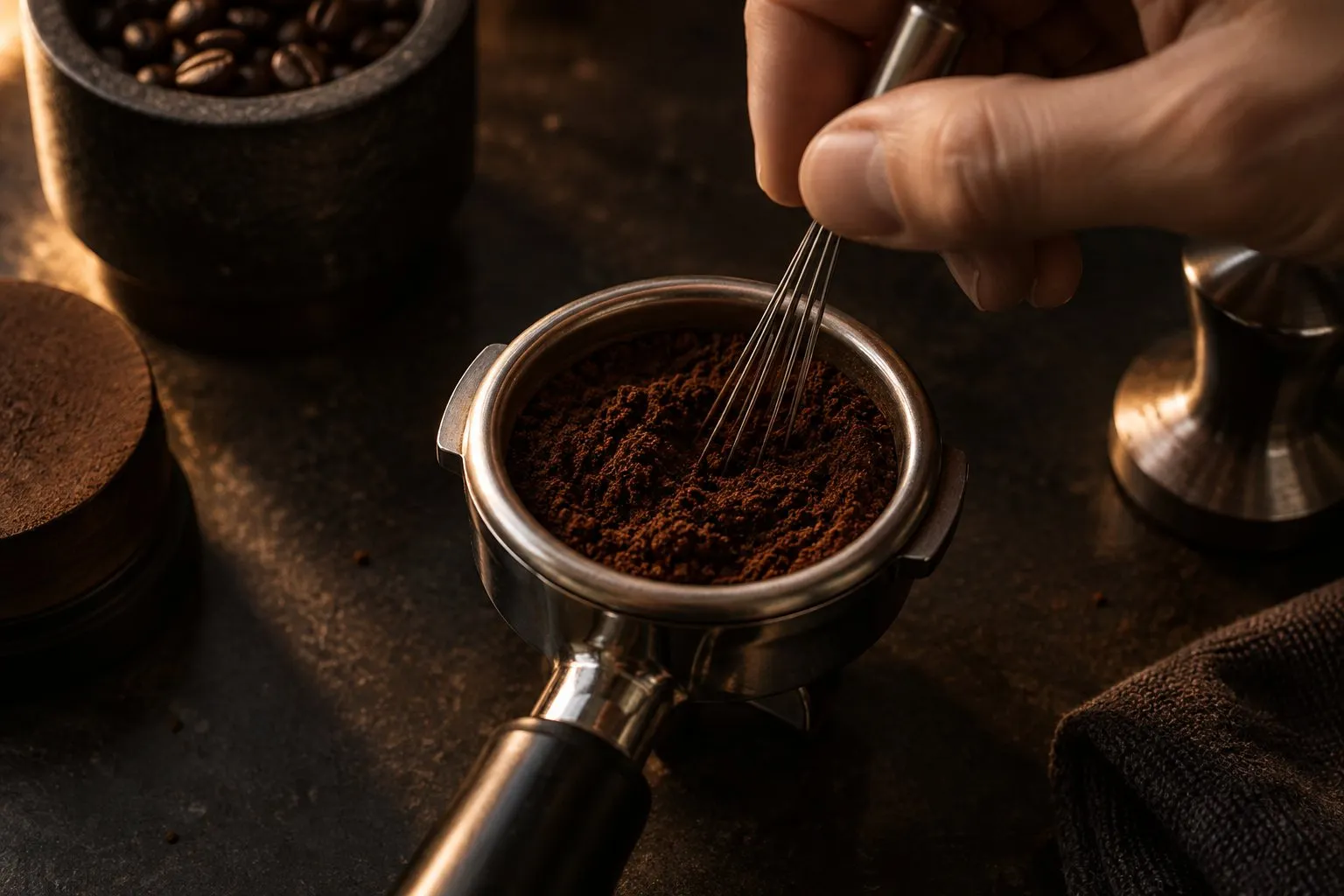 WDT toolA WDT tool stirs clumps out of your grounds before you tamp. What it does, what thin needles get you, how it differs from a distributor, and which to buy.
- Espresso doseHow many grams of coffee for espresso: dose by basket. Breville's 8 to 11 g and 16 to 19 g baskets, its 18 to 22 g start, and why Italy's standard says 7 g.
semiautomaticespressomachine.com Editorial Team
Espresso gear & shot craft
We are the editorial team at semiautomaticespressomachine.com. We read maker spec sheets, manuals, standards and published research on espresso and turn them into plain-English buying advice, with sources on every page. We do not run lab tests, and we say so openly.
- Spec sheets & standards read
- Sources on every page
- No lab tests – stated openly
- Publisher details in the imprint