Espresso Machine Cleaning Tablets and Backflush Powder: Follow Your Manual
Buy the cleaner your manual names. Breville's Barista Express, Impress and Bambino Plus manuals use a cleaning tablet on a supplied disc. Urnex's Cafiza is a powder that goes in a blind filter. The Bambino manual we read has no tablet step at all, so check before you order.
Disclosure: This page contains affiliate links (marked with *). If you buy through them, we earn a small commission at no extra cost to you. As an Amazon Associate I earn from qualifying purchases. Learn more
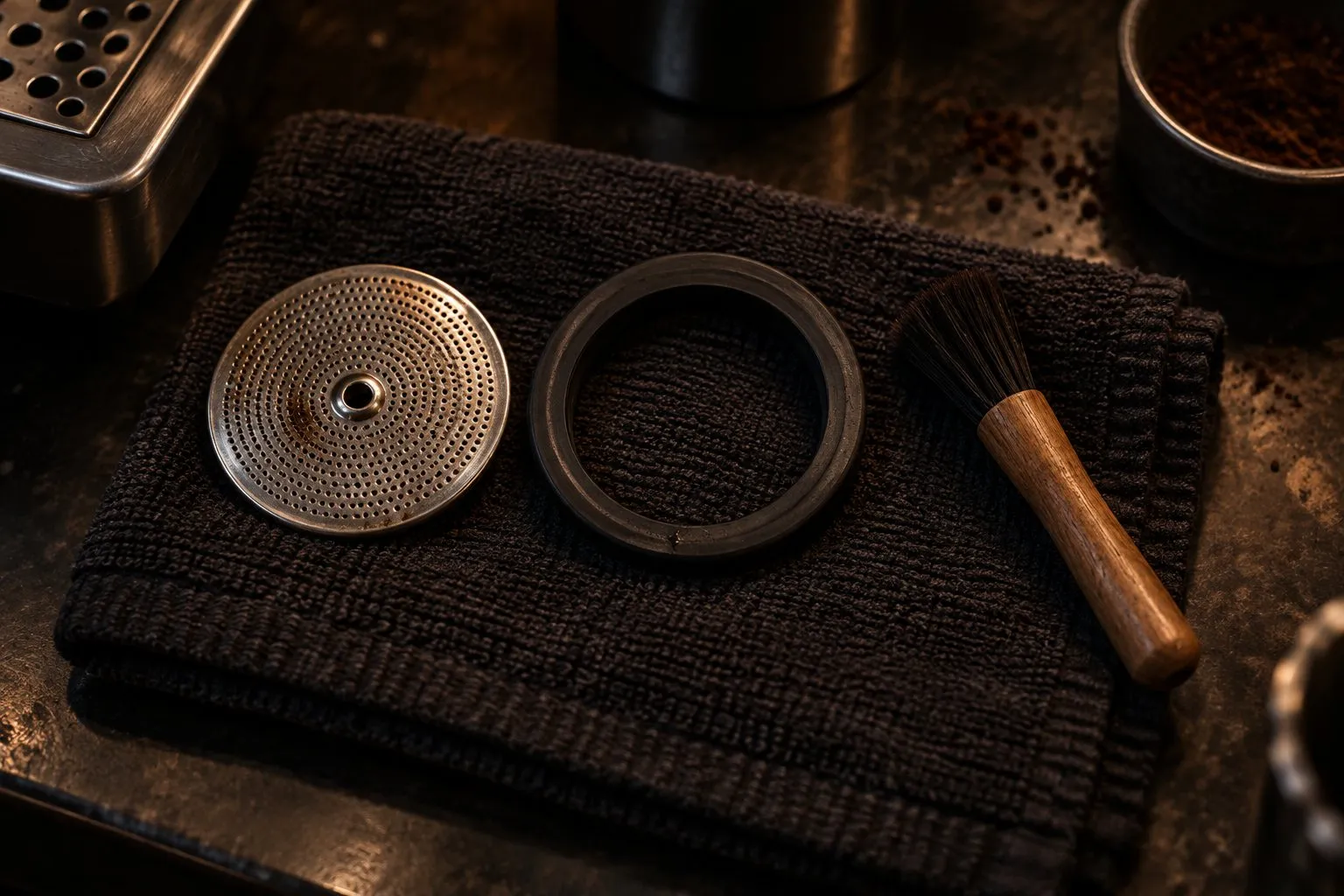
Cleaning tablets and backflush powder clear coffee oils from the group, and they aren't descalers. Use what your manual specifies: Breville's manuals for the Barista Express, Impress and Bambino Plus call for a tablet on the supplied disc. Urnex directs Cafiza users to a blind filter. If your manual names neither, ask the maker before you backflush.
On this page
Cleaning products are where generic advice does the most harm, because machines differ more than the labels suggest. So this page starts from what each maker's manual says, and only then gets to what to buy. For the wider routine, see how to clean an espresso machine.
We compare by manuals and maker pages, and we run no cleaning trials of our own.
Breville BEC250 tablets
Breville's own cleaning tablets, for machines whose manual puts a tablet on the cleaning disc.
Why here: The Barista Express, Impress and Bambino Plus manuals all call for a cleaning tablet on the supplied disc. This BEC250 pack holds 8, per the listing.
Best for: Breville machines whose manual has a tablet step
- The Barista Express, Impress and Bambino Plus manuals call for a cleaning tablet in the cleaning cycle
- 8 tablets, per retailer
- The Bambino manual we read has no tablet step
- Other makers name their own products, so check your manual
- Type
- Cleaning tablets
- Fits
- Breville machines with a tablet step in the manual
- Price class
- Budget
Which cleaner for which machine
If your Breville manual has a tablet step → Breville BEC250 tablets
View(paid link to Amazon, opens in a new tab)Ad · paid link · check price & delivery on AmazonIf your manual describes a blind-filter backflush with powder → Urnex Cafiza powder
View(paid link to Amazon, opens in a new tab)Ad · paid link · check price & delivery on AmazonIf you own a 58 mm machine whose manual calls for a blind filter → Espresso Supply 58 mm insert · Seller data only
View(paid link to Amazon, opens in a new tab)Ad · paid link · check price & delivery on AmazonIf you own a Bambino
What each manual asks for
| Machine | Cleaning step in the manual | Signal | Product named |
|---|---|---|---|
| Barista Express | Back-flushing cycle, about 5 minutes: 1 CUP basket, then disc, then 1 tablet | CLEAN / DESCALE light flashes | Cleaning tablet, supplied disc |
| Barista Express Impress | Back-flushing cycle, about 5 minutes: 1 CUP basket, disc, 1 tablet | CLEAN / DESCALE light flashes | Cleaning tablet, supplied disc |
| Bambino Plus | Flushing cycle with a tablet on the disc | 1 CUP and 2 CUP flash in turn after 200 extractions | Cleaning tablet, supplied disc |
| Bambino | One combined clean and descale cycle, no tablet step in the manual we read | 2 Cup button keeps flashing | Descaling agent |
| Ninja Luxe Café, ES601ANZ guide | Clean cycle, about 6 minutes: double basket, disc, 1 tablet | CLEAN light | Ninja tablet and disc |
| Gaggia Classic Evo | No backflush in the manual we read; filters washed daily, Gaggia tablets for a deeper clean of the filters | None described for cleaning | Gaggia cleaning tablets |
Two things stand out. Even within one brand the routine differs: the Bambino manual we read never mentions a tablet, so don't assume a Breville tablet belongs in every Breville. And the Gaggia manual doesn't describe a backflush, so we wouldn't start one on a Gaggia just because a powder's label makes it sound routine.
Clean by the machine's own signal, with the product its manual names.
The options side by side
Three products from our plan, for three different setups. They aren't interchangeable, so read this as sorting, not as a ranking.
| Breville BEC250 tablets | Urnex Cafiza powder | Seller data onlyEspresso Supply 58 mm insert | |
|---|---|---|---|
| Type | Cleaning tablets | Backflush powder | Backflush insert |
| Fits | Breville machines with a tablet step in the manual | Not stated by model | 58 mm, per listing |
| Price class | Budget | Budget | – |
| Best for | Breville machines whose manual has a tablet step | Machines whose manual includes a blind-filter backflush | 58 mm machines whose manual calls for a blind filter |
| On Amazon(paid link to Amazon, opens in a new tab)Ad · paid link · check price & delivery on Amazon | On Amazon(paid link to Amazon, opens in a new tab)Ad · paid link · check price & delivery on Amazon | On Amazon(paid link to Amazon, opens in a new tab)Ad · paid link · check price & delivery on Amazon |
The products one by one
Breville BEC250 tablets
The Breville BEC250 pack* holds 8 tablets, per the listing title. On the Barista Express, the steps are short: 1 CUP basket in the portafilter, then the cleaning disc, then one tablet. Lock it in, fill the tank with cold water, empty the drip tray and start the cycle from the buttons. Afterward, check that the tablet has dissolved, and repeat the cycle if it hasn't.
Button combinations differ by model, even within Breville's range. The Express manual has you hold three buttons for about 10 seconds, and the Impress copy says 3 seconds. Use the book for your machine.
Urnex Cafiza powder
Urnex's page gives the clearest directions we found for a powder. Cafiza* goes in a blind filter, at up to 1/2 teaspoon (3 g) per backflush. Run the brew cycle 10 seconds on and 10 seconds off, five times. Then rinse and repeat without powder, and pull one shot through a normal basket to clear what's left. Don't drink that shot.
Urnex also describes a soak for parts: 6 g per liter of hot water, 30 minutes, with a portafilter's handle kept out of the solution. That's the part most home users could use regardless of their machine's backflush setup, provided the manual allows the part to be soaked. Urnex lists the product as NSF certified, and it names no machine models.
A 58 mm backflush insert
The Espresso Supply insert* is a metal insert listed at 58 mm, and we only have the listing. It's the piece Urnex's directions assume you own, if your machine has none. Check two things first: that your basket is 58 mm (for a Gaggia Classic that size comes from retailers, not from Gaggia), and that your manual describes a backflush.
What to check before you buy
- Your manual's cleaning section. It decides everything below. If you've lost it, makers usually keep a copy online.
- Tablet or powder. A tablet needs a disc or basket setup made for it. Powder needs a dosing step and a blind filter.
- What's in the box. Breville lists tablets and a disc with the Barista Express and Impress, so you may not need to reorder soon.
- Soak or backflush. They're different jobs. A soak cleans loose parts, and a backflush reaches the group.
Common mistakes
- Treating the clean light as a descale light. On the Express and Impress, flashing means clean and solid means descale. Our Breville descaling guide covers the second one, and the descaler page covers products.
- Backflushing because a video did. Follow your own manual, because some of them don't describe it.
- Skipping the rinse. Both the Breville and Urnex directions end with a rinse, and Urnex tells you to throw out the first shot.
- Buying a generic pack on a title alone. A listing that names two brands isn't the same as either maker's manual naming that product.
Our recommendation
If you own a Barista Express, Impress or Bambino Plus, reorder Breville's tablets* when the supplied ones run out, since that's what those manuals describe. If your manual calls for a blind-filter backflush with powder, Cafiza* has the documentation to match. Everyone else should read the manual first and buy second. The accessories page sets out the rest of the kit, the start page begins with what you drink, and how we compare explains what “Seller data only” means on the cards above.
Asked at the bar
Are cleaning tablets and descaler the same thing?
No. A cleaning cycle deals with coffee oils in the group, and descaling deals with minerals from your water. Breville's Barista Express manual says plainly that its back-flushing cycle is separate from descaling, and the machine's light signals the two differently: flashing for cleaning, solid for descaling. Buy and use them as two separate products.
Can I use Cafiza in a Breville espresso machine?
Breville's manuals we read name a cleaning tablet and the supplied disc, and we found no statement from Breville about Cafiza either way. Urnex's page names no machine models. So the safe route on a Breville is the tablet its manual describes. If you want to use powder anyway, ask Breville support first.
How often does an espresso machine need a cleaning cycle?
Follow the machine's own signal. The Barista Express flashes its CLEAN / DESCALE light, and the Bambino Plus flags it after 200 extractions. Urnex's Cafiza page gives no home schedule. If your machine has no signal, take the interval from its manual rather than from a general rule.
Do I need a blind filter for cleaning tablets?
Not on the Breville machines whose manuals we read. They use a supplied cleaning disc inside a normal filter basket. Urnex's directions for Cafiza do call for a blind filter. For any other machine, check whether the manual describes a backflush at all before you buy an insert.
Where this comes from
- Breville: Barista Express instruction book (copy hosted by Williams-Sonoma)
- Breville: Barista Express Impress instruction book BES876_USCM_IB_F26 (US, Canada, Mexico)
- Breville: Bambino Plus instruction book (US, Canada, Mexico)
- Breville: Bambino instruction book (US, Canada, Mexico)
- Urnex: Cafiza Powder
- Gaggia: Classic Evo operating instructions
Next round
- Clean your machineHow to clean a semi-automatic espresso machine: daily wipe-downs, the clean cycle or blind filter step, and where the Breville, Gaggia and Rancilio manuals differ.
 Descale a BrevilleHow to descale a Breville espresso machine, step by step from the manuals: Barista Express, Impress, Bambino and Bambino Plus, what the lights mean, and what to use.
- DescalersWhich espresso machine descaler to use: what the Breville, Gaggia and De'Longhi manuals specify, what citric and lactic formulas contain, and when a universal fits.
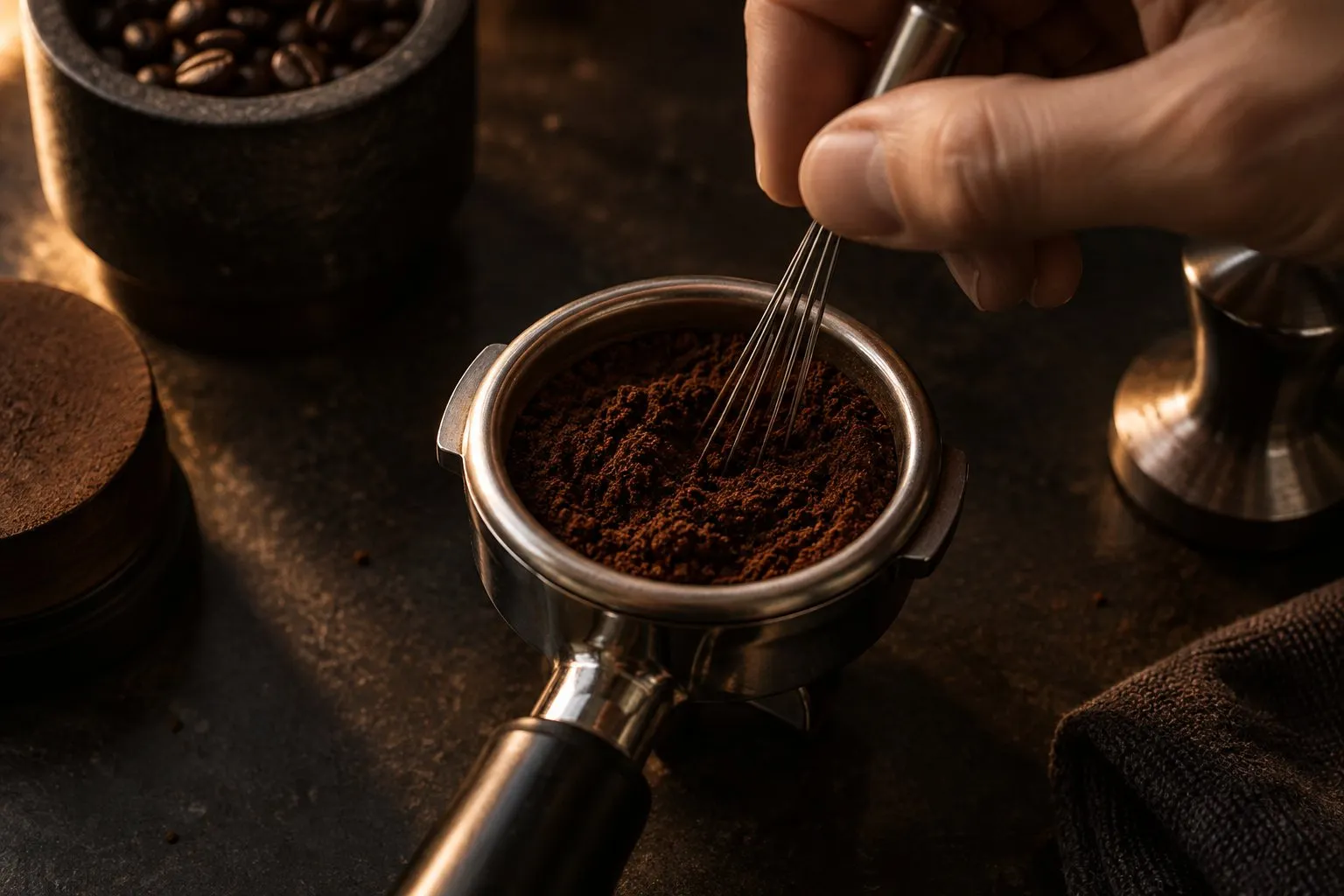 AccessoriesWhich espresso accessories are worth buying first: scale, tamper, pitcher, WDT tool and more, sorted by portafilter size, with what your machine already includes.
 Barista ExpressBreville Barista Express BES870XL: grinder, PID, 54 mm portafilter and care from Breville's own documents, and who should buy something else.
semiautomaticespressomachine.com Editorial Team
Espresso gear & shot craft
We are the editorial team at semiautomaticespressomachine.com. We read maker spec sheets, manuals, standards and published research on espresso and turn them into plain-English buying advice, with sources on every page. We do not run lab tests, and we say so openly.
- Spec sheets & standards read
- Sources on every page
- No lab tests – stated openly
- Publisher details in the imprint