Why 9 Bar? Espresso Brew Pressure, Pump Ratings and the Over-Pressure Valve
The 15 or 20 bar on the box is what the pump can reach. Espresso is brewed at about 9 bar. That figure comes from Italy's certified espresso specification, and one 2002 study found real differences between 7, 9 and 11 atm. It is a target for the brew, not a rating for a machine.
Disclosure: This page contains affiliate links (marked with *). If you buy through them, we earn a small commission at no extra cost to you. As an Amazon Associate I earn from qualifying purchases. Learn more
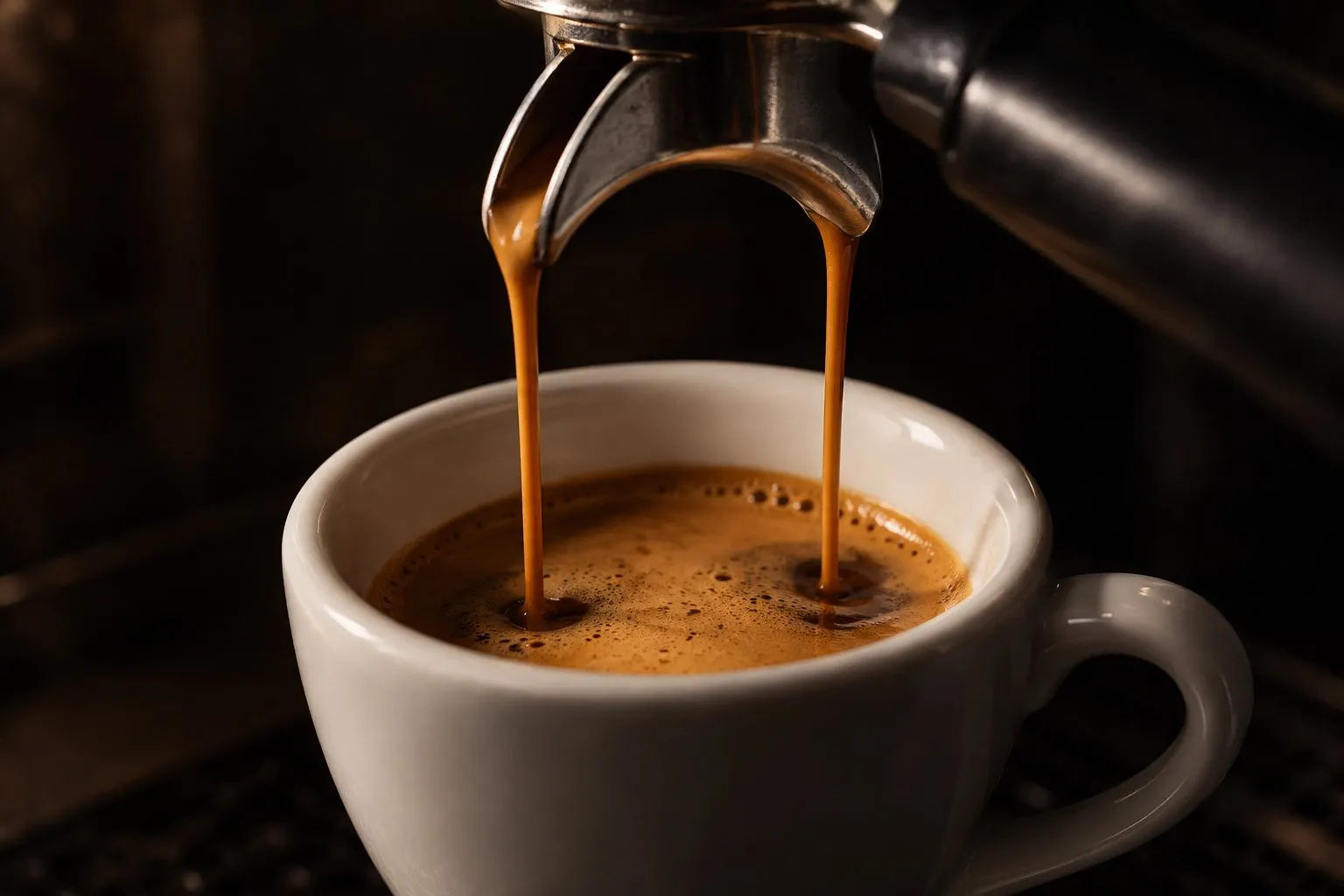
About 9 bar. Italy's INEI specifies 9 bar, plus or minus 1, at the entry for certified espresso, and Breville lists a 15 bar pump next to 9 bar extraction. So the pump rating is not the brew pressure. The puck resists the water, an over-pressure valve limits the top end where one is fitted, and a gauge shows you the result.
On this page
If you weigh your shots, you have probably stopped trusting the big number on the box. Our page on 15 bar vs 20 bar deals with that label. This one goes a level down: where 9 bar comes from, what sits between the pump and your puck, and what a gauge can and can't tell you.
Where 9 bar comes from
The most specific document we found is the certified recipe from the Istituto Nazionale Espresso Italiano (INEI). Its leaflet lists “entry water pressure” at 9 bar, plus or minus 1, next to the other numbers for a certified cup. It states the figure and gives no reason for it. We found no document that explains how the trade settled on 9.
- 9 bar ± 1
- Entry water pressure, certified espresso (INEI)
- 15 bar
- Pump on the Barista Express (Breville)
- 9 bar
- Extraction on the same machine (Breville)
There is some evidence behind it. Andueza and colleagues (Journal of Agricultural and Food Chemistry, 2002) prepared Arabica espresso at 7, 9 and 11 atm. In their analysis, the 11 atm coffees separated from the other two, and 7 and 9 atm separated from each other as well. The 9 atm coffees showed consistency of foam and a high share of key odorants linked to fresh, fruity, malty and buttery notes. We read only the abstract, it is one study of one type of coffee, and it reports atm, not bar. So it is a reason to take 9 seriously, not a proof that 9 is ideal for every bag you buy.
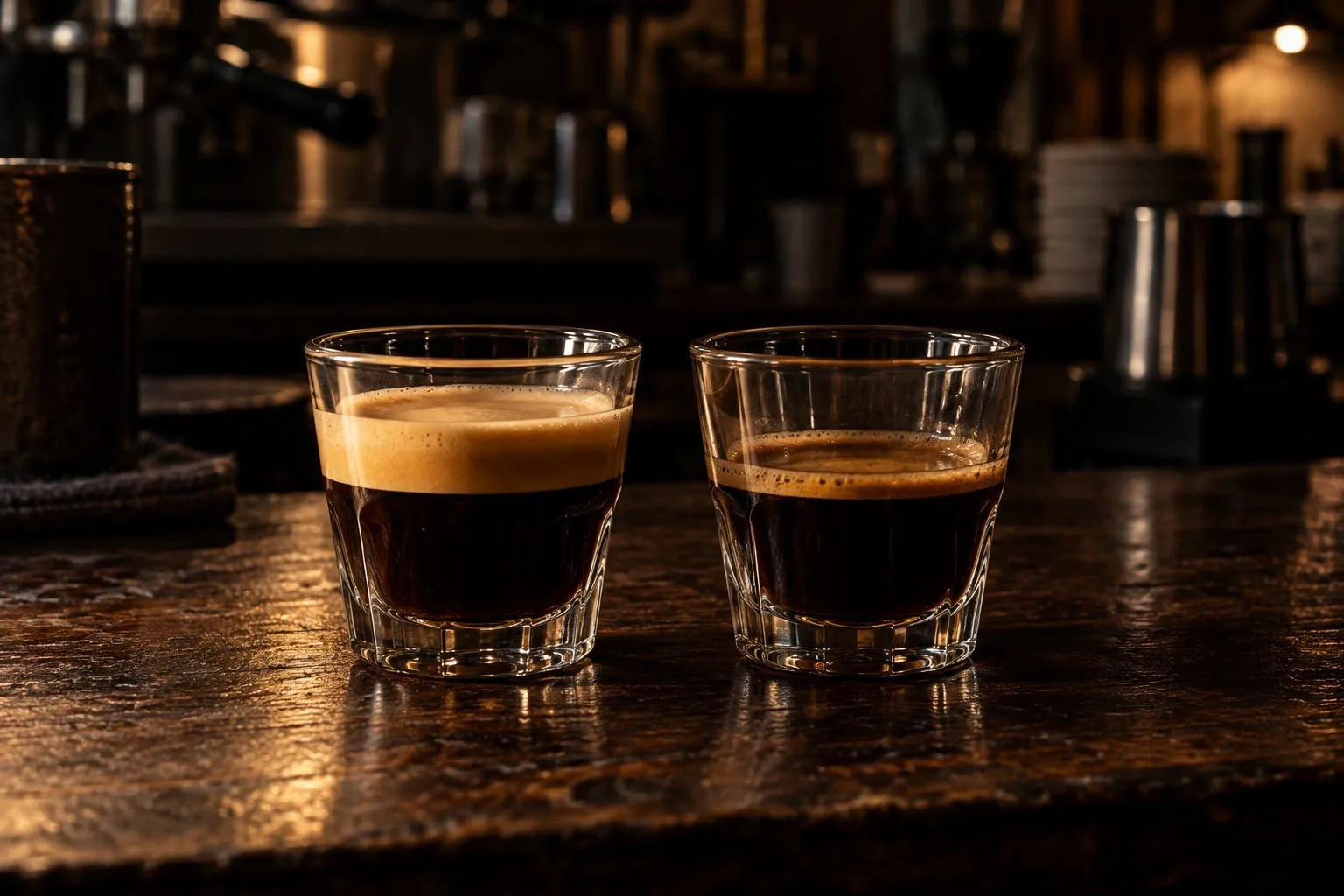
Crema shows CO2, so freshness and roast. It says little about flavor.
Foam came up in that study, so a word of caution. A nicer head on the shot doesn't settle anything by itself, and what crema actually tells you has its own page.
Pump, valve, puck: three different things
The pump rating is what the pump can reach. Breville lists a 15 bar Italian pump and a 9 bar extraction for the Barista Express on one page, which is the clearest illustration you will find. Listings with 20 bar on the box use the same kind of figure, and the ones we compare give no brew pressure beside it.
The over-pressure valve, or OPV, limits brew pressure. On a Gaggia Classic it is set to 9 bar, per retailers. Gaggia's own Classic Evo manual doesn't give a bar figure, so we can't confirm that number from the maker. If you are thinking of changing it, this is a job for a technician. The manual for the Rancilio Silvia says so outright about its pump pressure adjustment: a qualified technician only.
The puck is what makes pressure happen at all. Water can't build pressure against nothing. How fine you grind, how much you dose and how you prepare the bed all decide how much it resists.
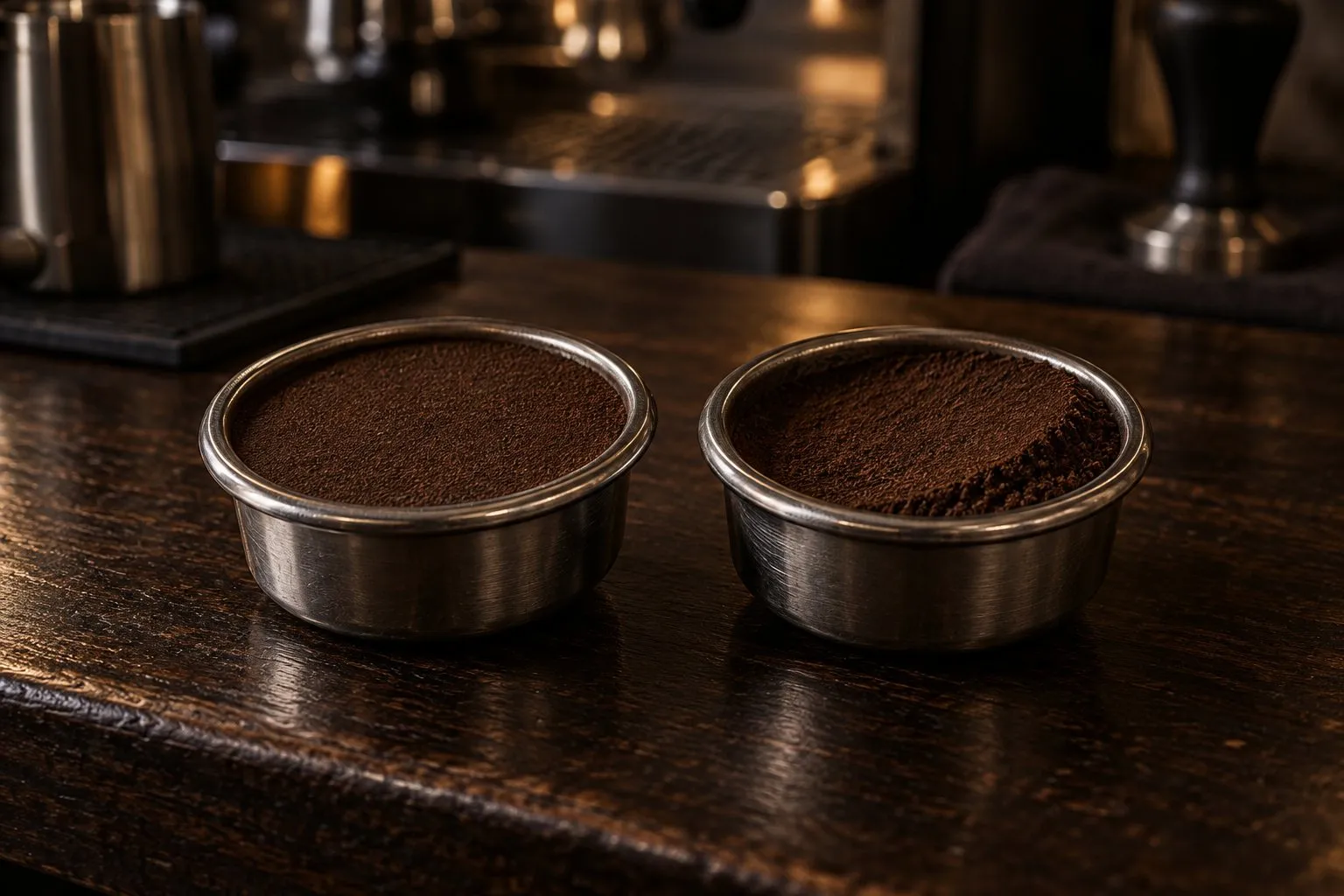
Your puck sets the reading
The same machine can show very different pressure on two shots, because the coffee changed and the machine did not. Breville's Barista Express manual names grind, dose and tamp as the causes when the gauge reads high or low. Press until the coffee stops compressing, and keep it level.
Pre-infusion: low pressure first
Pre-infusion means low water pressure at the start of the shot. In Breville's words, it gently expands the grounds for an even extraction before pressure rises. That has a practical side for anyone timing shots: the first drops arrive late, and that delay is expected.
| Machine | When the first drops should appear | How to extend pre-infusion |
|---|---|---|
| Barista Express | After 4 to 7 seconds | Hold the 1 Cup or 2 Cup button, release for full pressure |
| Bambino | After 8 to 12 seconds | Hold the button for more than a second, release to start extraction |
Both figures come from Breville's manuals, and each is given “as a guide.” They are not interchangeable, so a good Barista Express shot and a good Bambino shot won't look the same at the five second mark. Breville's guide counts shot time from the moment you start the brew cycle, so pre-infusion is part of your 25 to 30 seconds, not extra.
Machines that don't advertise pre-infusion aren't necessarily doing without it, and we can't tell from a listing. Your manual is the place to check.
How to read a pressure gauge
If you are shopping for an espresso machine with a pressure gauge, the Barista Express and the Breville Dual Boiler both have one, according to Breville. The Bambino manual, the Gaggia Classic Evo manual and the Silvia manual we read don't mention one.
The Barista Express manual gives each zone a meaning:
| Needle position | What Breville says it means | Causes it lists |
|---|---|---|
| Pre-infusion zone | Low pressure at the start of the shot | None, this is normal |
| Solid grey zone | Extracted at the ideal pressure | None |
| Lower zone | Too little pressure, water runs too fast | Grind too coarse, too little coffee, under-tamping |
| Upper zone | Too much pressure, water runs too slow | Grind too fine, too much coffee, over-tamping |
Breville Barista Express
Machine and conical burr grinder in one body, with PID and a 54 mm portafilter.
Why here: A printed gauge with zones, a 15 bar pump and 9 bar extraction stated on one page. Handy if you want to see all of this during the shot.
Best for: First-time buyers who want one box and no separate grinder to choose
- Integrated conical burr grinder with 16 settings (Breville)
- Thermocoil heating with PID temperature control (Breville)
- Named best overall in America's Test Kitchen's roundup of 2 July 2025
- A better grinder later means buying a separate one
- One thermocoil, not two boilers
- The price swings widely between sale days, so check it on the day
- Heating
- Thermocoil
- Pump, as stated
- 15 bar
- Brew pressure, as stated
- 9 bar
- Portafilter
- 54 mm
- PID
- Yes
- Built-in grinder
- Yes, 16 settings
- Milk
- Manual wand
- Price class
- Mid-range
The grey zone is a guide to flow. It is not a verdict on the cup. If the needle sits right and the shot tastes sour, the shot is still sour, and the sour espresso page is the better place to go next.
What about a Barista Express gauge that doesn't move? The manual's gauge section doesn't cover that, and we won't guess at a repair. Note whether coffee flows normally, then contact Breville support. The same goes for a replacement gauge or a retrofit on a Gaggia or a Silvia. These parts sit in a circuit with hot water under pressure, so leave the work to a service technician.
Moka pot vs espresso machine
A moka pot has no pump. As the water in the lower chamber heats, vapor pressure builds and pushes it up through the coffee. A 2026 preprint models exactly that sequence, with pressure rising until extraction starts. That also explains the main practical difference: you don't set the pressure on a moka pot, and you control it far less than you do on a machine.
You will see low bar figures quoted for moka everywhere. We could not read a primary measurement, so we print no number. For the same reason we won't rule on whether a moka pot makes “real” espresso. INEI's recipe assumes a qualified machine and 9 bar at the entry, and a moka pot isn't built to hold a set pressure. That's as far as the evidence we read goes.
If you are weighing the two and want to take the machine route, our guide to choosing a machine starts from what you drink. The heating system and the grinder will do more for your cup than any pressure figure. Dial in by taste, using one change at a time.
Asked at the bar
How many bars of pressure do you need for espresso?
About 9 bar. INEI, the Italian espresso institute, specifies 9 bar, plus or minus 1, at the entry for certified espresso. Breville gives 9 bar extraction on its product pages too. A pump rated 15 or 20 bar is not a sign that the shot brews at that figure.
What does an OPV do on an espresso machine?
OPV stands for over-pressure valve. It limits how high brew pressure can go, whatever the pump is able to reach. On a Gaggia Classic it is set to 9 bar, per retailers. Adjusting one means working inside a machine with hot water under pressure, so take that to a service technician.
What is pre-infusion?
Pre-infusion is low water pressure at the start of the shot, before full pressure arrives. Breville says it gently expands the grounds for an even extraction. It is why the first drops take a few seconds to appear, and the manuals give different figures for that wait: 4 to 7 seconds on the Barista Express, 8 to 12 on the Bambino.
What should a pressure gauge show during a shot?
Read the zones printed on your own gauge. On the Barista Express the needle starts in a pre-infusion zone, then should sit in the solid grey zone during extraction. Below it, Breville points to a shot running too fast, and above it to a shot running too slow. Then taste the shot before you change anything.
What is the difference between a moka pot and an espresso machine?
A moka pot has no pump. Water heats in a sealed lower chamber, and the vapor pressure that builds up pushes it through the coffee. A semi-automatic machine uses a pump and a controlled brew pressure, and you stop the shot yourself. We could not read a primary measurement of moka pressure, so we print no bar figure for it.
Where this comes from
- INEI: Certified Italian Espresso leaflet (copy on a third-party server)
- Breville: BES870 Barista Express product page
- Breville: Barista Express instruction book (copy hosted by Williams-Sonoma)
- Breville: Bambino BES450 instruction book (US and Canada)
- Andueza et al.: Influence of water pressure on the final quality of Arabica espresso coffee (J. Agric. Food Chem., 2002), abstract only
- Siregar: A minimal thermo-fluid model for pressure-driven extraction in a moka pot (arXiv preprint, 2026)
Next round
- 15 Bar vs 20 Bar: Is the Bigger Number Better?Is a 20 bar espresso machine better than 15 bar? No: the box shows what the pump can reach, and espresso is brewed at about 9 bar. What to compare instead.
 Gaggia Classic ProGaggia Classic Pro and E24: Gaggia's own values, the manuals on steam and descaling, what mods risk for the warranty, and who should pick something else.
 Dial in espressoHow to dial in espresso: fix the dose, set a yield, then change only the grind until time and taste line up. Steps, a symptom table and the exception to the rule.
 Puck prepEspresso puck prep in six steps: dry, weigh, stir, settle, tamp level, lock in. What channeling is, which tools have evidence, and what a wet puck means.
 Barista ExpressBreville Barista Express BES870XL: grinder, PID, 54 mm portafilter and care from Breville's own documents, and who should buy something else.
semiautomaticespressomachine.com Editorial Team
Espresso gear & shot craft
We are the editorial team at semiautomaticespressomachine.com. We read maker spec sheets, manuals, standards and published research on espresso and turn them into plain-English buying advice, with sources on every page. We do not run lab tests, and we say so openly.
- Spec sheets & standards read
- Sources on every page
- No lab tests – stated openly
- Publisher details in the imprint