Home Espresso Setup: A Counter Plan From Budget to Premium
Measure the counter first, then choose the machine, and only then buy the small stuff. A good home espresso setup keeps the grinder, scale and machine within one reach, with water close and a towel to hand. Most of the items sold as coffee bar accessories come last, and many came in the box with your machine.
Disclosure: This page contains affiliate links (marked with *). If you buy through them, we earn a small commission at no extra cost to you. As an Amazon Associate I earn from qualifying purchases. Learn more
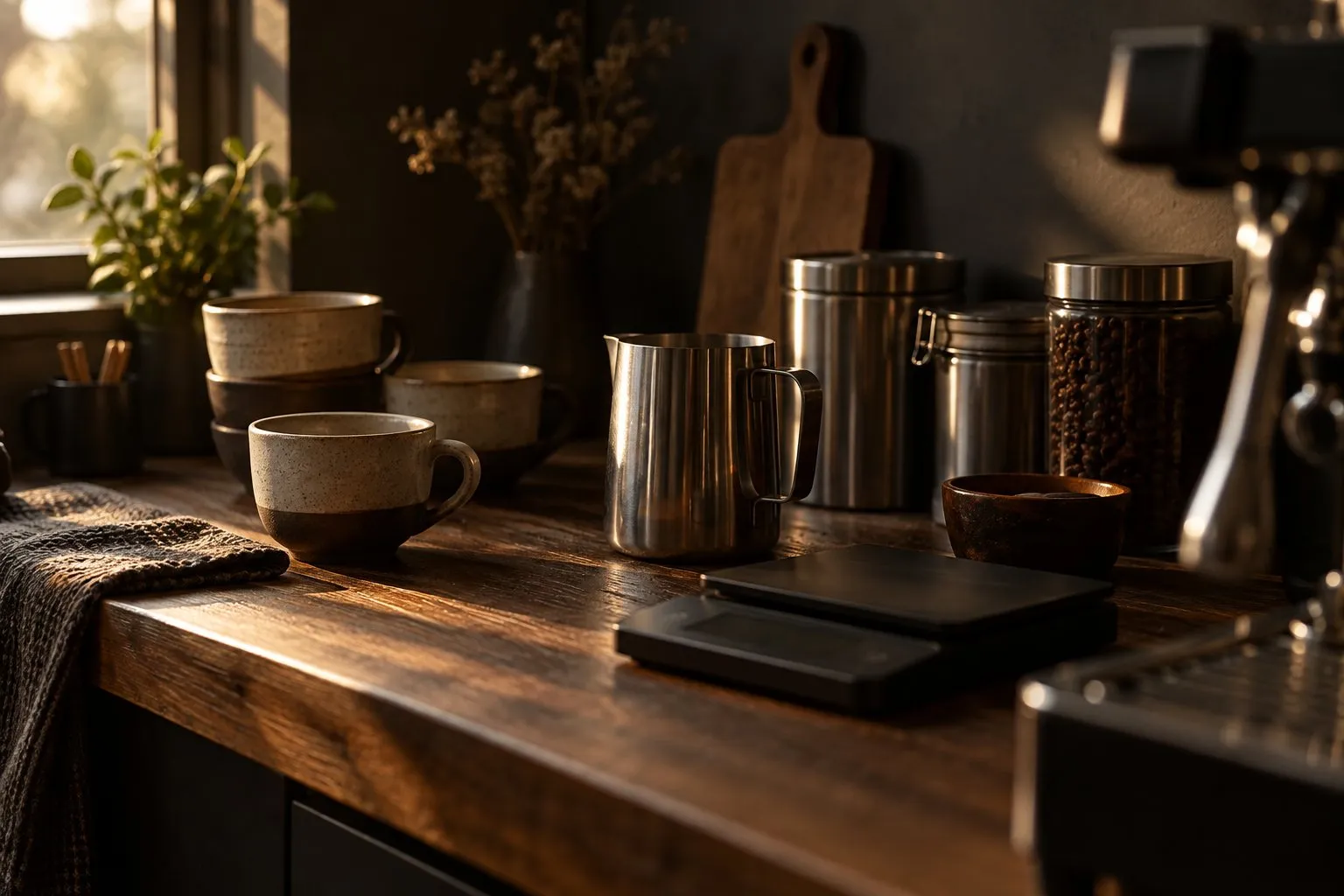
Start with the width you have, then pick a one-box machine or a machine plus separate grinder. Put the grinder beside the machine, the scale in front and a towel within reach. A scale comes first, then cups that suit your drink and a surface to tamp on. Stations and matching sets can wait.
On this page
A home coffee bar looks best when it's built around the order you do things in: beans, grinder, scale, machine, cup, sink. The rest is decoration, and decoration is fine, as long as you buy it after the parts that change your coffee.
Most of the small items below are listings we have not seen documented anywhere else, so we name them as options and don't give them pick labels. Our actual recommendation here is the order and the layout.
Our starting point
If you are starting from an empty counter and want one machine that covers the most ground, this is the one we'd plan around.
Breville Barista Express
Machine and conical burr grinder in one body, with PID and a 54 mm portafilter.
Why here: One body holds the machine and grinder, and the box already includes a tamper, a milk jug and a dosing funnel, so it needs the least extra counter space and the fewest extra purchases.
Best for: First-time buyers who want one box and no separate grinder to choose
- Integrated conical burr grinder with 16 settings (Breville)
- Thermocoil heating with PID temperature control (Breville)
- Named best overall in America's Test Kitchen's roundup of 2 July 2025
- A better grinder later means buying a separate one
- One thermocoil, not two boilers
- The price swings widely between sale days, so check it on the day
- Heating
- Thermocoil
- Pump, as stated
- 15 bar
- Brew pressure, as stated
- 9 bar
- Portafilter
- 54 mm
- PID
- Yes
- Built-in grinder
- Yes, 16 settings
- Milk
- Manual wand
- Price class
- Mid-range
Which counter fits you?
If you want one machine and the fewest extras → Breville Barista Express
View(paid link to Amazon, opens in a new tab)Ad · paid link · check price & delivery on AmazonIf your counter is narrow and you'll pick your own grinder → Breville Bambino
View(paid link to Amazon, opens in a new tab)Ad · paid link · check price & delivery on AmazonIf you make several milk drinks in a row and have the depth for it → Breville Dual Boiler
View(paid link to Amazon, opens in a new tab)Ad · paid link · check price & delivery on AmazonIf you need the lowest budget first
If you are short on space above all
Measure first: maker dimensions
These figures come from the makers' own documents. Allow for the lid, the tank and a hand above the group, because the maker's size doesn't include your elbows. Breville's Bambino label looks mixed up, so hold it both ways against your gap.
| Item | Printed as width x depth x height | Source |
|---|---|---|
| Breville Bambino | 11.9 x 6.1 x 13.5 in | Breville |
| Rancilio Silvia | 9.3 x 11.4 x 13.4 in | Rancilio |
| Breville Barista Express | 15.9 x 13.1 x 12.4 in | Breville |
| Breville Dual Boiler | 37.9 x 40.3 x 37.1 cm | Breville |
| Breville Smart Grinder Pro | 8.5 x 6.3 x 15.3 in | Breville |
A separate grinder's hopper sits high: the Smart Grinder Pro stands 15.3 inches tall. Check the clearance under your wall cabinets before you put a grinder at the back of the counter. Other models have their sizes on our Barista Pro and Baratza Encore ESP pages.
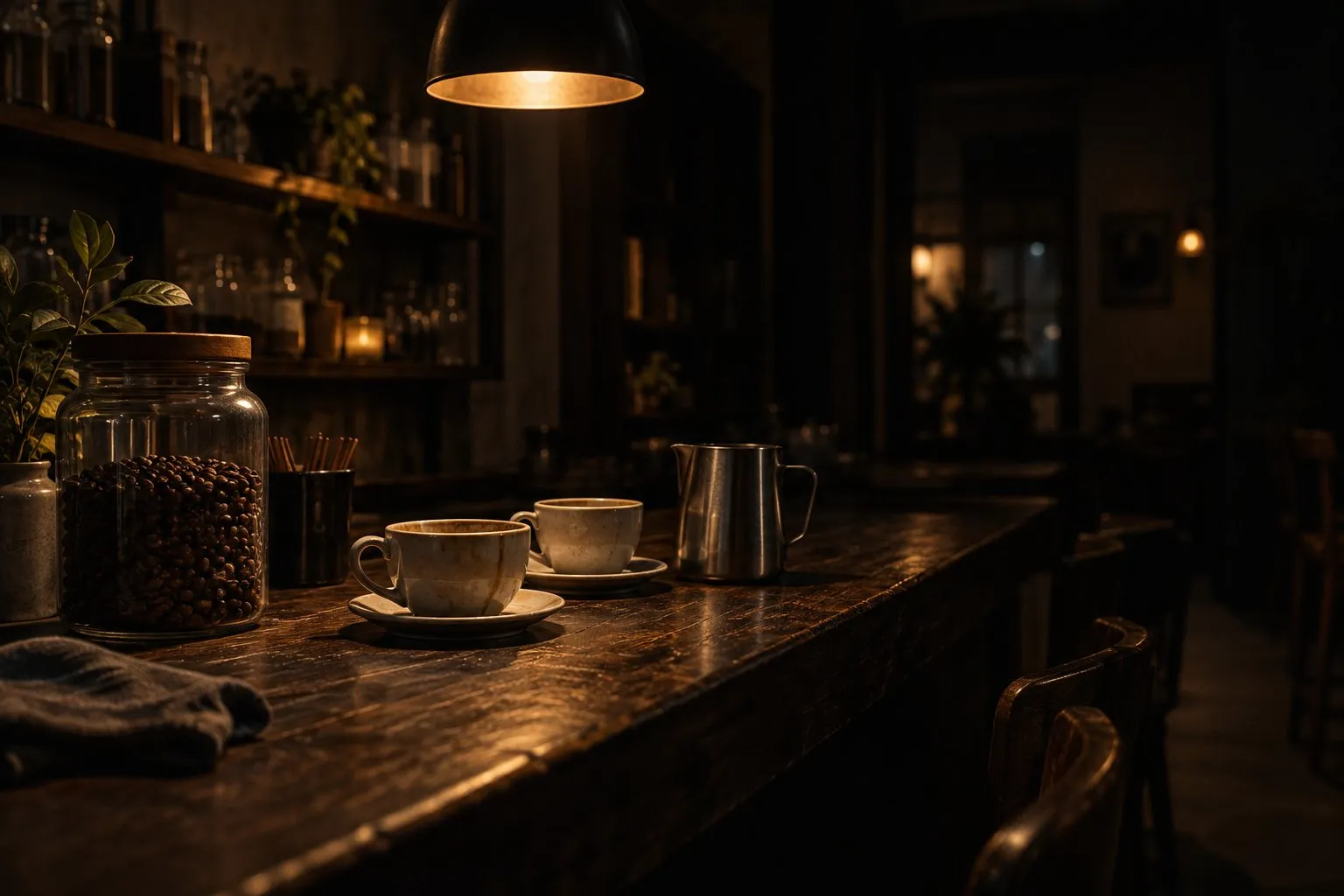
Grinder, scale, machine, cup. Keep them in one reach.
Three counters, budget to premium
| Budget | Mid-range | Premium | |
|---|---|---|---|
| Machine | From our budget guide | Barista Express*, or Bambino* plus a grinder | Breville Dual Boiler*, or see prosumer machines |
| Grinder | Budget grinder or hand grinder | Built in, or Smart Grinder Pro* | A separate grinder, since this machine has none |
| Scale | One 0.1 g scale | The same | The same |
| Milk | The jug in the box, if any | The jug in the box | The 16 oz jug in the box, plus a smaller pitcher if needed |
| Extras | A towel | Mat, towel, cups | Mat, towels, cups, knock box |
Our main point is in the bottom row. The extras barely change between budgets, so a small budget can still have a tidy bar.
The layout we suggest
This is our own reasoning about how the work flows. It isn't a standard, so adapt it to your counter and your dominant hand.
- Grinder next to the machine. You go straight from dose to tamp, and fewer grounds end up on the floor.
- Scale in front of the group. You weigh the dose, then the shot. If you can, leave it in the same spot.
- Tamping spot beside the machine. A mat protects the counter and the portafilter spouts.
- Knock box or trash close by. You'll use it every shot.
- Towels at hand. One for the wand and one for the counter, so milk stays away from your cups.
- Water close to the tank. A jug beats walking the tank to the sink if you use filtered water.
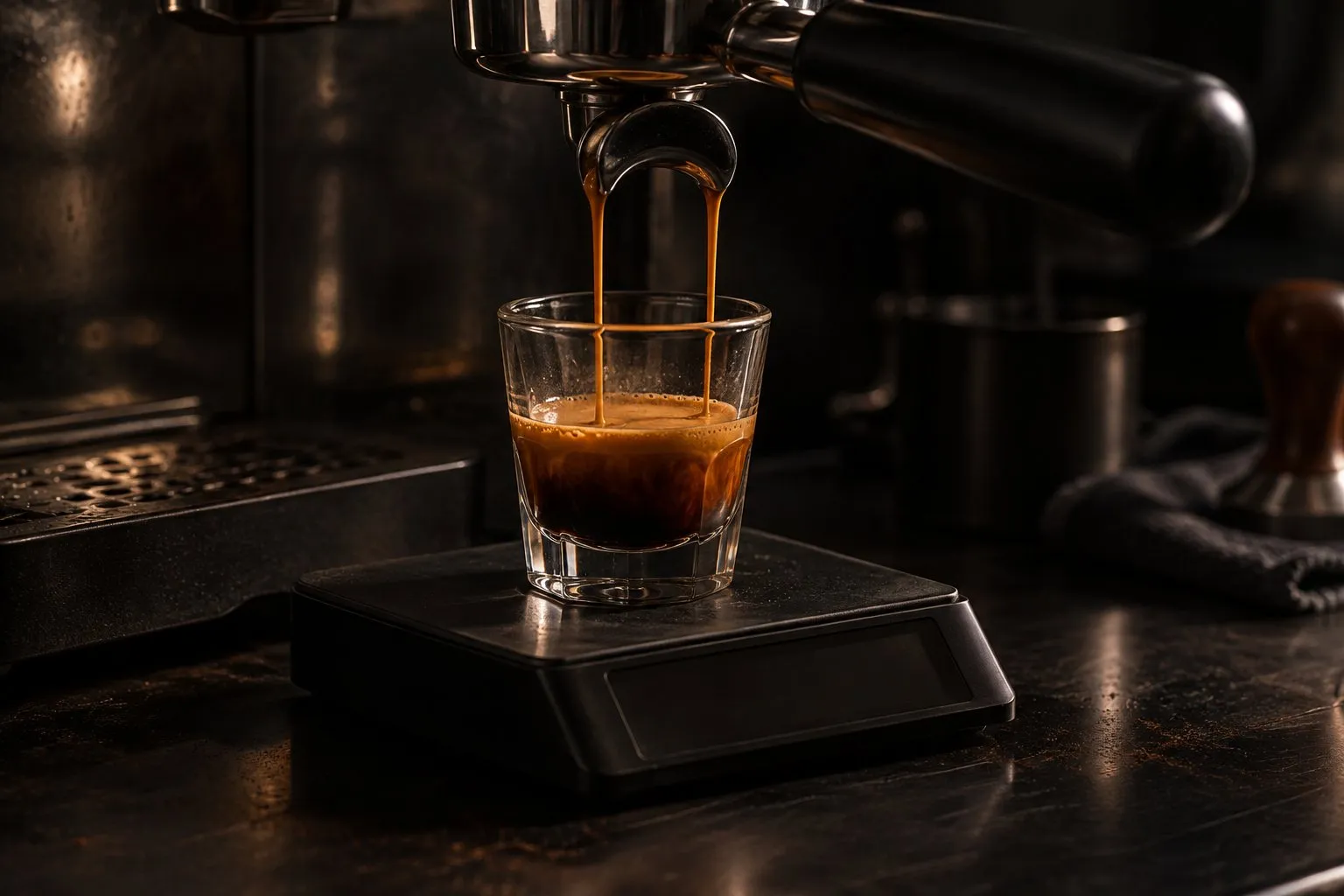
The scale earns the best spot
You weigh both the grounds and the shot, so the scale gets used every time. That's why it comes first on our accessories page. The Maestri House S2* is one listed option with a timer and 0.1 g steps. Any scale with both features fills this spot.
Cups: buy for the drink
People search for espresso cups far more than for anything else in this category, and it's the easiest part to get right if you decide on your drink first.
| Drink | Reference point | Source |
|---|---|---|
| Espresso | White china, 50 to 100 ml | INEI |
| Cappuccino | 150 to 160 ml | INEI |
| Flat white | No larger than 8 oz, if possible | Breville, see our flat white how-to |
INEI picks china for the froth, smell and taste, and that's a fine reason. A clear glass has its own use: you can watch the shot layer as it runs. Spouted glasses also let you split a shot or pour it over milk. These two are listed options:
Before you buy tall cups, measure the space under your spouts. Clearance differs by machine, and a glass that doesn't fit stays in the cupboard.
Mats, stations and towels
We only have the listings for these, so here's what they do, not how well they do it.
A tamping mat* is the simple option. It's rubber, per the listing, it isn't tied to one portafilter size, and it's the simplest type to start with.
A walnut tamping station* gives a 54 mm Breville portafilter a fixed place to sit, per the listing. It's tidy, but it only suits one size, so it's a poor buy if you might change machines.
Bar towels* are the unglamorous essential. Wipe the wand right away, then purge it, as your manual asks.
The Breville Knock Box 10* is the option from a machine maker, per its listing. Our knock box page covers the sizes. The stainless pitcher range* is there when the jug in your box doesn't suit your drink, and our pitcher page sorts them out.
Power and water
An espresso machine can be a serious electrical load by itself. If you plan to run a kettle or a second appliance beside it, read the rating plates first. For anything about your circuit, ask a licensed electrician rather than guessing.
Water is part of the setup
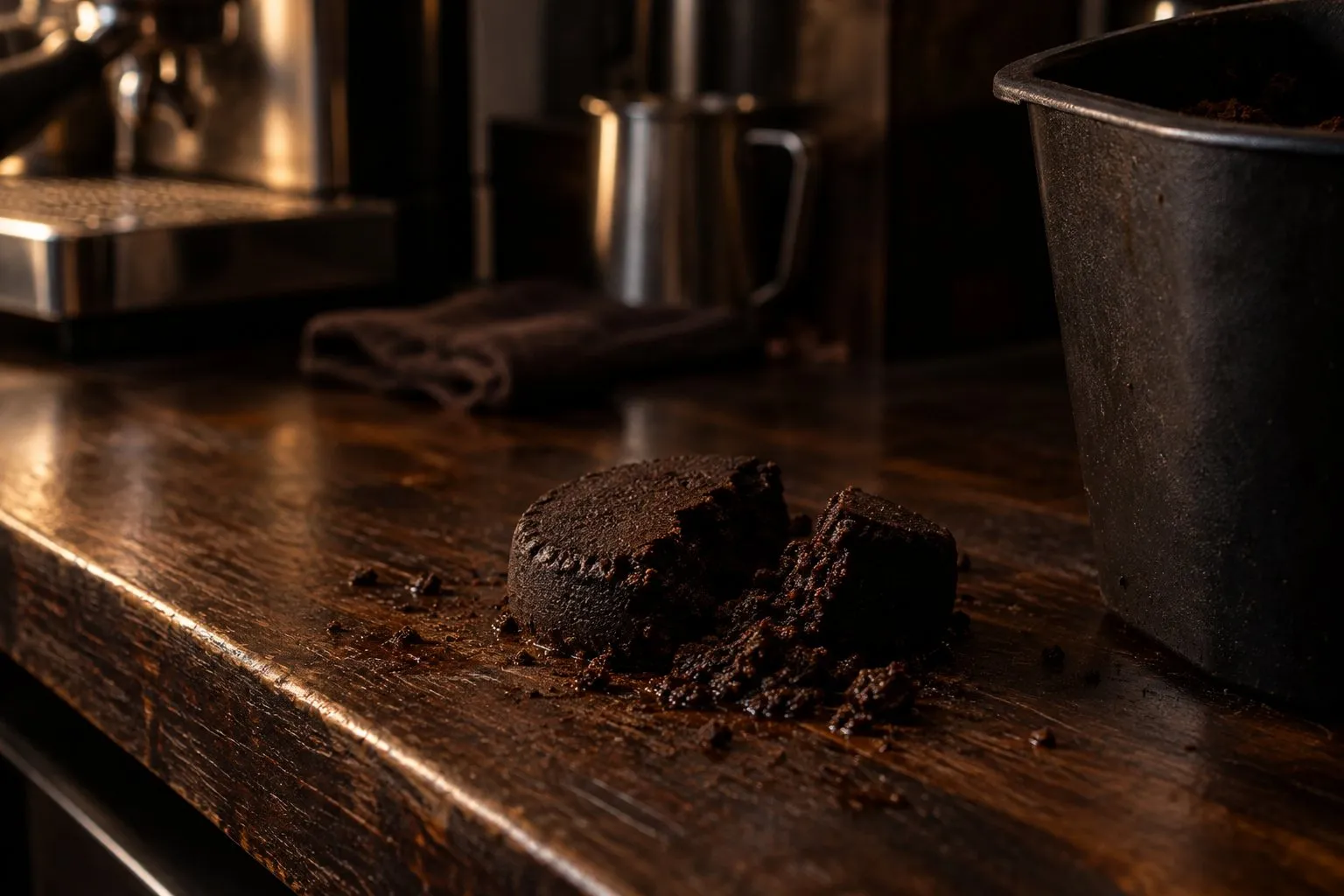
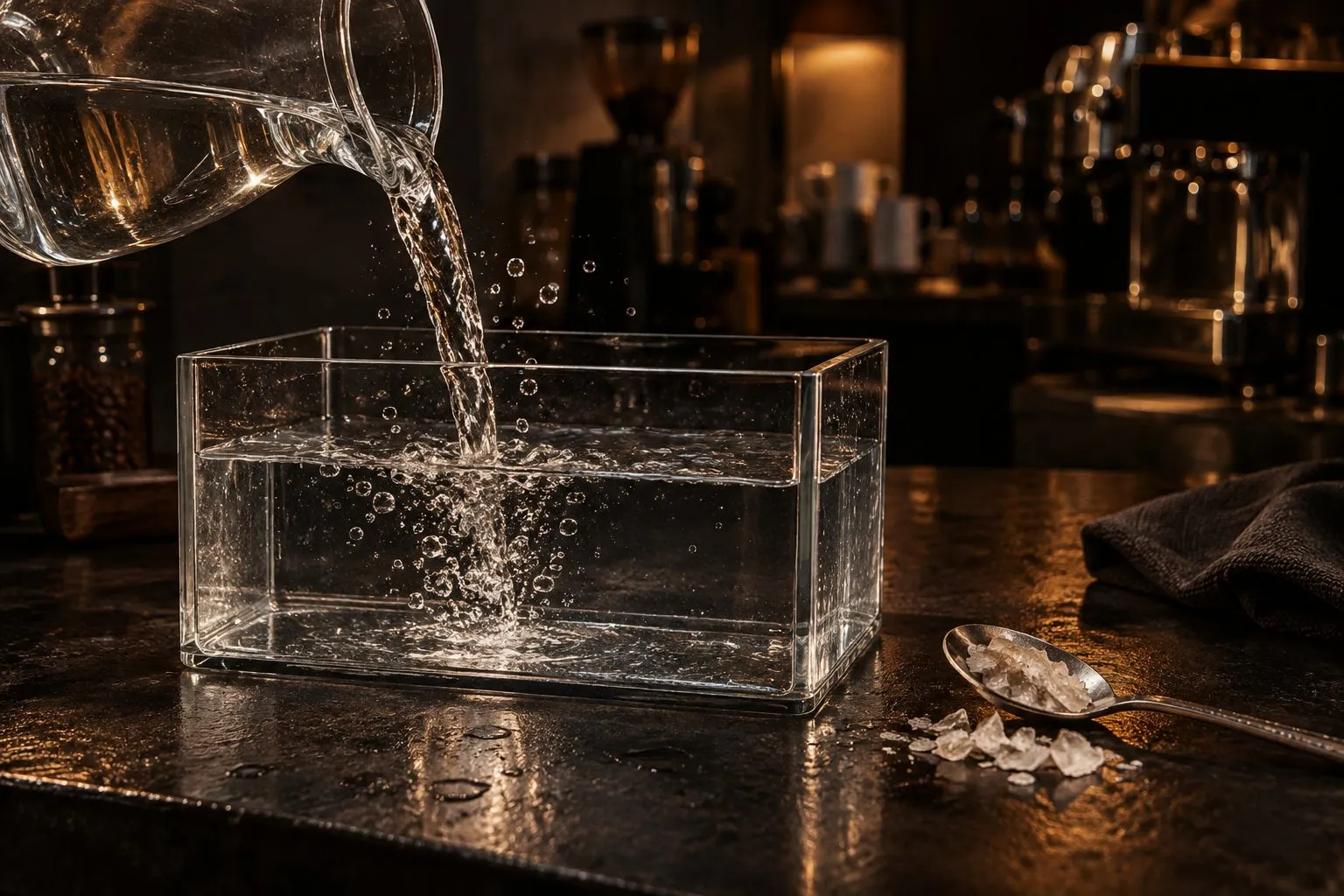
Plan where the water comes from, and whether a filter or a jug belongs on the counter. In the scene here, the white mineral flakes on the spoon stand in for what a water recipe adds. Our water page has the numbers, and your machine's manual says when to change any filter.
Common mistakes
- Buying a set before you open the machine's box. You may already own the tamper, jug or funnel.
- Buying tools for the wrong size. Stations, funnels and tampers depend on your portafilter. Check our accessories table and your manual.
- Forgetting the cabinets. A tall hopper and a low shelf don't mix.
- Matching before measuring. A set of cups that doesn't fit under your spouts stays in the cupboard.
- Skipping the scale to afford the decor. Nothing else on the counter helps you dial in.
Still choosing the machine?
These four questions end in one machine.
Our recommendation
Measure, then buy the machine, the grinder and a scale. For most people starting from nothing, the Barista Express keeps that list shortest. After that, add a mat and a towel, then cups for what you actually drink. Buy everything else only once you can name the problem it solves. Short on room? Compact machines starts from the gap you have. For the full buying order, see our accessories guide and our guide to semi-automatic machines. We compare by spec sheet and listing and don't test these items, as how we compare explains.
Asked at the bar
What do you need for a home espresso setup?
A machine, an espresso-capable grinder unless the machine has one built in, and a scale. Check the box before you buy anything else, because Breville's Barista Express and Bambino both include a tamper and a milk jug. Beyond that, cups that suit your drink and a towel for the wand cover most days.
How much counter space does an espresso machine need?
It depends on the build. Breville prints a Bambino as 11.9 x 6.1 x 13.5 in, labeled W x D x H, though that label looks mixed up, and a Barista Express as 15.9 x 13.1 x 12.4 in. A separate grinder needs its own spot beside the machine. Allow room to lift the lid and fill the tank too.
What size espresso cups should I buy?
Italy's espresso institute describes the ideal espresso cup as white china, holding 50 to 100 ml, and the cappuccino cup as holding 150 to 160 ml. Breville suggests no more than 8 oz for a flat white. Those are good reference points, not rules. Buy for the drink you actually make most.
Do I need a tamping station?
No. It gives the portafilter a stable place to sit while you tamp, and it looks tidy, but a mat on the counter does the basic job. A station is also specific to one portafilter size. If you may change machines, buy the mat first and decide later.
Can several coffee appliances share one outlet?
Read the rating plate on each appliance first, because an espresso machine can be a large load by itself. If you are unsure what your circuit can carry, ask a licensed electrician rather than guessing. Follow each manual on cords and extension cords as well.
Where this comes from
Next round
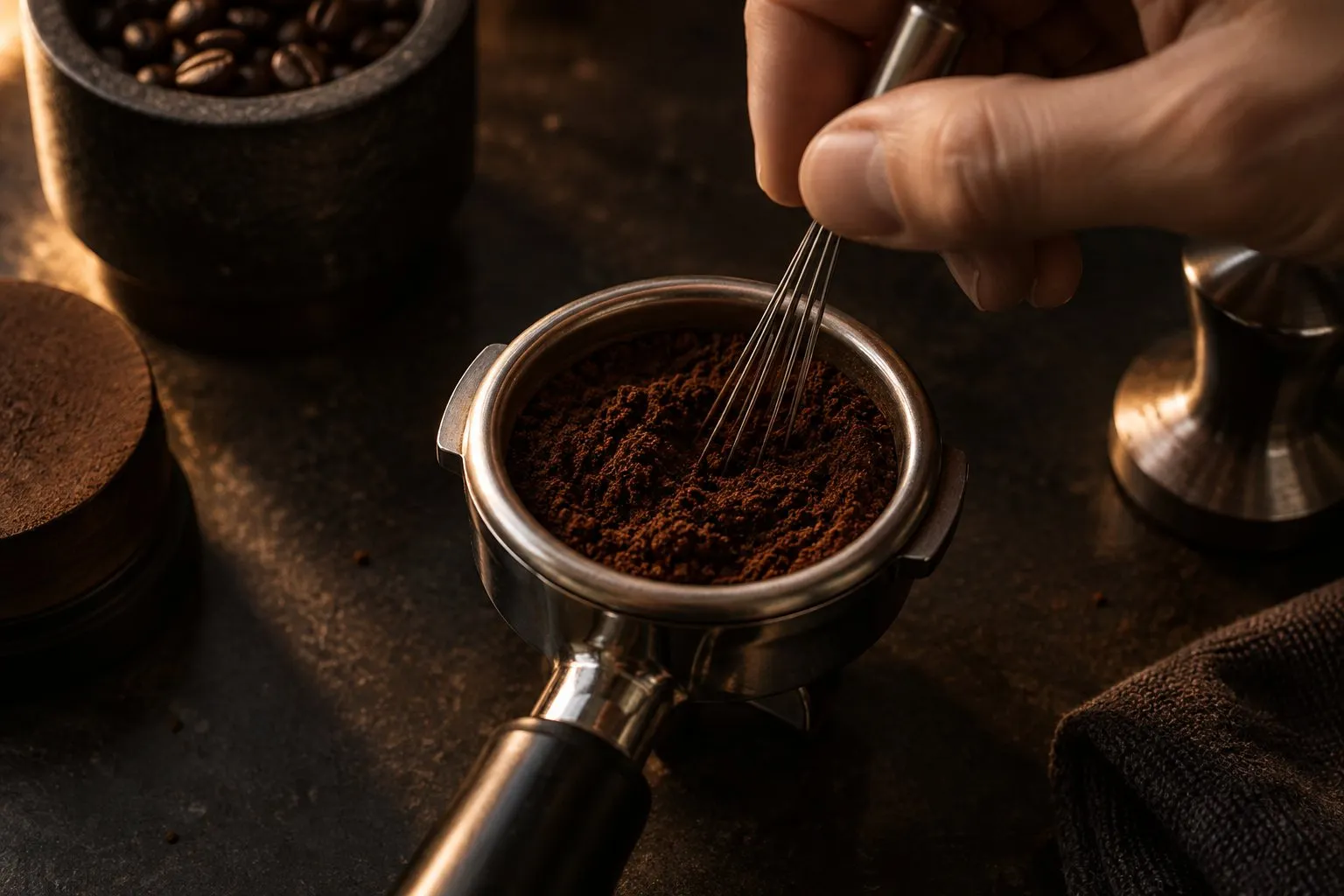 AccessoriesWhich espresso accessories are worth buying first: scale, tamper, pitcher, WDT tool and more, sorted by portafilter size, with what your machine already includes.
- Compact machinesCompact espresso machines compared by width, depth and height, with sources. Why “compact” on a listing means little, what to measure, and which machine to pick.
- Espresso scaleWhat an espresso scale needs: 0.1 g steps, a timer and a size that fits your drip tray. Listed options, plus Acaia and Timemore dimensions from their own data.
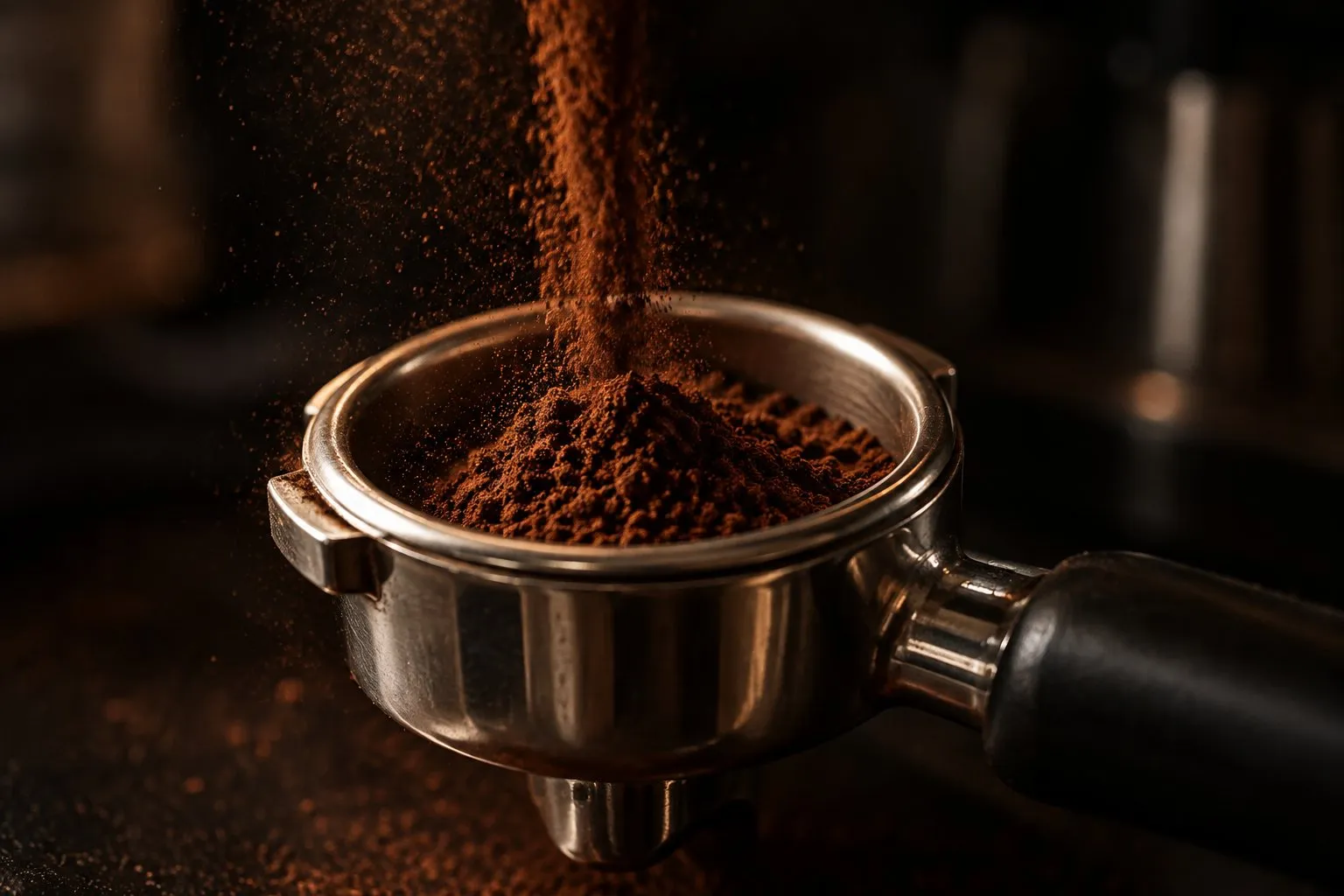 With grinderEspresso machines with a built-in grinder compared by spec sheet: Barista Express, Impress, Pro and Touch, plus Ninja, De'Longhi, KitchenAid, Gevi and CASABREWS.
- Espresso waterWhich water to use in an espresso machine: why too hard and too pure both cause trouble, what Breville and La Marzocco ask for, and where the SCA target fits in.
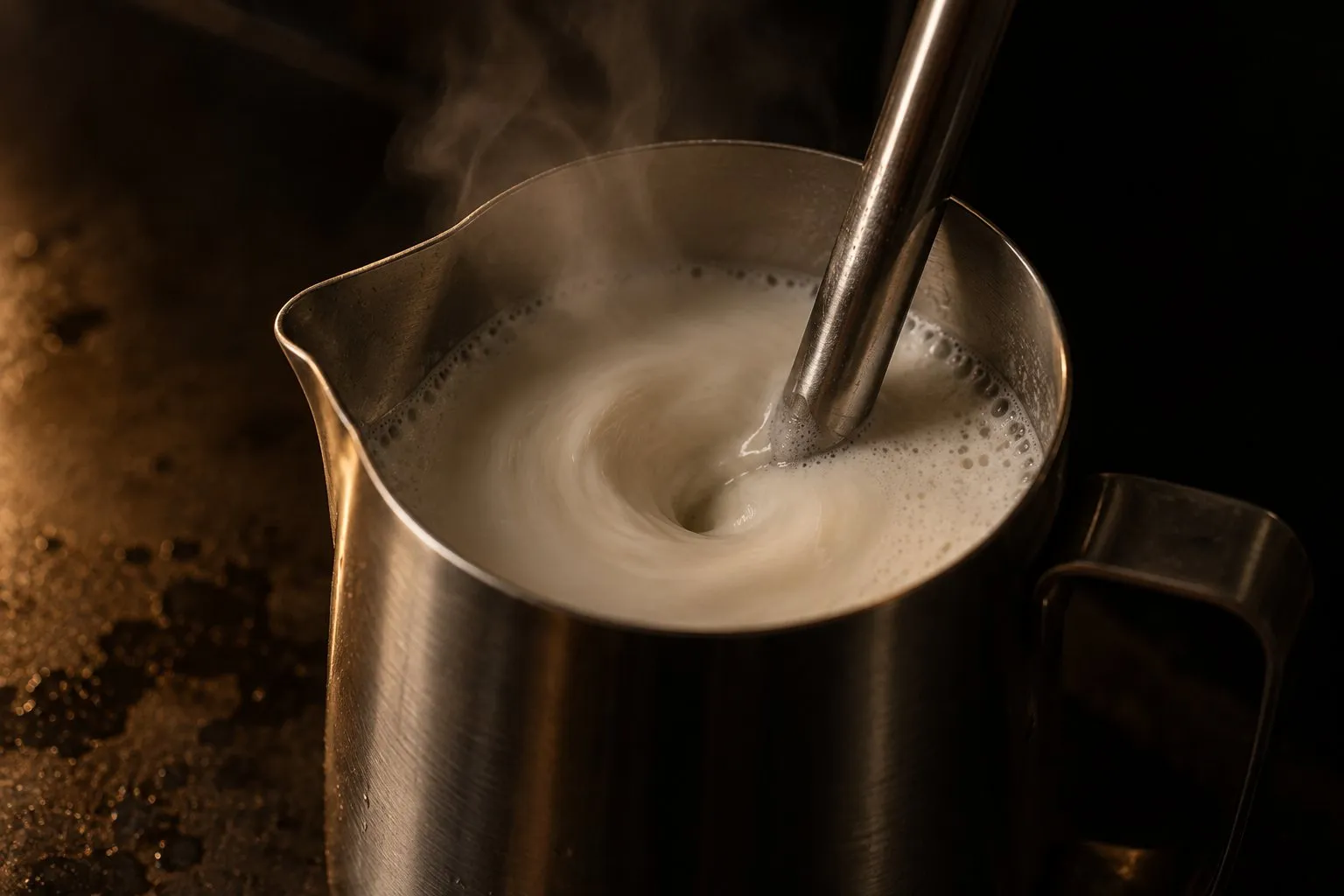 Milk pitcherWhich milk frothing pitcher to buy: size by how much milk you steam, what makers say about jug shape and fill level, and when you should keep the jug in your box.
semiautomaticespressomachine.com Editorial Team
Espresso gear & shot craft
We are the editorial team at semiautomaticespressomachine.com. We read maker spec sheets, manuals, standards and published research on espresso and turn them into plain-English buying advice, with sources on every page. We do not run lab tests, and we say so openly.
- Spec sheets & standards read
- Sources on every page
- No lab tests – stated openly
- Publisher details in the imprint